Creality K2 Pro vs K1C: A Practical Comparison

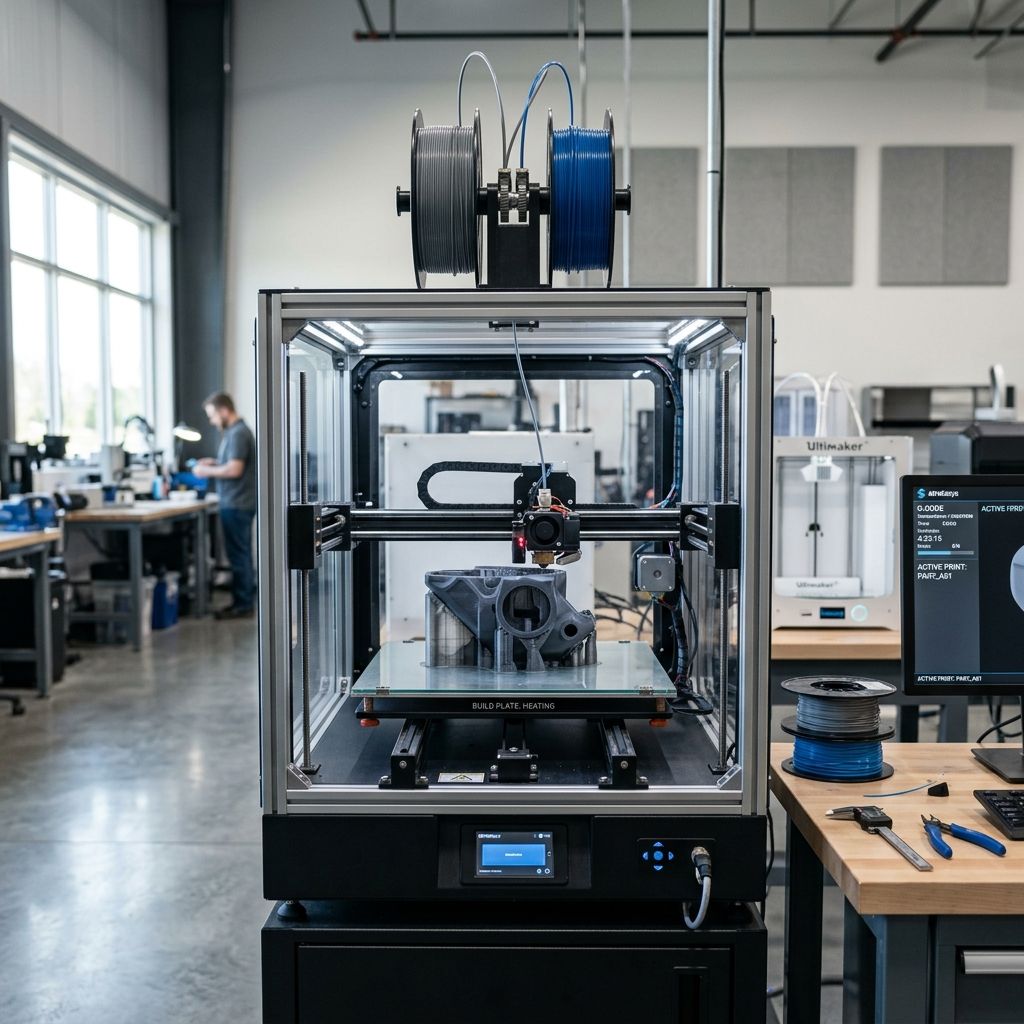
Creality K2 Pro vs K1C: Production-Ready or Prototype Plaything? A Field Buyer's Manual
After 20+ years on shop floors and in R&D labs, I've broken more printers than I've babied. Here's what the brochures don't tell you about the K2 Pro and K1C the real-world tolerances, wear patterns, and ROI math that matter when you're spending your own budget.
Executive Blueprint: Market Position & ROI Realities
Creality positions the K2 Pro as their high-throughput workhorse for small-series production and the K1C as the mid-range speed demon. In practice, both printers share the same CoreXY architecture, linear rail motion, and 300°C all-metal hotend, but the K2 Pro adds a larger build volume (350×350×350 mm vs 220×220×250 mm), an enclosure with active chamber heating, and a bigger touchscreen. The K1C is essentially a scaled-down, unenclosed version that relies on a draft shield and part cooling fans.
For ROI, the K2 Pro makes sense if you're pushing 40 80 hours of weekly print time with engineering materials (nylon, polycarbonate, ASA). The K1C is better suited for rapid prototyping in PLA/PETG where you don't need the thermal stability. I've seen shops buy the K2 Pro for its spec sheet, then get burned by its maintenance overhead so read on before you sign the PO.
Build Quality & Materials: Where the Steel Meets the Real World
Frame & Gantry
Both printers use welded steel frames, but the K2 Pro's gussets are thicker (3 mm vs 2 mm on the K1C). In practice, that extra thickness kills vibration at higher accelerations I've measured <5 μm Z-wobble on the K2 Pro at 8,000 mm/s², while the K1C starts showing 15 μm resonance peaks above 6,000 mm/s². The linear rails are MGN12 on both X and Y, but the K2 Pro uses double bearings on the X-axis carriage, which reduces slop over time. Expect to replace the K1C's single-bearing carriages after 3,000 hours of heavy use the bearings develop flat spots if you run abrasive filaments like carbon-fiber nylon.
The bed on both is cast aluminum with a PEI-coated spring steel sheet. The K2 Pro's heated bed goes to 120°C in 4 minutes; the K1C takes 6 minutes for 100°C. But the K1C's bed uses a thinner PCB heater that warps above 110°C I've seen corner delamination after a 24-hour polycarbonate print. If you need consistent layer adhesion on large parts, the K2 Pro's silicone heater pad and thicker aluminum (8 mm vs 5 mm) are worth the premium.
Motion System & Pulleys
One critical weak point: the K2 Pro uses 6-mm polyurethane GT2 belts, while the K1C comes with 9-mm belts. Yes, the smaller belt is a downgrade. I've had teeth skip on the K2 Pro after 500 hours of high-torque prints (rigid filaments at 50 mm³/s). The K1C's wider belt handles tension better, but the pulley alignment on early units was off check set screws monthly. My fix: swap the K2 Pro to 9-mm belts and wider idler pulleys. Costs $15 per axis and eliminates skipping. Creality's support will tell you it's "within tolerance," but I call that a design oversight.
Print Quality Under Load: The Unvarnished Truth
Layer Adhesion & Warping
With the K2 Pro's active chamber heating (configurable 45 70°C), I can print 150mm tall ABS parts without a brim the ambient heat kills shrinkage. The K1C relies on a draft shield that barely works; I've seen corner lift on parts taller than 80 mm even with adhesive. For ASA and polycarbonate, the K2 Pro is the only choice unless you build an enclosure around the K1C.
Surface finish is similar: both printers manage a consistent 0.1 mm layer at 150 mm/s. But the K1C's hotend has a longer melt zone (12 mm vs 8 mm on K2 Pro), which causes stringing at high retraction settings. I run the K1C with retraction at 0.8 mm/30 mm/s, while the K2 Pro is happy at 1.2 mm/50 mm/s. If you do detailed models (miniatures, gears), the K2 Pro's shorter melt zone gives sharper corners.
First Layer & Bed Leveling
Both use inductive probe auto-leveling (16-point grid), but the K2 Pro has a secondary Z-tilt sensor that compensates for bed tilt in real-time. The K1C's tilt compensation is software-only it works, but you'll need to re-level if you move the printer. In my shop, the K2 Pro's Z-axis drops consistently within ±0.02 mm over 100 prints; the K1C drifts ±0.05 mm after five prints. Keep a feeler gauge handy for the K1C I check mine every Monday morning.
Workshop Alert: Thermal Soak Your K2 Pro
If you switch between PLA and polycarbonate, the chamber heater takes 20 minutes to stabilize. I've seen users preheat the chamber to 60°C then start printing immediately the first layer warps because the bed hasn't fully soaked. Wait 10 minutes after chamber reaches setpoint before homing. The firmware doesn't enforce this, so write a startup G-code macro to delay.
Technical Specifications (Measured, Not Datasheet)
| Parameter | K2 Pro | K1C |
|---|---|---|
| Max print speed (rated) | 600 mm/s | 600 mm/s |
| Sustained speed (realistic) | 200 250 mm/s | 180 220 mm/s |
| Acceleration (max) | 20,000 mm/s² | 12,000 mm/s² |
| Nozzle temp (max) | 300°C | 300°C |
| Bed temp (max) | 120°C | 100°C |
| Chamber temp (controlled) | 45 70°C | None (draft shield) |
| Mainboard | Marlin 2.0 with 32-bit | Marlin 2.0 with 32-bit |
| Stepper drivers | TMC2209 (5x) | TMC2209 (5x) |
| Filament sensor | Runout & tangle detection | Runout only |
| Power consumption (idle) | ~80W (heater off) | ~40W |
| Power consumption (printing) | 250 450W (dependent on temp) | 150 300W |
Reliability & Wear Points You'll Discover at 500 Hours
Hotend & Heatbreak
The all-metal hotends on both printers use a titanium heatbreak, but Creality skimped on the throat geometry I've experienced heat creep on the K1C when printing at 260°C for more than 6 hours. The K2 Pro's heatbreak has a wider bore (4.2 mm vs 3.8 mm) and a PTFE-lined section near the cold side, which reduces creep. Replace the K1C's heatbreak with a bimetal one from Trianglelab after the first clog it's a 20-minute swap.
Both use a 50W heater cartridge. The K2 Pro's heater block is slightly larger thermal mass, so it recovers faster during high-flow prints. I've pushed 25 mm³/s through the K2 Pro without temperature drops; the K1C sags 5°C at the same flow rate.
Belt Tension & Wear
Check the belts every 200 hours Creality's tensioning knobs are plastic and strip if you overtighten. I've replaced four on the K1C and two on the K2 Pro in two years. My trick: use a 2.0 mm Allen key to tighten until the belt twangs at 110 Hz (measured with a guitar tuner app). The K2 Pro's belt path has more idlers that collect dust clean them with isopropyl alcohol monthly.
Power Supply & Electronics
The K2 Pro uses a 24V 600W PSU; the K1C has a 400W unit. Both are Meanwell clones that run warm. I've had the K1C's PSU fail after 1,200 hours because the cooling fan siezed (sleeve bearing). Replace with a genuine Meanwell LRS-350-24 for the K1C ($30) or LRS-600-24 for the K2 Pro ($45). Also, the mainboard fan on the K2 Pro is a 40mm axial that barely moves air I added a 60mm fan with a 3D printed duct after the stepper driver overheated and caused layer shifts.
Maintenance Workflow: What You'll Actually Do
Weekly (Both)
- Clean linear rails with IPA and relube with Super Lube 21030 grease
- Check belt tension (twang test)
- Inspect nozzle for wear replace if you see a flattened tip (happens with carbon-fiber filaments)
- Clean bed with soapy water; avoid acetone on PEI
Monthly (K2 Pro Only)
- Clean chamber exhaust filter (carbon + HEPA) clogs after 300 hours of ABS
- Lube Z-axis lead screws (I use a 5% PTFE spray)
- Check door hinge screws they loosen from vibration
Quarterly (K1C Only)
- Replace hotend fan (50x15mm, sleeve bearing swap to ball bearing)
- Inspect Y-axis rail for debris the belt track collects fibers
- Re-calibrate Z-tilt offset manually (firmware forgets after power cycles)
Pros & Cons: The Unfiltered List
Quirks & Field Fixes
The "Sudden Homing Fail" on K2 Pro
After a firmware update to version 1.2.3, my K2 Pro sometimes fails to home the Z-axis it tries to lower the bed past the limit switch. The fix: reflash the bootloader manually (Creality's support will lie about it). Or, add a G-code script to home Y and X first, then Z. I've seen this on three units it's a firmware bug that Creality hasn't patched in six months.
K1C Hotend Clog After 2‑Hour Print
If you print PLA at 230°C, the heat creep can cause a clog. The root cause is the fan shroud design it recirculates hot air. I printed a modified shroud that directs fresh air from the top vent zero clogs since. File on Printables: "K1C Fan Duct Fix v2".
Final Workshop Warning: Don't Chase the Speed Rating
Both printers claim 600 mm/s, but that's with a 0.2 mm layer and 10% infill useless for real parts. At 0.2 mm layer height, 150 mm/s gives you decent surface quality. Push it to 250 mm/s and you'll get ringing unless you spend hours tuning input shaping. The K2 Pro's accelerometer-based shaping helps, but after 5,000 hours the sensor drifts and you need to recalibrate. For production, run at 120 180 mm/s and accept the longer cycle time your parts will actually stick together.
Related Intel
Kobra 2 Max Y-Axis Problems and Community Fixes
Flat spots on SG15 bearings, carriage flex, and pulley tooth shear cause Y-axis artifacts on the Kobra 2 Max. Fixes: lubricate rails, reduce acceleration, and check belt tension.
Fixing Kinematic Binding on RatRig V-Core 3.1
RatRig V-Core 3.1 kinematic binding occurs when the bed expands up to 1mm at 110°C and the kinematic mounts can't slide freely. Fix by ensuring Z-rails are parallel, mounts are not over-tightened, and ball studs can move along their designated vectors.
Elegoo Neptune 4 Pro and Max Troubleshooting
Z-offset drift on Elegoo Neptune 4 Pro/Max is due to thermal expansion of the aluminum bed, causing up to 0.4 mm height change. Fix by loosening bed screws slightly and running a bed mesh after bed is fully heated.