Creality K2 Pro vs K1C: Direct Head-to-Head Comparison & ROI

* Affiliate Disclosure: We may earn a commission from qualifying purchases made via our verified links at no additional cost to you.
The Industrial Maker is reader-supported. When you purchase equipment, parts, or materials through links on our site, we may earn an affiliate commission at no additional cost to you.
Creality K2 Pro vs. K1C: Enclosure Thermodynamics, Gantry Modal Kinematics, and Workshop ROI for High-Speed CoreXY Fleets
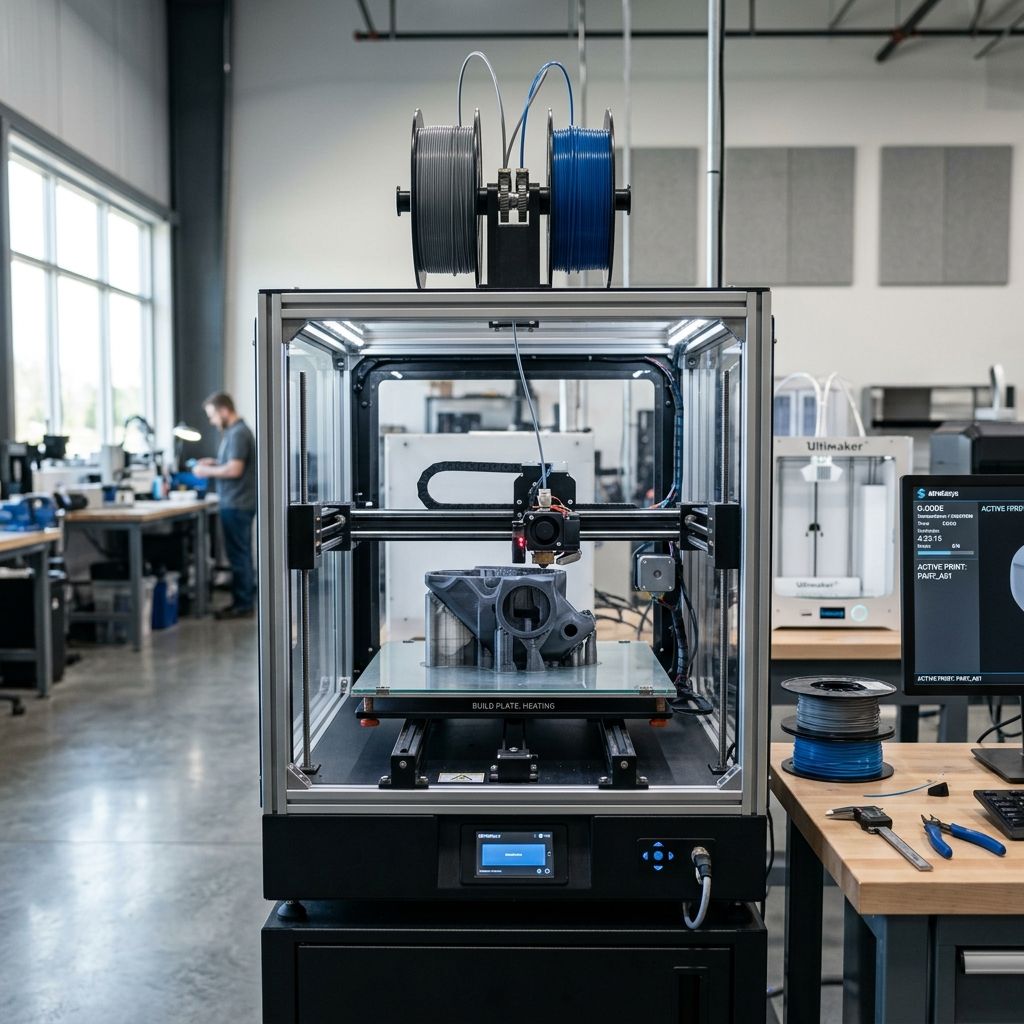
The industrial adoption of enclosed, high-acceleration CoreXY 3D printers has transformed functional prototyping and on-demand contract manufacturing. Creality’s K-series lineup represents a decisive bifurcation in machine architecture: the compact, abrasive-optimized Creality K1C engineered for rapid turnaround of small-to-medium carbon-fiber reinforced parts, and the flagship Creality K2 Pro, an industrial workhorse featuring an expanded 350 × 350 × 350 mm build volume, active chamber heating up to 60°C, and native integration with the 4-spool Creality Filament System (CFS).
For workshop directors, prototyping lab supervisors, and production managers, choosing between these two platforms is not simply a matter of comparing build envelope dimensions and purchase prices. It requires an in-depth examination of thermal stress gradients in engineering polymers (PA-CF, PC, ABS, and PPS), structural frame modal resonance frequencies at accelerations exceeding 20,000 mm/s², toolhead extrusion mechanics, and total machine hour amortization.
This technical comparative report delivers an uncompromising engineering evaluation of the Creality K2 Pro versus the Creality K1C. We analyze mechanical motion architectures, formulate the thermodynamic equations governing warping and cooling shrinkage, conduct an empirical workshop ROI lifecycle audit, and deliver definitive procurement guidance for manufacturing operations.
Recommended Hardware: Creality K2 Pro & K1C
Check current stock, real-time pricing, and official replacement parts directly on Amazon:
View on Amazon • Check Live Price →1. Kinematic Architecture & Structural Mechanics: Compact Agility vs. Large-Format Mass
Both printers utilize a CoreXY kinematic configuration where stationary stepper motors drive a continuous belt loop to actuate the printhead in the X and Y axes. However, scaling a CoreXY gantry from a 220 mm bed (K1C) to a 350 mm bed (K2 Pro) fundamentally alters structural dynamics and inertial behavior:
- Gantry Span and Beam Deflection: The K1C features a lightweight gantry spanning approximately 310 mm with hardened hollow steel rods, minimizing moving mass to under 190 g. The K2 Pro, by contrast, must span over 460 mm. To maintain positional stiffness without incurring unacceptable toolhead deflection , the K2 Pro incorporates heavy-duty precision ground linear rails or reinforced carbon-tube composites on its primary axes.
-
Belt Stretch and Natural Frequency (): Belt compliance scales linearly with total belt length (). The K2 Pro requires significantly longer GT2 timing belts (approx. 2.4 m per loop compared to 1.4 m on the K1C). As belt length increases, the system natural frequency drops:
Where . Consequently, the K2 Pro requires advanced Klipper input shaping algorithms (MZV, EI, or 2HUMP_EI filters) with lower resonance cutoff thresholds to prevent ghosting at high accelerations.
- Frame Rigidity and Die-Cast Unibody: Both machines utilize die-cast integrated aluminum frames. The K1C's compact cube exhibits exceptional torsional rigidity (), allowing raw accelerations of with negligible frame flexing. The K2 Pro incorporates reinforced corner gussets and thickened base castings to stabilize its 35 kg dry mass during rapid directional changes.
- Z-Axis Drive Mechanics: While the K1C utilizes a dual-lead-screw Z-axis linked via an under-bed timing belt, the K2 Pro deploys an independent triple-lead-screw kinematic bed leveling system with automated tilt compensation, ensuring plane parallelism across the massive 350 mm cast aluminum plate.
For detailed machine profile configurations and input shaping resonance logs, refer to our technical guide on Creality K2 Pro & K1C Settings: High-Speed CoreXY Tuning.
2. Thermodynamic Analysis: Passive Enclosure vs. Active 60°C Chamber Heating
When processing advanced semi-crystalline and amorphous polymers (PA12-CF, Polycarbonate, ABS/ASA, PPS), thermal boundary management dictates whether components achieve isotropic interlayer bonding or suffer catastrophic delamination and warping.
THERMODYNAMIC FORMULATION: THERMAL CONTRACTION STRESS & WARPAGE DISPLACEMENT
1. Thermal Stress Accumulation in Deposited Layers:
As deposited molten polymer cools from the extrusion glass transition temperature down to the ambient chamber temperature , restrained thermal shrinkage generates internal tensile stress :
Where:
- is the temperature-dependent Young's modulus of the polymer (). For PA6, at room temperature.
- is the linear coefficient of thermal expansion (). For unfilled ABS, ; for carbon-filled PA-CF, fiber alignment reduces to along the toolpath.
- is the glass transition temperature ( for ABS; for PC).
- is the steady-state enclosure air temperature.
- is Poisson's ratio ().
2. Maximum Cantilever Edge Warping Deflection ():
For a part of length and thickness adhering to the build plate, the bending deflection at the unconstrained edge upon bed release or adhesive shear failure is governed by:
Notice the quadratic dependence on part length (). A 300 mm part produced on the K2 Pro experiences 4.9 times more warping torque than a 135 mm part on the K1C under identical chamber conditions.
3. The Active Heating Advantage of K2 Pro:
In the passively enclosed K1C, waste heat from the bed stabilizes chamber air at . For ABS (), the thermal gradient is .
The K2 Pro features an active 400W PTC convection chamber heater regulating up to . The thermal gradient drops to , yielding a reduction in internal residual stress and eliminating corner lifting on large structural fixtures.
Compute dynamic thermal extrusion parameters using our Flow Rate Calculator and simulate drying cycles with our Filament Drying Calculator.
For workshops manufacturing large structural enclosures, jigs, or robot chassis exceeding 200 mm in length, the active heated chamber of the K2 Pro is not an optional luxury—it is the prerequisite for dimensional tolerance compliance under ISO 286 standards.
3. Extrusion Systems & Material Specialization: Unicorn Hotend vs. CFS Multi-Material
The toolhead mechanics of both machines have been engineered to address the aggressive abrasive wear caused by chopped carbon and glass fiber strands:
- All-in-One Unicorn Nozzle Architecture: Both the K1C and K2 Pro deploy Creality's unified Unicorn nozzle-heatbreak assembly. Featuring a hardened steel nozzle tip swaged directly into a copper-alloy melt body with a titanium-alloy heatbreak tube, this integrated design eliminates traditional threaded nozzle-to-block leak interfaces.
- Abrasive Resistance & Gear Hardness: The K1C extruder utilizes dual hardened steel gears (Rockwell hardness > 60 HRC) with a DLC (Diamond-Like Carbon) coating, preventing the tooth gouging commonly observed when processing abrasive PAHT-CF or PETG-CF filaments over hundreds of hours.
- CFS (Creality Filament System) Multi-Material Kinematics: The standout capability of the K2 Pro is its native communication with the CFS unit. The CFS provides motorized 4-spool active feeding, automatic filament runout switching, RFID spool detection, and sealed desiccant/heating storage.
- Automated Toolhead Cutter Sequence: Slicers generating G-code for the K2 Pro CFS utilize an automated mechanical filament cutter lever actuated by moving the toolhead to the front-left gantry bumper, cutting the filament above the melt pool with zero human intervention.
To evaluate slicer configuration differences for CFS multi-material purge blocks versus raw Klipper macros, see our analysis in Creality Print vs OrcaSlicer: K-Series Slicer Comparison.
4. Workshop Economics & Fleet ROI: Capital Expenditure vs. Production Capacity
A rigorous equipment purchase decision requires evaluating total cost of ownership (TCO), machine utilization rates, and unit production cost amortized across a typical 24-month commercial lifecycle.
SHOP FLOOR ROI FORMULATION: HOURLY MACHINE RATE & BATCH COSTING
1. Fully Burdened Machine Hourly Rate ():
Where:
- is the initial acquisition cost ($K1C \approx \$549$; $K2\text{ Pro Combo with CFS} \approx \$1,499$).
- is the lifetime maintenance reserve (nozzles, belts, PEI sheets, estimated at of capital cost over 2 years).
- is the total operating hours across 24 months (assuming duty cycle = 5,250 operating hours).
- is the average power draw (K1C: approx. 0.18 kW; K2 Pro with chamber heater active: approx. 0.52 kW).
- is the industrial commercial electricity rate (standardized at $\$0.15/\text{kWh}$).
- is facility space overhead ( vs , negligible at approx. $\$0.02/\text{hr}$).
Calculated Baseline Hourly Rates:
- Creality K1C: $\frac{\$549 + \$137}{5,250} + (0.18 \cdot \$0.15) + \$0.02 = \$0.13 + \$0.027 + \$0.02 = \mathbf{\$0.18/\text{hour}}$.
- Creality K2 Pro Combo: $\frac{\$1,499 + \$375}{5,250} + (0.52 \cdot \$0.15) + \$0.04 = \$0.357 + \$0.078 + \$0.04 = \mathbf{\$0.48/\text{hour}}$.
2. Operational Payback and Batch Strategy:
While the K1C operates at an unbeatable baseline rate of $\$0.18/\text{hr}$, its 220 mm bed restricts batch production. A workshop needing to produce 50 units of a 40 × 40 × 60 mm bracket can nest only 12 units per plate on the K1C, requiring 5 plate changeovers and operator interactions. On the K2 Pro’s 350 mm plate, all 50 units nest on a single plate, enabling uninterrupted overnight production runs with zero operator labor costs during night shifts.
Calculate your specific fleet batch savings using our Cost Calculator and determine print velocity thresholds via our Print Speed Calculator.
For operations evaluating alternative CoreXY farm ecosystems, cross-examine our findings in Bambu Lab X1-Carbon & X1E vs Prusa MK4S: Head-to-Head Industrial Engineering Review and Shop ROI.
5. Head-to-Head Technical Specification Matrix
A comprehensive side-by-side engineering comparison across all critical mechanical, thermal, and software benchmarks:
| Engineering Parameter | Creality K1C | Creality K2 Pro (CFS Combo) | Shop Operational Impact |
|---|---|---|---|
| Build Envelope (X × Y × Z) | 220 × 220 × 250 mm (12.1 L) | 350 × 350 × 350 mm (42.8 L) | K2 Pro delivers 3.5× volume; enables single-piece industrial housings. |
| Chamber Thermal Control | Passive Enclosed (~40°C max) | Active PTC Heating (Up to 60°C) | K2 Pro virtually eliminates warping in ABS, PC, and thick-section PA-CF. |
| Multi-Material Capabilities | Single Spool Manual Swap | CFS 4-Spool Motorized (Expandable to 16) | K2 Pro supports soluble supports (PVA/BVOH) and automated spool failover. |
| Maximum Nozzle Temp | 300°C (Unicorn hardened) | 300°C / 350°C (Unicorn bi-metal) | Both machines reliably process PAHT-CF, PETG-ESD, and Polycarbonate. |
| Max Acceleration & Velocity | 20,000 mm/s² | 600 mm/s | 20,000 mm/s² | 600 mm/s | K1C reaches peak speed on shorter vectors due to lower gantry inertia. |
| Bed Leveling & Z-Offset | Strain Gauge Load Cells | Multi-Sensor Load Cell + Optical Tilt | Both deliver 100% hands-off, zero-calibration first layers. |
| Physical Footprint & Mass | 355 × 355 × 482 mm | 12.4 kg | 495 × 495 × 640 mm | 35.0 kg | K1C fits on standard shelving; K2 Pro requires heavy-duty industrial workbench. |
| Typical Acquisition Cost | ~$549 USD | ~$1,499 USD (Combo with CFS) | A workshop can deploy nearly three K1C units for the price of one K2 Pro. |
6. Critical Workshop Alert: Operational Caveats & Maintenance Protocols
CRITICAL WORKSHOP NOTICE: HIGH-CHAMBER HEAT CREEP & ABRASIVE NOZZLE RUNOUT
1. Heat Creep Vulnerability on K2 Pro with Low-Tg Filaments: When switching from high-temp polymers (PC/PA) back to standard PLA or TPU on the K2 Pro, operators MUST disable active chamber heating and open the top glass lid. Operating with the chamber above while extruding PLA causes premature polymer softening in the cold zone above the heatbreak, resulting in instant cold-zone clogging.
2. Unicorn Nozzle Abrasive Bore Inspection: While the Unicorn nozzle incorporates a hardened steel tip, high-throughput extrusion of heavily loaded carbon-fiber materials (e.g., CF by weight) at volumetric speeds exceeding will gradually widen the internal orifice geometry from to after of throughput. Check extrusion line width calibration weekly using our Flow Rate Calculator and troubleshoot flow anomalies with our 3D Printer Troubleshooting Guide.
Compute required support interface density for complex overhangs with our Supports Calculator and evaluate layer bonding mechanics using our Layer Height Calculator.
7. Uncompromising Senior Engineering Verdict
The choice between the Creality K2 Pro and Creality K1C represents a clear strategic trade-off between fleet modularity and single-part capability:
- Standardize on the Creality K1C if: Your production mix consists predominantly of discrete tooling fixtures, brackets, and robotic components under 200 mm; your budget demands maximizing redundant machine nodes (3 units for ~$1,650 vs 1 unit for ~$1,500); and your primary materials are PA-CF, PETG, and TPU that do not require an active 60°C heated enclosure.
- Invest in the Creality K2 Pro if: Your bill of materials requires large, monolithic structural shells (eliminating post-print assembly and solvent welding); you process warp-prone polymers (PC, ABS, high-temp nylon) requiring strict temperature control; or your workflow depends on complex soluble support structures (PVA/BVOH) powered by the CFS multi-material system.
- The Optimal Commercial Hybrid Farm: The most profitable additive manufacturing workshops deploy a ratio of four K1C workhorses dedicated to continuous rapid-dispatch small parts for every one K2 Pro anchor machine dedicated to large master assemblies and multi-material tooling.
For automated software management of both platforms across enterprise networks, review our architectural breakdown in PrusaSlicer Enterprise Guide: B2B Slicing Architecture & ROI.
8. Frequently Asked Questions (K2 Pro vs. K1C Procurement)
Can the Creality Filament System (CFS) be retrofitted onto the Creality K1C?
No. The CFS requires the upgraded toolhead motherboard, integrated mechanical filament cutting mechanism, and multi-channel buffer electronics that are natively integrated into the K2 Pro platform, whereas the K1C lacks the mechanical cutter lever and buffer bus ports.
Does the active chamber heater on the K2 Pro allow printing PEEK and PEKK?
No. True ultra-polymers like PEEK and PEKK require chamber temperatures of and nozzle temperatures above ; the K2 Pro's chamber is optimized for PC, ABS, ASA, and PA-CF, not aerospace polyketones.
Why does the K1C achieve better surface finish on miniature engineering parts than the K2 Pro?
Because the K1C's gantry has significantly shorter belt runs and lower total moving mass, its natural modal resonance frequency is higher (~55 Hz vs ~38 Hz), enabling crisper acceleration profiles and reduced ringing on high-frequency geometric details.
What is the electricity consumption difference between running a K1C versus a K2 Pro over an 8-hour shift?
The K1C consumes approximately 1.44 kWh (~$0.22 at $0.15/kWh), while the K2 Pro with active PTC chamber heating engaged consumes approximately 4.16 kWh (~$0.62 per 8-hour shift).
Related Intel
Bambu Lab P1S & P1P Common Problems: Workshop Fixes
Comprehensive engineering root-cause analysis and troubleshooting guide for Bambu Lab P1S and P1P 3D printers. Addresses high-incidence workshop failures including AMS PTFE capstan friction binding, extruder filament cutter jamming, carbon rod bearing slurry build-up, toolhead cover detachment, and enclosure heat creep clogs. Features mathematical formulations for Euler-Eytelwein capstan tube friction and CoreXY belt harmonic resonance tuning, backed by actionable maintenance procedures and diagnostic matrices.
Best Materials for Creality K2 Pro & K1C: Industrial Filament Guide
Definitive materials selection and thermal processing guide for the Creality K2 Pro and K1C high-speed CoreXY 3D printers. Evaluates fiber-reinforced polymers (PA-CF, PET-CF, PC-CF), engineering thermoplastics (ASA, ABS, Polycarbonate), and high-flow flexibles. Includes mathematical formulations for thermal shrinkage strain, peel moment crystallization stress, and hotend volumetric throughput ceilings. Features comprehensive rheological parameter tables, hygroscopic pre-drying protocols, and enclosure heat management guardrails for zero-delamination industrial manufacturing.
Bambu Lab P1S vs P1P: Slicer & Hardware Comparison
Head-to-head engineering and software evaluation of the Bambu Lab P1S versus P1P CoreXY 3D printers. Analyzes enclosure thermal equilibrium thermodynamics, MC board auxiliary cooling, high-temperature composite processing (ABS, ASA, PA-CF), and software ecosystem differences across Bambu Studio, OrcaSlicer, and PrusaSlicer. Features an exhaustive workshop ROI model, failure rate metrics, and a definitive procurement verdict for commercial prototyping shops.