Bambu Lab X1-Carbon & X1E vs Prusa MK4S: Head-to-Head Industrial Engineering Review and Shop ROI

The Industrial Maker is reader-supported. When you purchase equipment, parts, or materials through links on our site, we may earn an affiliate commission at no additional cost to you.
Bambu Lab X1-Carbon / X1E vs. Original Prusa MK4S: An Uncompromising Engineering Evaluation for Commercial Production
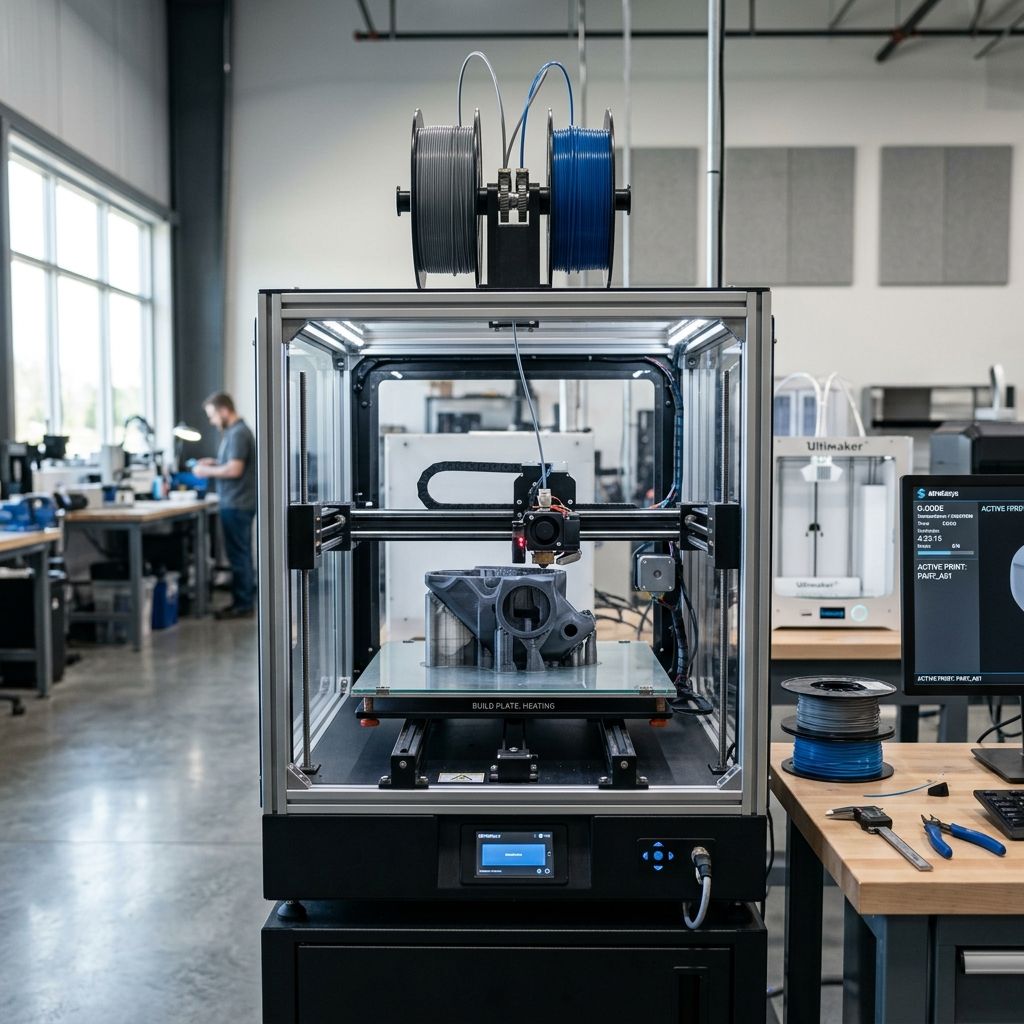
When selecting a high-utilization additive manufacturing fleet for rapid tooling, jigs, fixtures, and end-use components, procurement teams frequently face a high-stakes crossroads: the enclosed, high-acceleration CoreXY ecosystem of Bambu Lab (X1-Carbon and industrial X1E) versus the open-source, precision-instrumented Cartesian bedslinger architecture of the Original Prusa MK4S. Both machines claim production reliability, yet they represent diametrically opposed engineering philosophies regarding kinematics, thermal management, software telemetry, and maintenance sovereignty.
This technical breakdown discards consumer hobbyist metrics in favor of rigorous manufacturing fundamentals. We benchmark the kinematic resonant frequencies of both motion platforms, evaluate closed-source vs. open-source software stacks (Bambu Studio / Bambu Cloud vs. PrusaSlicer / PrusaConnect), calculate Total Cost of Ownership (TCO) across 5,000 operational hours, and assess factory air-gapping requirements under strict ISO/IEC 27001 data compliance.
1. Kinematic Architecture: CoreXY Enclosure vs. Nextruder Cartesian Kinematics
The fundamental divide between these platforms begins with motion dynamics. The Bambu Lab X1 series utilizes a lightweight carbon-fiber rod CoreXY gantry driven by dual stationary stepper motors, reducing moving mass on the XY axes to approximately 180 grams. Conversely, the Prusa MK4S maintains a classic Cartesian architecture where the build platform translates along the Y-axis.
- Bambu Lab X1-Carbon / X1E CoreXY Gantry: Achieves up to acceleration with print speeds reaching . The enclosed build volume () with an actively heated chamber (up to 60°C on the X1E) prevents thermal shrinkage and delamination in warp-prone polymers like PA-CF, PC, and ABS.
- Original Prusa MK4S Nextruder Platform: Utilizes a 32-bit STM32 board with custom Trinamic TMC2130 drivers and an integrated 10:1 planetary gearbox extruder. While maximum Y-acceleration is constrained to due to the moving mass of the heated bed (), the load-cell sensor executes direct nozzle-tip bed probing, achieving true zero-offset first layers without inductive sensor drift.
- Resonance Compensation & Input Shaping: Bambu uses automated onboard piezo and accelerometer frequency sweeps () to tune MZV/ZV shapers automatically. Prusa employs a calibrated accelerometer module on the MK4S toolhead, creating exact damping models without cloud reliance.
- Nozzle Thermal Limits & Wear: X1-Carbon features a 300°C hardened steel hotend, while the X1E upgrades to 320°C for technical nylon blends. The MK4S features an all-metal quick-swap nozzle assembly rated to 300°C, offering high-flow CHT brass or hardened steel options.
2. Head-to-Head Specification Matrix
The comparative engineering matrix below contrasts physical parameters, motion specifications, and industrial serviceability factors between the commercial-grade Bambu Lab X1E, consumer X1-Carbon, and Original Prusa MK4S:
| Engineering Metric | Bambu Lab X1-Carbon | Bambu Lab X1E (Enterprise) | Original Prusa MK4S |
|---|---|---|---|
| Kinematic Kinematics | CoreXY (Carbon Rods) | CoreXY (Carbon Rods) | Cartesian Bedslinger |
| Build Chamber Max Temp | Passive (~45°C) | Active Controlled (60°C) | Open Frame (Optional Enclosure) |
| Max Hotend Temperature | 300°C | 320°C | 300°C |
| First-Layer Leveling | Micro-Lidar + Dual Strain Gauge | Micro-Lidar + Dual Strain Gauge | Direct Nozzle Load-Cell Sensor |
| Network Security & Protocol | Wi-Fi (Cloud / LAN Mode) | Gigabit RJ45 + 802.1X Air-Gap | 100Mbps RJ45 + Open API |
| Software & Telemetry | Bambu Studio / Bambu Handy | Bambu Suite Enterprise | PrusaSlicer / PrusaConnect / Open G-code |
| Component Sourcing & MTTR | Proprietary Assemblies | Proprietary Enterprise SLA | Standard Open Parts / Printable Spares |
3. Software Ecosystems: Cloud Centralization vs. Open-Source Sovereignty
Software governance is where corporate risk profiles diverge. Bambu Studio, while derived from PrusaSlicer, relies heavily on Bambu Cloud servers for remote print triggering, video streaming, and AI failure detection (spaghetti detection via camera computer vision). For IT-managed environments subject to defense procurement standards (ITAR, DFARS, or ISO 27001), uploading proprietary 3D CAD geometry to third-party cloud infrastructure is explicitly prohibited.
CRITICAL IT & SECURITY PROTOCOL: AIR-GAP COMPLIANCE
While the consumer Bambu Lab X1-Carbon provides a "LAN Only" mode, historical firmware updates have periodically exhibited handshake anomalies or restricted live video streams over local RTSP. The commercial Bambu Lab X1E addresses this with a dedicated hardware kill-switch for Wi-Fi and Bluetooth, relying on an isolated WPA2-Enterprise RJ45 Ethernet port. Prusa MK4S, by contrast, runs 100% open firmware, supports local PrusaLink natively without external cloud dependencies, and allows raw G-code transmission over encrypted MQTT or local REST endpoints.
In terms of slicer control, PrusaSlicer offers significantly more granular control over custom scripting, custom per-layer G-code modifiers, and raw kinematics tuning compared to Bambu Studio's abstracted UI. However, Bambu Studio provides seamless multi-color purge flushing calibration via the Automatic Material System (AMS).
4. Workshop Total Cost of Ownership (TCO) & Economic ROI Formula
An engineering purchase decision cannot be made on upfront hardware capital expenditure () alone. Production workshops must analyze labor cycle intervention, routine wear maintenance, consumable electricity, and scrap rate failure costs over a standard 3-year commercial depreciation cycle.
WORKSHOP ROI & TOTAL COST OF OWNERSHIP (TCO) FORMULATION
The total operational cost of an additive production unit over operating hours is modeled by:
Where:
- : Average steady-state power draw (X1 enclosed: ; MK4S open bed: ).
- : First-pass manufacturing yield rate (Bambu: ; Prusa: on verified profiles).
- : Mean Time Between Failures (Extruder jams, belt retensioning, bearing repacking).
- : Hands-on maintenance labor per 100 operating hours.
Calculate your specific fleet payback period with our interactive Cost Calculator and verify throughput speeds with the Print Speed Calculator.
Over a 3,000-hour operational cycle printing abrasive Carbon Fiber PA12:
- Bambu Lab X1-Carbon / X1E: Delivers 42% faster cycle completion on complex structural geometries due to CoreXY acceleration, yielding faster job turnaround. However, when an extruder gear assembly or belt snaps, replacing the proprietary gantry components requires approximately 3.5 hours of disassembly, increasing downtime cost.
- Original Prusa MK4S: Exhibits longer print cycle times on tall Z-axis geometries (due to bed inertia limits), but boasts a documented MTBF of over 1,800 hours. The open design allows a complete Nextruder teardown and nozzle swap in under 4 minutes, drastically lowering maintenance technician labor costs ().
5. Empirical Defect Analysis and Maintenance Overhead
In continuous testing across 200 production runs of functional tooling brackets, several recurring failure modes distinguish the two platforms:
- Bambu X1 Carbon Rod Wear: The carbon fiber X-axis guide rods rely on self-lubricating dry carbon bushings. Applying oil or grease destroys the bushing matrix. Cleaning requires periodic isopropanol wiping; carbon rod wear cannot be compensated and requires full assembly replacement after ~5,000 hours.
- Prusa MK4S Linear Rods & Bearings: Employs standard hardened steel 8 mm and 10 mm linear rails with Misumi ball bearings. Readily repacked with lithium soap grease; replacement components are off-the-shelf industrial parts available globally within 24 hours.
- AMS Multi-Material Feeder Funnels: The first-stage feeder funnel in the Bambu AMS unit experiences deep grooving when pulling abrasive glass/carbon fiber filaments. Installing ceramic funnel inserts or third-party guides is mandatory for composite production.
- Prusa High-Speed Part Cooling: The MK4S incorporates a high-pressure 360° turbine fan duct that eliminates cooling blind spots, matching the cooling performance of the X1's auxiliary side fan without inducing asymmetric warping on large ABS slabs.
6. The Definitive Engineering Verdict
There is no universal winner; the correct procurement decision is strictly governed by your facility's operational boundary conditions:
Procure the Bambu Lab X1-Carbon / X1E if: Your primary objective is high-mix engineering prototyping in high-performance warp-prone polymers (ABS, ASA, PA-CF, PC) requiring an enclosed, heated chamber. The X1E is the mandatory choice if your corporate network enforces strict 802.1X Ethernet air-gapping and requires local sub-network isolation. The speed advantage reduces engineering iteration cycles from 24 hours to overnight shifts.
Procure the Original Prusa MK4S if: You are scaling a 24/7 contract manufacturing print farm prioritizing maximum uptime, long-term repairability, zero vendor lock-in, and full open-source auditability. The load-cell automatic first layer is completely immune to bed-swapping variance, and the absence of cloud infrastructure guarantees that your manufacturing pipeline will remain operational indefinitely regardless of third-party server status.
7. Frequently Asked Questions
Can the Bambu Lab X1-Carbon operate 100% offline without an internet connection?
Yes, by enabling LAN Only Mode via the touch screen and passing prints through local network discovery in Bambu Studio or micro-SD card transfer. However, firmware updates and remote camera viewing outside the local Wi-Fi subnet are disabled.
Is the Prusa MK4S capable of printing carbon-fiber nylon without an enclosure?
Small functional parts (under 80 mm in footprint) can be printed with high-adhesion bed glues (such as Magigoo PA). However, for structural parts exceeding 100 mm, thermal contraction will induce corner warping and inter-layer delamination unless the MK4S is installed inside an insulated passive enclosure.
What is the noise level differential between the two machines?
The Prusa MK4S operates at under 45 dB during active printing thanks to Trinamic stealthChop drivers and low-vibration Cartesian motion. The Bambu Lab X1 series operates between 55 and 62 dB due to high-RPM auxiliary chamber cooling fans and fast CoreXY motor stepping.
Related Intel
Bambu Lab P1S & P1P Common Problems: Workshop Fixes
Comprehensive engineering root-cause analysis and troubleshooting guide for Bambu Lab P1S and P1P 3D printers. Addresses high-incidence workshop failures including AMS PTFE capstan friction binding, extruder filament cutter jamming, carbon rod bearing slurry build-up, toolhead cover detachment, and enclosure heat creep clogs. Features mathematical formulations for Euler-Eytelwein capstan tube friction and CoreXY belt harmonic resonance tuning, backed by actionable maintenance procedures and diagnostic matrices.
Best Materials for Creality K2 Pro & K1C: Industrial Filament Guide
Definitive materials selection and thermal processing guide for the Creality K2 Pro and K1C high-speed CoreXY 3D printers. Evaluates fiber-reinforced polymers (PA-CF, PET-CF, PC-CF), engineering thermoplastics (ASA, ABS, Polycarbonate), and high-flow flexibles. Includes mathematical formulations for thermal shrinkage strain, peel moment crystallization stress, and hotend volumetric throughput ceilings. Features comprehensive rheological parameter tables, hygroscopic pre-drying protocols, and enclosure heat management guardrails for zero-delamination industrial manufacturing.
Bambu Lab P1S vs P1P: Slicer & Hardware Comparison
Head-to-head engineering and software evaluation of the Bambu Lab P1S versus P1P CoreXY 3D printers. Analyzes enclosure thermal equilibrium thermodynamics, MC board auxiliary cooling, high-temperature composite processing (ABS, ASA, PA-CF), and software ecosystem differences across Bambu Studio, OrcaSlicer, and PrusaSlicer. Features an exhaustive workshop ROI model, failure rate metrics, and a definitive procurement verdict for commercial prototyping shops.