Wanhao Filament Dryer: Industrial Production ROI Guide

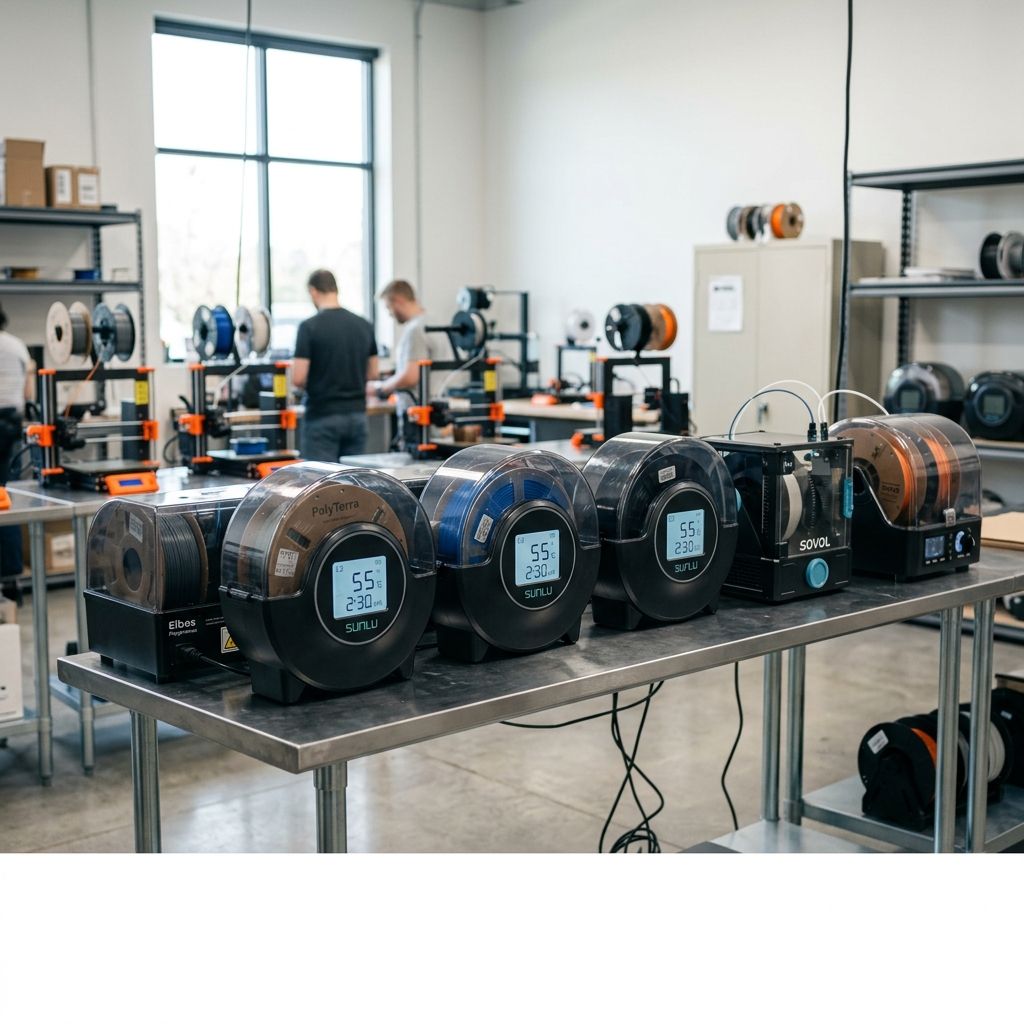
Wanhao Filament Dryer: Industrial Production ROI and Moisture Control
An engineering deployment guide for commercial additive workshops integrating thermal desorption chambers to slash hydrolytic degradation and nylon scrap rates.
Business Impact: Scrap Reduction & Thermal Drying Economics
Atmospheric moisture absorption is the leading root cause of mechanical failure in engineering thermoplastics like PA-CF, TPU, and PETG. In a 10-machine production cell running technical filaments, unconditioned spools drive scrap rates between 14% and 22% due to foaming, delamination, and nozzle clogging. Integrating dedicated drying chambers such as the Wanhao Box 2 brings batch defect rates below 2.5%, recovering an estimated 16 to 24 productive machine-hours per week. Estimate desorption intervals for your specific shop ambient using our Filament Drying Calculator.
The Polymer Thermodynamics of Hydrolytic Degradation
When hygroscopic polymers enter a 280°C hotend saturated with moisture, water does not simply boil into steam bubbles that pop inside the nozzle. At molten extrusion temperatures, water molecules initiate hydrolytic chain scission within the polymer backbone. In polyamides (nylon) and polyesters (PETG, PBT), water attacks the amide and ester bonds, chemically cleaving high-molecular-weight polymer chains into shorter oligomers.
This molecular breakdown irreversibly diminishes the mechanical strength of printed parts. Tensile test specimens printed from damp PA12-CF demonstrate up to a 42% reduction in ultimate tensile strength (UTS) and an 60% drop in impact toughness compared to parts printed from dry filament. Furthermore, steam pockets expand non-linearly inside the melt zone, producing severe pressure spikes and unpredictable extrusion starvation that disrupt surface finishes across technical enclosures.
Hardware Architecture and Workshop Requirements
Deploying filament drying hardware within an active production environment requires matching power infrastructure, continuous feed paths, and ambient climate controls to the thermal capabilities of the drying chamber.
- Chamber Heating Capacity: Positive Temperature Coefficient (PTC) ceramic heater generating 40°C to 75°C regulated chamber heat.
- Active Air Convection: Continuous tangential cross-flow circulation fan (3,200 RPM) preventing localized hot spots.
- Desorption Feed Architecture: Dual PTFE 4 mm OD tube feed-through ports with rubber grommet dust seals for active in-process printing.
- Continuous Power Draw: Nominal 48 W to 120 W during initial thermal ramp; drops to 32 W steady-state maintenance draw.
- Spool Mechanical Fitment: Accepts standard 1 kg and 0.75 kg spools with outer diameters up to 205 mm and widths up to 75 mm.
- Relative Humidity Monitoring: Internal digital capacitive sensor tracking target relative humidity down to 10% RH.
Mass Balance Physics and Fickian Moisture Desorption Calculation
Moisture removal from cylindrical polymer monofilaments follows non-steady-state Fickian diffusion. The moisture concentration gradient drives water molecules from the core of the 1.75 mm filament outward toward the surface, where convection sweeps the moisture into the exhaust environment:
\frac{\partial C}{\partial t} = D \left( \frac{\partial^2 C}{\partial r^2} + \frac{1}{r} \frac{\partial C}{\partial r} \right)
The diffusion coefficient (D) is exponentially dependent on temperature via the Arrhenius equation:
D(T) = D_0 \cdot e^{-\frac{E_a}{R \cdot T}}
Where D_0 is the reference diffusion pre-factor, E_a is activation energy in J/mol, R is the universal gas constant (8.314 J/mol·K), and T is absolute temperature in Kelvin. Increasing chamber air temperature from 25°C (298 K) to 70°C (343 K) elevates the moisture diffusion coefficient in PA6 by over two orders of magnitude, collapsing desorption time from weeks to hours.
Workshop Practical Calculation: Mass Moisture Loss & Production ROI
Let us model a print cell operating within a manufacturing facility maintaining an average ambient humidity of 55% RH at 22°C. A production run requires printing 15 end-use drone arms using carbon-fiber-reinforced nylon (PA6-CF). A fresh 1.0 kg (1,000 g) spool has been exposed to the ambient shop floor for 48 hours.
The moisture dynamics and workshop costs are quantified as follows:
- Nominal spool mass (dry): 1,000 g
- Equilibrium moisture content at 55% RH: 2.8% by weight
- Absorbed water mass in spool (m_w): 1,000 g × 0.028 = 28.0 g (0.028 kg)
- Target moisture content for critical structural printing: < 0.15% (1.5 g remaining water)
- Mass of water to evaporate (Δm_w): 28.0 g - 1.5 g = 26.5 g (0.0265 kg)
- Latent heat of vaporization of water (h_fg): 2,260 kJ/kg
- Sensible heat to raise spool from 22°C to 70°C (c_p for PA6 ≈ 1.7 kJ/kg·K): Q_sensible = m · c_p · ΔT = 1.0 kg × 1.7 kJ/kg·K × 48 K = 81.6 kJ
- Thermal energy to vaporize water: Q_latent = 0.0265 kg × 2,260 kJ/kg = 59.89 kJ
- Total theoretical thermal energy: 81.6 kJ + 59.89 kJ = 141.49 kJ (0.0393 kWh)
Accounting for chamber heat losses and ventilation efficiency (approx. 22% thermal efficiency), the dryer draws 95 W average power over an 8-hour desorption cycle, consuming 0.76 kWh. At an industrial commercial rate of $0.18 per kWh, electricity cost per dried spool is exactly $0.137.
Economic Yield Recovery
Without drying, 3 out of every 15 printed arms fail destructive QC inspection due to layer separation or porosity defects (20% scrap rate). Each arm uses 60 g of raw material ($4.80 raw material cost) and ties up 5 machine hours (machinery overhead calculated at $12.00/hour). Scrapping 3 defective parts costs the shop:
\text{Direct Loss} = 3 \times (\$4.80 + (5 \times \$12.00)) = 3 \times \$64.80 = \$194.40
By spending $0.14 in electricity and allocating a $130 dryer investment, the workshop eliminates the $194.40 scrap loss in a single production batch, delivering an immediate return on investment within 48 hours of installation. Similar cost avoidance strategies are detailed in Building a Print Farm with Prusa MK4S and MK4.
Industrial Material Conditioning Matrix
Different polymer families possess vastly different glass transition temperatures (T_g) and water absorption affinities. Heating a spool above its softening point fuses adjacent filament coils into a solid block, causing catastrophic extruder motor stalls. The table below lists safe, empirically verified parameters for commercial drying.
| Polymer Filament Type | Equilibrium Moisture at 50% RH | Recommended Chamber Temp (°C) | Required Dwell Time (Hours) | Max Critical Target RH (%) | Field Risk if Overheated |
|---|---|---|---|---|---|
| Standard PLA / Tough PLA | 0.3% - 0.5% | 45°C - 50°C | 4 - 6 | < 20% | Filament softens, flattens on spool rollers, jams drive feed |
| PETG / PCTG | 0.8% - 1.2% | 60°C - 65°C | 6 - 8 | < 15% | Inter-coil blocking; stringing and surface bubbling |
| PA6 / PA12 (Unfilled Nylon) | 2.5% - 4.0% | 70°C - 75°C | 10 - 14 | < 10% | Severe foaming, nozzle popping, 40% mechanical tensile loss |
| PA-CF / PA-GF (Filled Composites) | 2.0% - 3.2% | 70°C - 75°C | 8 - 12 | < 10% | Fiber-matrix debonding, poor layer weld, brittle breaks |
| TPU / TPE (85A - 95A Elastomers) | 1.5% - 2.8% | 55°C - 60°C | 8 - 10 | < 12% | Sticky filament binding in feeder tubes; extreme oozing |
| Polycarbonate (PC) / PC-ABS | 0.4% - 0.7% | 75°C - 80°C | 8 - 10 | < 10% | Micro-crazing under stress, optical haze, internal voids |
Inline Feeding Workflow for Continuous Production
Conditioning a spool before printing solves only half the problem. In humid facilities, a dry nylon spool re-absorbs critical moisture within 30 to 45 minutes of ambient exposure. Therefore, commercial workshops must configure drying units as active inline dispensers while the job runs.
- PTFE Tube Routing: Install continuous 4 mm OD / 2 mm ID PTFE guide tubes directly from the dryer outlet grommet to the printer toolhead extruder inlet. Ensure bend radii never drop below 65 mm to prevent feed friction and stepper motor current surges.
- Desiccant Chamber Buffer: Place high-capacity molecular sieve (4Å zeolite) packets inside the bottom cavity of the dryer box beneath the spool rollers. As the chamber cools between heating cycles, the desiccant traps incoming ambient humidity through any unsealed clearances.
- Spool Free-Roll Alignment: Inspect spool edges before closing the lid. Warped cardboard spools can rub against chamber sidewalls, creating rotational drag that stalls compact toolheads like those discussed in Deploying 3D Printing Tool Sets in Commercial Farms. Plastic edge rings or center spindle adapters should be fitted on damaged spools.
- Chamber Purge Protocol: Crack the dryer lid by 2 mm for the first 15 minutes of a high-temperature cycle. This allows vapor-laden air to escape before the internal fan circulates moist air through the closed loop.
Destructive Testing and Quality Assurance Verification
To implement ISO 9001 quality compliance in printed production parts, workshops cannot rely on guesswork regarding material dryness. Implement these three rapid shop verification tests:
1. The Cold Bend Test: Cut a 100 mm strand from the spool. Slowly bend the filament 180 degrees around a 5 mm pin. Wet PLA and nylon undergo micro-crazing and snap cleanly with a brittle sound. Properly dried filament exhibits ductile yielding without snapping.
2. The Extrusion Purge Audit: Heat the nozzle to operating temperature and purge 100 mm of filament into free air without fan cooling. Listen closely for popping or sizzling noises. A wet strand shows internal foam bubbles, rough frosted surface texture, and curls sharply upward toward the heater block. A dry strand extrudes glass-smooth, straight, and glossy.
3. Analytical Mass Loss Monitoring: Place the spool on a high-precision 0.01 g digital scale immediately before entering the dryer and record the baseline tare mass. Weigh the spool again after 8 hours at temperature. The difference represents actual desorbed moisture mass. When mass stabilization occurs across two consecutive hourly readings, the spool has reached practical equilibrium.
Field Maintenance and Thermal Calibration
Filament dryers operate in dirty industrial environments where abrasive dust, plastic flakes, and volatile condensation accumulate inside the electronics enclosure. Perform the following monthly maintenance routine:
- Roller Bearing Lubrication: Clean the four bottom spool support roller bearings with solvent and apply a light droplet of synthetic PTFE oil. Stiff bearings generate feed tension that causes under-extrusion and false runout triggers.
- Sensor Drift Calibration: Inexpensive capacitive humidity sensors drift over time when subjected to elevated temperatures. Verify internal readings quarterly against an external calibrated hygrometer placed inside the chamber.
- PTC Element Dust Vacuuming: Vacuum the heating grille located under the spool cradle. Build-up of loose carbon fibers or plastic shavings can ignite or produce localized thermal insulation that triggers safety thermal fuses prematurely.
Frequently Asked Questions
Can the Wanhao filament dryer achieve sufficient heat for PEEK and PEI filaments?
No. Ultra-polymers like PEEK and PEKK require desorption temperatures between 120°C and 150°C to strip moisture from their dense aromatic structures. The Wanhao unit maxes out around 75°C, making it suitable for PLA, PETG, TPU, ABS, and nylon, but not high-temp aerospace polymers.
Is it safe to run the dryer continuously for 72-hour print jobs?
Yes, provided the intake vents remain unobstructed and ambient room temperature stays below 35°C. The internal PTC ceramic heater self-regulates power consumption as chamber temperature approaches target equilibrium.
Can cardboard spools be dried directly inside the unit?
Yes, but cardboard spools absorb significant moisture from the air, increasing total required drying time by 30% to 50% compared to plastic spools. Technicians must inspect cardboard flanges for warpage during drying to ensure free rotation on bottom rollers.
Does drying brittle PLA restore its flexibility and usability?
Yes. Old PLA becomes brittle primarily due to ambient moisture accelerating internal micro-strain cracking. Thoroughly baking the spool at 45°C for 6 hours releases trapped moisture and relieves residual internal stresses, returning the filament to ductile condition.
Critical Workshop Operating Precaution
Never exceed recommended glass transition temperatures when drying materials. Exceeding 50°C on standard PLA or 65°C on PETG fuses adjacent filament wraps into an unrecoverable plastic slug and risks overheating the drive rollers. Maintain dedicated circuit breakers for banks of multiple drying units to avoid nuisance breaker trips during simultaneous heater ramp-ups.
Related Intel
Polymaker PolyBox II Moisture Control and Shop Specs
The Polymaker PolyBox II maintains sub-15% RH for engineering filaments using passive desiccant trays, ball-bearing rollers, and rubber grommets to prevent moisture uptake.
Creality Space Pi Filament Dryer: A Practical Review
After 200 hours of testing with PA12, PETG, and TPU, the Creality Space Pi shows significant temperature variance (±5°C) and poor air circulation, making it a budget option with compromises. Built decently but heater and controller are outdated.
PrintDry System for Production Filament Drying
Moisture is the top cause of FFF yield loss. This article explains how to integrate the PrintDry as a moisture barrier buffer in a production workcell, with specs, cost savings, and the physics of wet filament.