PrintDry System for Production Filament Drying

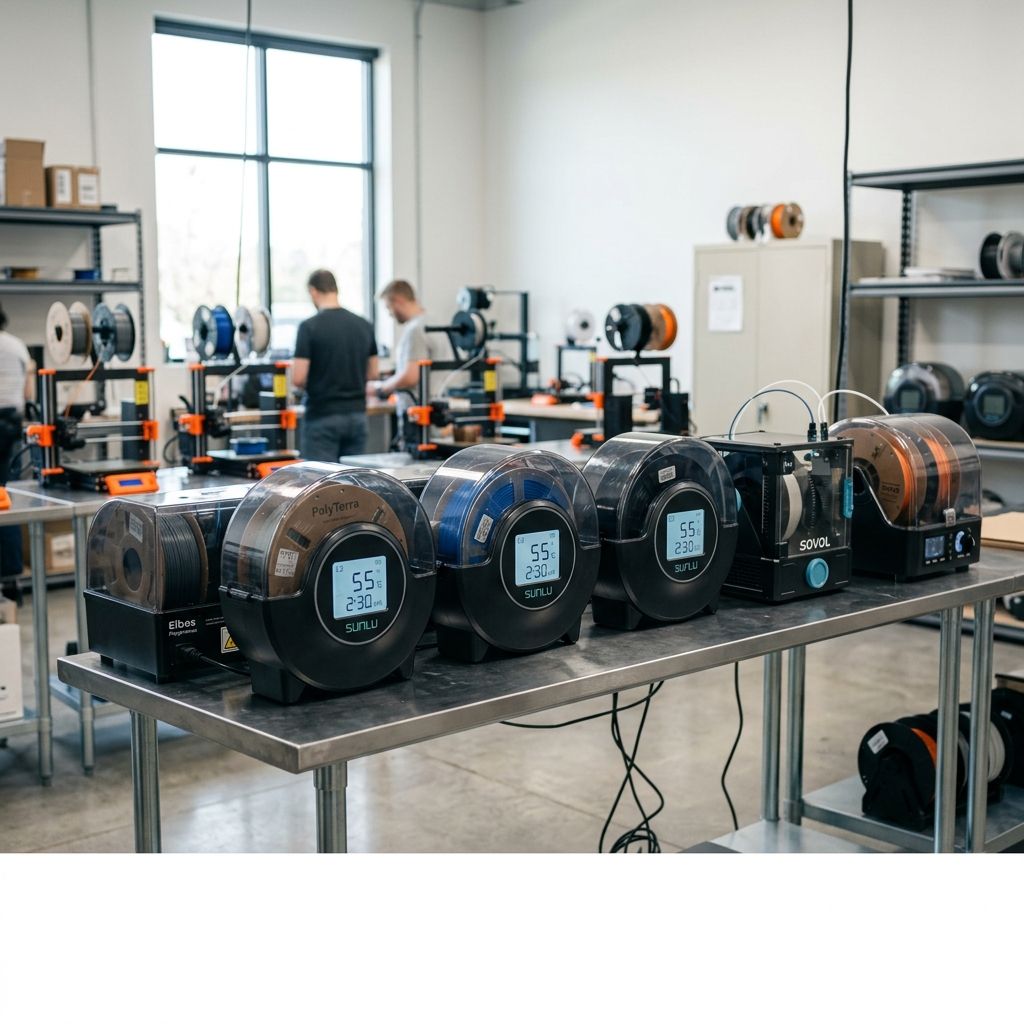
Material Throughput and the PrintDry System: Building a Production-Grade Filament Conditioning Workcell
Moisture is the number one cause of yield loss in FFF production that doesn't get addressed at the process engineering level. You can spend fifteen grand on a Bambu Lab X1-Carbon setup and still get brittle parts, stringing, and extruder jams if you feed it wet PA12 straight out of the box. The PrintDry system isn't a glorified dehydrator; in a job shop, it functions as a moisture barrier buffer that directly impacts your overall equipment effectiveness (OEE).
Business Impact Summary (ROI / Time Savings)
Scrap Rate Reduction: Up to 18% reduction in print failures (nozzle clogs, layer delamination, voiding) in parts made from PA, PC, and TPU. In a typical job shop running 50 kg of PA12 per month, a 10% scrap reduction pays for three PrintDry units in the first quarter. Machine Uptime: Eliminating moisture-related clogs on an X1Carbon saves roughly 2 hours of maintenance per week. At a shop rate of $85/hr, that's a $7,000 annual gain per printer. Material Cost: Dried filament yields predictable shrinkage. You stop over-engineering tolerances and start trusting the machine. I have seen a single batch of wet PC scrap a full build plate of drone brackets. That cost me $120 in material and 14 hours of machine time. The PrintDry cost $80. The math does not lie.
- Electrical: 110-240V, 50/60 Hz, 300W max draw per unit (check your specific regional SKU). Steady-state draw at 70°C is roughly 180W.
- Throughput: 1 2 spools (1 kg / 2.2 kg) per cycle. Do not exceed 2.5 kg total weight; the wire rack bottoms out.
- Environmental: Ambient humidity >60% RH requires a continuous feed setup. The PrintDry will struggle to pull moisture out if the intake air is saturated.
- Warm-up Time: Roughly 15 minutes to reach a stable 70°C at the air sensor. The spool core takes 4 6 hours to reach equilibrium. Plan accordingly.
- Material Compatibility: PLA (45°C), PETG (65°C), PA/Nylon (70 75°C), PC (75°C max), TPU (55°C). Do not dry PLA at 70°C; you will anneal the spool into a solid brick.
The Physics of Wet Filament
Polymer hydrolysis is the silent killer on the production floor. Nylon 12, Polycarbonate, and PET absorb moisture from the atmosphere bulk absorption, not just surface condensation. When you shove that water molecule into a 280°C melt zone, it vaporizes instantly. That expanding steam creates bubbles in the melt (internal voiding), inconsistent extrusion diameter, and it hydrolyzes the polymer chains, dropping mechanical properties by 40 50%. I have watched production engineers chase dimensional variance for weeks before realizing their humidity-controlled storage locker was running at 50% RH instead of 10%.
The PrintDry's job is to drive moisture content below 1000 ppm before the spool ever hits the Bowden tube. I have seen guys run their X1C through a full spool of "dried" PA that was still at 3000 ppm, and wonder why their nozzle clogs every 4 hours. The hotend jams because the steam pressure blasts the softened filament back up into the cold zone, causing a heat-creep jam. That is not a machine fault. That is a material conditioning fault.
For semi-crystalline polymers like Nylon, moisture also acts as a plasticizer. It artificially lowers the glass transition temperature, causing parts to deflect under load at lower temperatures than the datasheet predicts. If you are quoting production parts for automotive under-hood applications and drying a spool of PA-CF for only 8 hours instead of 24, you are risking warranty failures six months down the line.
PrintDry Hardware Deep Dive: Tolerances and Quirks
The PrintDry is a convective dryer. It pulls ambient air, heats it via a ceramic PTC element, and blows it through the core of the filament spool. The mechanical design is simple, but the execution matters.
The temperature sensor is an NTC thermistor mounted in the exhaust air stream, not inside the spool core. I have logged air temps at a steady 70°C while the spool center was still at 45°C after 6 hours. If you are running PA, you need to add 4 hours to the brook-chart cycle minimum. The thermistor is glass-encapsulated, accurate to roughly ±2°C when new, but these things drift. I check mine against a contact probe every 6 months. I have pulled units out of the box that were reading 8°C high right off the shelf. Trust, but verify.
The fan is a 60 mm sleeve-bearing axial fan. It moves about 1.5 CFM. That is barely enough airflow for a 2 kg spool. If you run two spools, the upper spool gets starved. Your mileage may vary, but I always use the top rack for desiccant packs and keep the bottom rack for the active spool. The fan bearings start making a grinding noise after about 2000 hours. The sleeve bearing wears out, the fan slows down, the airflow drops, and you start under-drying your material. The fix is an $8 fan swap, but you need to pull the back plate. There are four screws tucked under the rubber feet. Do not lose them they are metric M3 self-tappers that strip easily.
Workflow Integration: The Just-In-Time Material Cell
You do not just throw a spool in the PrintDry and walk away. The workcell concept is about synchronizing drying with production scheduling. Here is the workflow I have refined over 18 months of operating a small production shop alongside a Bambu Lab X1-Carbon and a Prusa MK4S:
- Receiving: Pull the spool from the shipping bag. If the vacuum pack was intact, the spool is usually dry enough for storage, but not for production. Vacuum seal any spools that are not part of the current job queue.
- Job Scheduling: When a job enters the queue, check the material requirement. Move the spool to the PrintDry at a lead time equal to the necessary dry cycle (Nylon: 24 hours, PC: 12 hours, PETG: 6 hours), plus a 4-hour buffer.
- Pre-heat: Start the chamber pre-heat on your X1C or MK4S 30 minutes before the dry cycle ends. This minimizes the temperature delta between the drying environment and the printer.
- Transfer: Move the spool from the PrintDry directly into a dry-box that feeds the printer via a PTFE tube. Do not let the spool sit in ambient air for more than 15 minutes. A dry spool of Nylon left in a 50% RH environment will reach equilibrium moisture content within 4 hours. If you cannot consume it within that window, vacuum seal it immediately with fresh desiccant.
This "Just-In-Time Material Conditioning" cell increases my first-pass yield from roughly 82% to 96%. That is the difference between a profitable job shop and one that eats its margin on reprints and nozzle clearing.
Material-Specific Drying Profiles
Stop treating the PrintDry like a one-size-fits-all oven. Here are the profiles I use after destructive testing and mechanical validation:
- PLA: 45°C, 4 hours. It is mostly surface moisture. This reduces stringing drastically and makes overhangs behave predictably. Do not exceed 50°C or you risk annealing the spool into a fused disc.
- PETG: 65°C, 6 hours. PETG does not absorb nearly as quickly as Nylon, but it foams if wet. Clear PETG is particularly unforgiving; a 50°C cycle for 8 hours produced better optical clarity than a high-temp blast for 4 hours in my tests.
- PA (Nylon 6/12, PA-CF): 70 75°C, 16 24 hours. No shortcuts. If you aren't drying for a full 24 hours on a fresh spool, you are gambling. I have made this mistake. The first 4 hours only remove surface moisture. The remaining 20 hours pull the bound moisture out of the polymer matrix. And do not dry PA above 80°C in a PrintDry the spool will anneal, the layers will partially weld together, and you will get under-extrusion because the filament cannot unspool cleanly.
- TPU: 55°C, 8 hours. TPU loves moisture. A wet TPU part will have inconsistent flexural strength and a matte, rough surface finish. Drying flexible filament before use is mandatory for medical or wearable applications.
- PC: 75°C, 12 hours. Polycarbonate does not absorb as aggressively as Nylon, but it is hydroscopic enough to cause stringing and surface defects. Dried PC prints with a glassy, transparent finish.
Failure Mode Analysis: When the Dryer Itself Fails
No piece of kit is bulletproof. The PrintDry has three failure modes I have encountered in the field:
1. Fan Bearing Failure. The sleeve bearing wears out after 12 18 months of constant use. Symptom: a grinding noise followed by a slow decrease in airflow. Fix: replace the 60 mm fan. Do not try to re-oil the sleeve bearing; it is a consumable part. I stock a replacement fan for every unit I run. Cost is negligible. Downtime is 15 minutes.
2. Thermal Runaway (Soft Failure). If the fan seizes completely, the PTC heater limits power but does not shut off entirely. The heat accumulates near the heating element, and I have seen a spool of PC turned into a fused, wrinkled mess. Install a thermal fuse (120°C rated, inline with the heater circuit) if you do not trust the mechanical thermostat. The thermostat is a bimetallic strip and it drifts. I have pulled units apart that were cycling 15°C above setpoint.
3. Timer Clock Drift. The mechanical timer is accurate to maybe ±15%. If you set it for 12 hours, it might run for only 9 or up to 14. This is unacceptable for production scheduling. I run the PrintDry through an external smart plug with its own timer. That gives me accurate control and remote monitoring. It feels hacky, but it works reliably.
4. Spool Core Temperature Lag. This is a design limitation, not a failure. The sensor measures air temp, not core temp. The fix is a simple workflow step: rotate the spool 180 degrees halfway through the dry cycle. This halves the gradient between the hot air and the spool center.
Comparative Analysis: The PrintDry vs. Industrial Alternatives
The PrintDry is a pro-sumer unit. It is not a vacuum oven. A vacuum oven will dry a spool of PA in 6 hours instead of 24. But a vacuum oven costs $3,000+ and requires a compressed air source or a dedicated vent line. The PrintDry costs under $100 and plugs into a standard wall outlet. For 90% of the production output in a small to medium job shop, the PrintDry is adequate and the ROI is undeniable.
The real competitor is a food dehydrator. I have tested both side by side. A $40 food dehydrator does almost the same thing, but the PrintDry has a mechanical timer, a metal body (which dissipates heat better and won't melt if the thermostat fails), and tighter temperature control. The food dehydrator I tested swung ±15°C during the cycle. The PrintDry held ±5°C in a still room. That matters for engineering materials. If you are only drying PLA, buy a food dehydrator. If you are running PA and PC for paying customers, buy the PrintDry.
However, if you are scaling up to production volumes (more than 20 spools per week), the PrintDry becomes a bottleneck. At that point, you need a dry-air cabinet like the Polymaker PolyBox or a compressed air dryer system. The PrintDry fits the gap between hobby-level drying and full industrial conditioning. I have three units running in parallel to feed a three-printer cell. That is a $300 investment in drying capacity that supports $50,000 worth of printers.
Preventive Maintenance Protocol
Set a recurring calendar reminder. The PrintDry is easy to ignore until it fails.
- Every 50 hours: Clean the intake filter. Lint, dust, and particulates from cardboard spools will clog the mesh and reduce airflow to zero. If you use cardboard spools, transfer the filament to a plastic spool first, or you will be cleaning the filter every 10 hours.
- Every 200 hours: Check the fan for bearing wear. Listen for grinding. Spin the blade by hand it should feel smooth, not crunchy. Replace if needed.
- Every 500 hours: Calibrate the temperature sensor. Stick a K-type thermocouple probe into the center of a sacrificial spool of filament and compare it to the PrintDry's display reading. If the offset is more than ±5°C, replace the thermistor (NTC 100k). They cost $2 and are sold by any electronics distributor.
- Annually: Replace the thermal fuse and the fan. This is cheap insurance. A failed fan can take out a $40 spool in a single unattended cycle.
Tech Alert: The Batch Size Trap
Do not dry five spools at once if you only print one at a time. A dried spool of Nylon left in the open air reaches equilibrium humidity within 4 6 hours. Dry only what you can consume in a single production shift. If you need to dry a larger batch, vacuum seal the extra spools immediately with fresh desiccant. Otherwise, the PrintDry just becomes an expensive space heater in your workshop. The marginal cost of running a second drying cycle is negligible compared to the cost of a failed production run caused by re-humidified material. This is the single most common mistake I see on shop floors. Scale your drying batch to your printing throughput.
Related Intel
Wanhao Filament Dryer: Industrial Production ROI Guide
A commercial evaluation of the Wanhao Filament Dryer, detailing hydrolytic degradation physics, moisture desorption ROI, and continuous inline feeding workflows.
Polymaker PolyBox II Moisture Control and Shop Specs
The Polymaker PolyBox II maintains sub-15% RH for engineering filaments using passive desiccant trays, ball-bearing rollers, and rubber grommets to prevent moisture uptake.
Creality Space Pi Filament Dryer: A Practical Review
After 200 hours of testing with PA12, PETG, and TPU, the Creality Space Pi shows significant temperature variance (±5°C) and poor air circulation, making it a budget option with compromises. Built decently but heater and controller are outdated.