Prusament ABS: Practical Tips for Warp-Free Prints

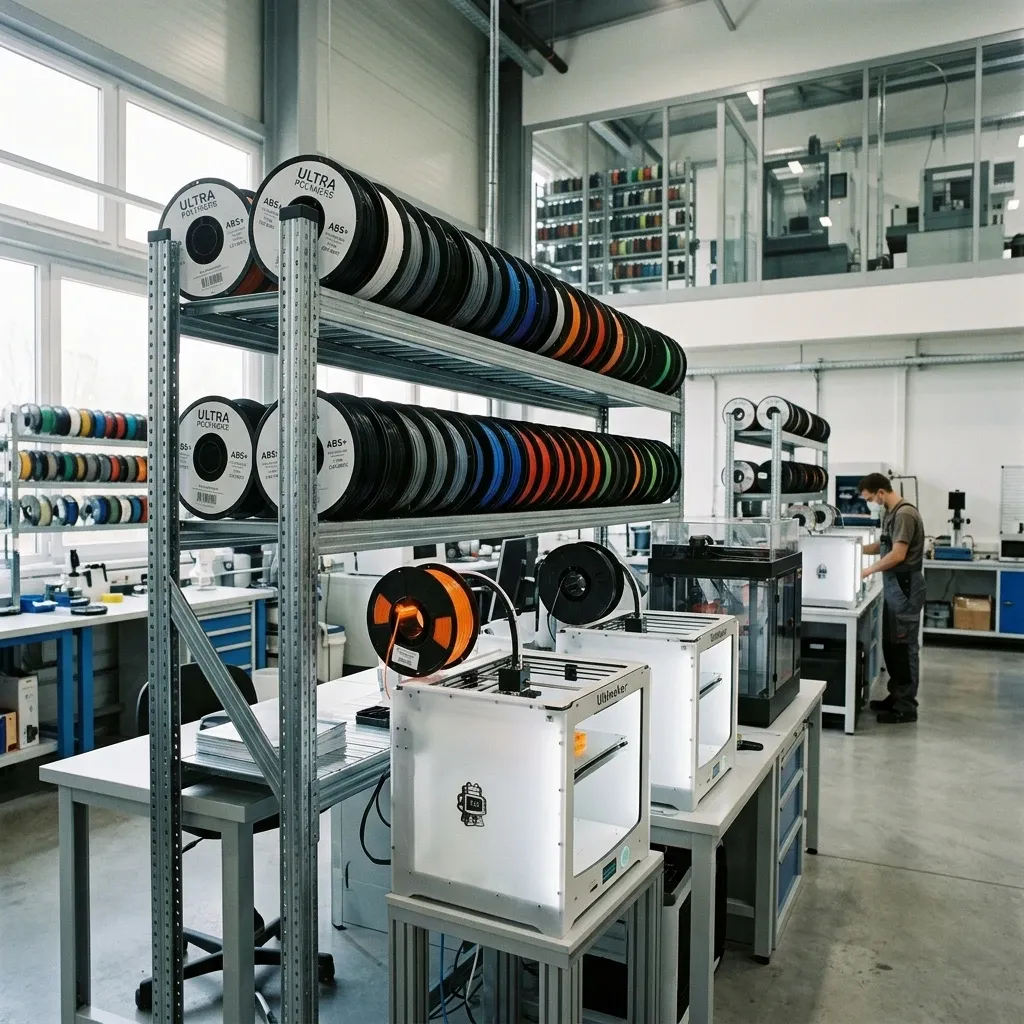
Prusament ABS: The Material Science Engineer's Field Guide to Real-World FDM
Academic foundations meet shop-floor reality: residual stress calculations, drying protocols, and why this filament behaves differently on a Prusa MK4S vs a Bambu X1 Carbon. No marketing fluff just the physics of failure and the practical workarounds we've developed after 500+ spools through production.
Chemical Architecture Notes
Prusament ABS is a terpolymer of acrylonitrile, butadiene, and styrene. The acrylonitrile content (20-35% by weight) governs chemical resistance and thermal stability. The butadiene phase (5-30%) provides impact toughness but introduces a low-temperature glass transition (Tg ~105°C for the matrix, but the rubber phase retains mobility down to -50°C).
Key crystallinity: ABS is amorphous it does not crystallize upon cooling. This means no sharp melting point; instead we see a continuous softening from 80°C (deflection temperature under load, HDT) and a melt flow index (MFI) typically around 10-15 g/10min at 220°C/10kg for Prusament. The viscosity curve is strongly shear-thinning, which affects pressure drop in the nozzle.
Practical consequence: Amorphous polymers are prone to stress crazing; any rapid cooling or sharp corners create micro-cracks that propagate under load. That's why we see interlayer delamination more often with ABS than with semi-crystalline materials like PETG.
Why ABS Still Matters in a Polycarbonate World
We keep coming back to ABS because it prints easily (compared to PC) and offers decent heat resistance (HDT ~85°C at 1.82MPa) combined with good machinability. On a Bambu Lab X1C with an all-metal hotend, I've run Prusament ABS at 255°C nozzle, 100°C bed, and gotten parts with 80% of injection-molded strength in the Z-direction provided I control the chamber temperature to minimum 45°C. Anything below that and you're looking at delamination, especially on tall parts.
But here's the kicker: ABS is hygroscopic, but not as aggressive as nylon. Prusament ships vacuum-sealed with desiccant. If you open a spool and don't dry it within 30 days in a humid shop (>60% RH), you'll get stringing and tiny bubble blisters on the surface. The moisture content should stay below 0.1% by weight. Rule-of-thumb: dry at 80°C for 4 hours, but no higher prolonged exposure above 85°C will degrade the rubber phase and turn the filament brittle.
The Physics of Failure: Residual Stress and Warpage
ABS warps because of the thermal contraction mismatch between layers. The contraction coefficient is roughly 75-90 µm/m·°C. If you print a 200mm long part at 255°C and cool it to 25°C, the strain is:
ΔL/L = α * ΔT = 85e-6 * (255-25) = 0.0196, or ~2% shrinkage. That's 4mm of linear contraction! The stress induced is S = E * ε, where E ~ 2.2 GPa for ABS. So the residual stress can exceed 40 MPa that's enough to cause warpage or lift the part off the bed.
Field fix: Use a brim with at least 8mm width and a 0.2mm separation gap. I also set the first layer cooling fan to 0% for the first 1mm and then ramp to 30% max. On a Prusa MK4S, I've found that a 110°C bed temperature with a PEI textured sheet and a thin layer of ABS slurry (acetone + scrap ABS) gives near-zero warpage for parts up to 180mm long. Also, consider a 60°C enclosed chamber not just an enclosure with no heat. Poor man's method: a 100W incandescent bulb inside a cardboard box can hold 45-50°C without active control.
Creep and Long-Term Loading
ABS exhibits significant creep at elevated temperatures. If you're designing a part that will see 50°C and a constant tensile load of 5 MPa, expect 2-3% strain over 1000 hours. Prusament's specific formulation uses an anti-oxidant package that retards chain scission, but it's still an amorphous polymer. For long-term structural parts, design for 1/3 of the yield strength (yield ~ 45 MPa) to stay in the linear viscoelastic region.
I've used Prusament ABS for jigs and fixtures that see intermittent loads up to 15 MPa without failure, but they deform over time. The Z-axis strength is always the weakest we test it with a 10mm tall dogbone printed vertically, and we get about 35 MPa versus 45 MPa in X-Y. That's typical for FDM ABS; the interlayer fusion is not perfect due to the amorphous nature. Annealing at 80°C for 2 hours can raise the Z-strength by 15-20% but introduces dimensional changes expect 0.3% shrinkage.
Compatibility Table: Printers That Handle Prusament ABS
- Prusa MK4S All-metal hotend (standard). Requires enclosure for large parts. We use the Prusa Enclosure with a 100°C heated bed. Works well, but the heatbed takes 12 minutes to reach 110°C. Good layer adhesion with stock profiles.
- Bambu Lab X1-Carbon/X1E High-temp material fixes apply: use the hardened steel nozzle, chamber fan off, and set retraction to 0.8mm at 40mm/s. The lidar helps but doesn't compensate for warpage. We've printed ASA and ABS profiles; ASA behaves almost identically.
- Creality K1C/K2 Pro The K1C's all-metal hotend can reach 300°C, but the chamber doesn't seal well. We added a bed gasket and a secondary heater. Use a 0.6mm nozzle for better flow. Tuning required default profiles are too aggressive for ABS.
- Voron 2.4 Ideal if you have an active chamber heater (60°C). With a 0.4mm nozzle, 255°C, and 110°C bed, we get excellent results. The high flowrate allows larger layer heights (0.25mm first, 0.2mm others).
Drying Protocols: What Actually Works on the Shop Floor
Don't trust the "dry at 70°C for 6 hours" from Prusa's website that's the safe recommendation. In a production environment, I use a food dehydrator modified with a PID controller. The filament is dried at 80°C for 4 hours, then moved to a dry box with silica gel (indicating, turns blue when dry). I've measured moisture content with a halogen moisture analyzer: starting at 0.3% after 2 weeks in 70% RH, dropping to 0.04% after 4 hours at 80°C. If the filament has visible bubbles when printing, you're at 0.15% or higher.
Critical tip: Never dry ABS above 85°C. I ruined a spool by leaving it at 90°C for 8 hours the filament became brittle and snapped every 50mm during retraction. The rubber phase had started to crosslink and embrittle. Also, ABS emits styrene and other VOCs during printing and drying; ensure adequate ventilation. Even in an enclosure, I run a carbon filter or vent to outside.
Troubleshooting Common Prusament ABS Failures
Warpage on Large Flat Surfaces
If you see corners lifting more than 2mm after 10 layers, your bed temperature is too low or the first layer cooling is too high. Check bed uniformity: I use a thermocouple on the print surface and often find a 5-10°C gradient from center to edge on the MK4S. Shim the bed with kapton tape to level. Also, apply ABS slurry I mix 100mL acetone with about 15g of scrap ABS in a jar. Apply a thin coat with a brush on the PEI sheet. It dries in 30 seconds. That tackiness holds the first layer.
Layer Delamination
Delamination between layers 1-2mm above the base classic cold chamber. Measure chamber temperature; if it's below 40°C, add a small space heater (500W ceramic) or preheat the chamber for 30 minutes before starting the print. Also, reduce the cooling fan speed to 20% after the first few layers. Some slicers (PrusaSlicer, Bambu Studio) allow you to set a minimum layer time increase it to 15 seconds to allow layers to cool slower.
Zits, Blobs, and Stringing
Moisture. Dry the filament. If you can't dry it, set retraction to 1.5mm at 30mm/s (on Bowden) or 0.8mm at 40mm/s (on direct drive). Also, check that your nozzle temperature is not too high for Prusament ABS I stay below 260°C. Above 265°C, the polymer degrades and creates char that causes nozzle clogs. Clean nozzle with a brass brush or perform a cold pull with nylon filament.
First Layer Not Sticking
Clean the build plate with isopropyl alcohol (99%) and a lint-free cloth. Don't use acetone on PEI; it can damage the coating. Increase first layer flow to 110% and set the Z-offset 0.02mm closer than normal. Use a 0.2mm first layer height. I also set the initial layer speed to 15mm/s.
Frequently Asked Questions
Can I print Prusament ABS without an enclosure?
Small parts (under 50mm in all dimensions) can print without an enclosure if the room is draft-free and at least 25°C. For anything larger, you'll get warpage. An enclosure is highly recommended even a cardboard box reduces air currents.
How does Prusament ABS compare to other brands?
Prusament is batch-controlled; the diameter tolerance is ±0.02mm, while generic ABS often varies ±0.10mm. That matters for consistent flow. I've also tested eSun ABS+ which is easier to print but has lower heat deflection. Prusament is very consistent useful for production where every spool must behave identically.
What is the maximum layer height for strong parts?
For structural parts, keep layer height at 0.2mm or less. Larger layers (0.3mm) reduce interlayer bonding because the contact area is smaller. I've tested 0.3mm layers and observed a 20% drop in Z-strength. For cosmetic parts, 0.2mm is fine.
Can I paint or glue Prusament ABS?
Yes, ABS bonds well with acetone-based glues or cyanoacrylate. For painting, use a primer designed for plastics (e.g., styrene-based). Sanding with 400-grit and a solvent wipe improves adhesion.
Safety Checklist (The One You Will Actually Read)
Tech Alert: Styrene Vapor Exposure
Printing ABS releases styrene, a possible carcinogen, and other VOCs. Always print in a well-ventilated area or use an enclosure with a HEPA and carbon filter. On the Bambu X1E, the Built-in filtration works but the HEPA filter clogs after 100 hours of ABS printing. Replace it and the carbon pre-filter every 3 spools. A fume extractor like the Bambu Lab's carbon filter helps but does not eliminate VOCs I still run a duct to outside. Never sleep in the same room as an ABS printer running. Symptoms of exposure: headache, dizziness, eye irritation. If you feel these, ventilate immediately.
Maintenance Workflow: 100-Hour Inspection for ABS-Only Printers
After every 100 hours of ABS printing (roughly 2 spools), do this:
- Check nozzle condition: Remove nozzle and inspect for brass burs or copper-colored deposits (degraded polymer). Clean with a torch or replace if needed. Use a hardened steel nozzle if you've run any abrasive-filled ABS.
- Clean hotend fan: ABS fumes accumulate dust on fan blades. A brush and compressed air (60 psi) to blow out. I've seen fans stall due to gunk buildup, causing heat creep.
- Lubricate lead screws: ABS dust is abrasive. Clean old grease and apply PTFE-based dry lube (Super Lube 51010) to lead screws and bearings. Wipe off excess.
- Check bed adhesion layer: If using PEI, wipe with acetone (careful not on textured side if it's powder-coated) and reapply slurry every 5 prints.
- Heatbreak thermal paste: On longer prints, the heatbreak can loosen. I reapply a thin coat of boron nitride paste every 500 hours to ensure consistent thermal conductivity.
For the Bambu X1C specifically, the AMS works with ABS spools (cardboard spools may cause friction). I've seen errors where the filament sensor fails due to dust. Clean it with a cotton swab and IPA.
Final Workshop Warning: Never Mix ABS with Nylon in the Same Dryer
We did that once dried ABS at 80°C and nylon at 70°C in the same unit. The ABS absorbed moisture from the nylon (nylon desorbs water above 60°C) and ended up at 0.2% moisture. Prints were a mess. Unless you have separate dryers, always dry ABS alone or keep the humidity sensor inside the box below 20% RH. Use indicating silica gel. If you don't have a dry box, store ABS in a sealed container with desiccant. The X1 Carbon high-temp material fixes article covers drybox setup for technical materials replicate that for ABS.