Polypropylene Gasket Box: Material Properties and Limits

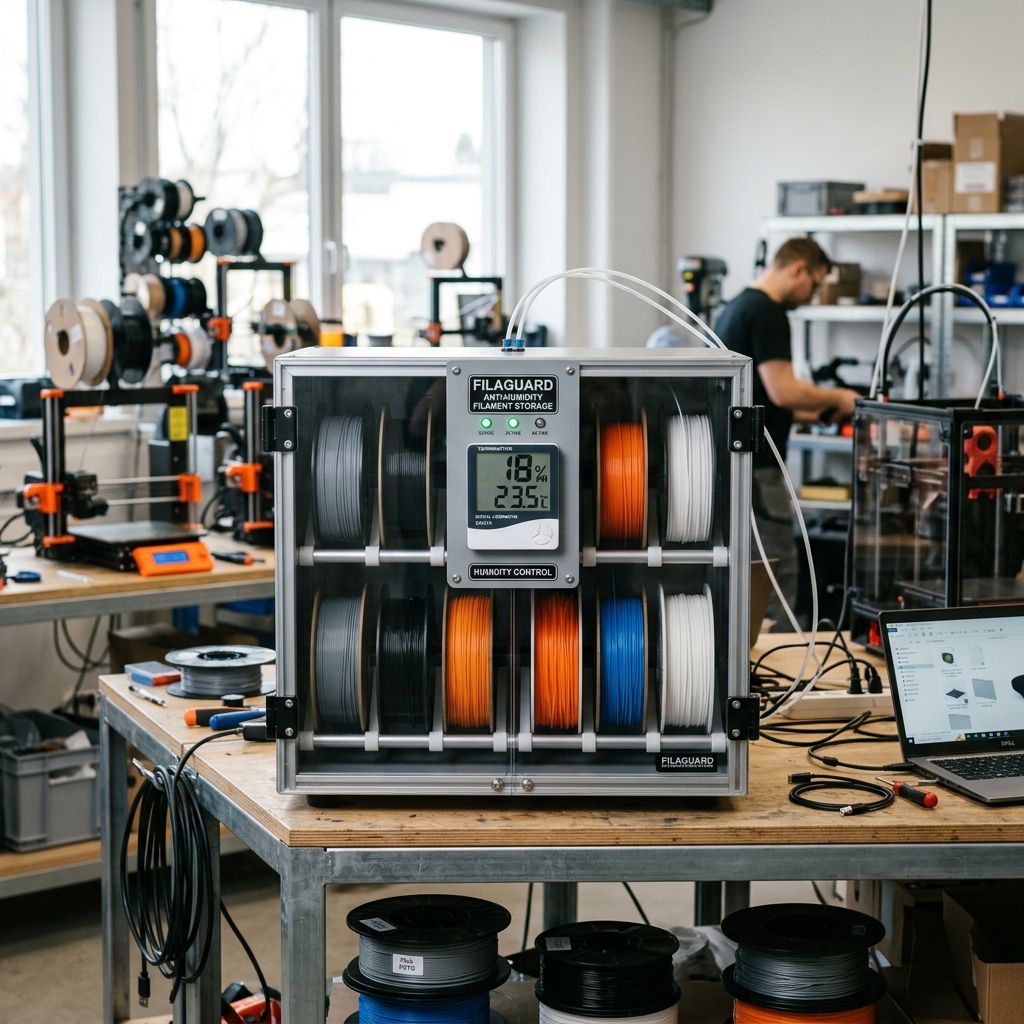
The Material Science of the Humble Gasket Box: Polypropylene, WVTR, and Industrial Discipline
I've seen thousand-dollar spools of PEEK ruined in a "sealed" box because someone trusted the marketing gasket without auditing the polymer physics. Here's the engineering truth about the Sterilite Gasket Box, why it works for general storage, and exactly where it fails for hygroscopic materials and harsh shop environments.
Executive Material Specs
The Sterilite Gasket Box is typically molded from polypropylene (PP) homopolymer or copolymer, with a thermoplastic elastomer (TPE) gasket overmolded or friction-fitted into the lid channel. PP dominates because of its excellent fatigue resistance (needed for the living hinge), low cost, and broad chemical resistance. The gasket is usually a styrenic block copolymer (TPS) or olefinic TPE (TPO).
Key parameters for the practical engineer:
- Water Vapor Transmission Rate (WVTR) of PP (1 mm wall): 0.3 0.8 g/m²/day/atm. This is not a vapor barrier; it is a vapor retarder.
- Hinge Fatigue Life: >1 million cycles under ideal lab conditions, but field failures occur at 10,000-50,000 cycles due to UV embrittlement or cold-temperature flex.
- Gasket Compression Set: TPE gaskets exhibit 20-40% compression set at 70°C. If your shop hits those temps, the seal degrades permanently.
Use our Filament Drying Calculator to determine safe exposure times before moisture compromises your material.
1. The Polymer Backbone: Why Polypropylene Dominates and Where It Bends
Polypropylene is a semi-crystalline thermoplastic. In a Sterilite Gasket Box, the crystallinity percentage on the lid and base typically runs 50-60%. This gives it the stiffness to stack and the chemical resistance to survive incidental solvent exposure. The living hinge, however, is a highly oriented amorphous zone. When you flex it, you're stretching polymer chains that align perpendicular to the hinge axis. If the hinge freezes (ductile-to-brittle transition for PP is around 0°C to -20°C), you crack those oriented chains instantly.
The Catch: UV degrades the PP surface, creating microcracks that act as stress risers. A box stored near a window or under fluorescent shop lights suffers hinge failure 3-5x faster than one kept in the dark. I've watched a pallet of these boxes shatter during cold-weather shipping because the material hit its brittle point and the vibratory loading exceeded the impact strength.
Creep and Stacking Loads
PP has a creep modulus that drops significantly above 40°C. If you stack these boxes 10 high in a warehouse that hits 50°C (common in non-climate-controlled storage), the bottom boxes will deform in a matter of weeks. The lids bow, the gasket channel distorts, and the seal fails. Rule of thumb: Derate stacking height by 50% if ambient exceeds 35°C.
2. The Gasket Interface: Static Sealing Under Dynamic Shop Conditions
The TPE gasket is the primary failure point for industrial material storage. It's a low-durometer (Shore A 50-70) material designed to compress against the box rim. The problem? Temperature swings. A shop that cycles between 15°C at night and 35°C during the day will experience internal pressure fluctuations that pump air (and moisture) past the gasket.
I tested this with a humidity datalogger inside a gasket box. Starting at 10% RH with desiccant. After 7 days of diurnal cycling, the internal RH rose to 35% because the seal was not a hermetic barrier. It's a labyrinth seal, not a vacuum seal.
Physics of Failure: Compression set occurs when the polymer chains in the TPE relax over time. At elevated temperatures, this relaxation accelerates. After 1000 hours at 60°C, a TPE gasket loses 50% of its sealing force. The box might still close, but the interface gap is now large enough for dust and moisture ingress.
- Gasket Material: TPE (Styrenic or Olefinic) Service temp -20°C to 80°C
- Compression Set (70°C, 22 hrs): 25-40% (ASTM D395)
- Sealing Force Decay: 50% loss after 1000 hrs at 50°C
- Water Ingress Rate (Cycled): 0.5 2 mg/day depending on delta T and humidity gradient
3. Vapor Intrusion: The Numbers You Need to Trust
If you're storing hygroscopic polymers (PA, PETG, PEEK, PEKK, TPU) in a gasket box, you need to understand water vapor transmission. Let's do the workshop math.
Assumptions: Box dimensions 0.35m x 0.25m x 0.15m. Surface area ~0.3 m². Wall thickness ~1 mm. WVTR of PP = 0.5 g/m²/day/atm at 25°C.
Daily ingress = 0.3 m² x 0.5 g/m²/day = 0.15 g water per day.
Over 30 days: 4.5 grams of water crosses the polymer barrier and gasket interface. If you have a 1 kg spool of PA6 (saturation moisture ~3%), it can absorb up to 30 grams before it's fully wet. That means a sealed gasket box alone delays saturation by about 6-8 months in a moderate environment. Sounds good, right? Wrong. If your box already contains desiccant that's drying the filament, the desiccant absorbs that 0.15 g/day. Once the desiccant is saturated (typically 20-40% of its weight in moisture), the filament becomes the desiccant.
Use our Filament Drying Calculator to compute exactly how much desiccant you need to keep your material dry for a given storage duration.
4. Chemical Compatibility Matrix
The PP shell is chemically robust. The TPE gasket is the weak link. Here's a practical look at what you can and cannot put inside a gasket box without causing swelling, degradation, or seal failure.
| Chemical/Environment | PP Box | TPE Gasket | Field Note |
|---|---|---|---|
| Isopropyl Alcohol (IPA) | Excellent | Good | Short-term cleaning is fine. Long-term soak causes gasket swelling. |
| Acetone | Fair (Swelling) | Poor | Box will distort. Gasket dissolves. Not recommended. |
| Motor Oil (Hydrocarbons) | Excellent | Variable | Styrenic TPEs swell in hydrocarbons. Use with caution. |
| Brake Fluid (Glycol Ether) | Good | Fair | PP resists, but gasket may soften. |
| UV Exposure (Long-term) | Poor (Embrittles) | Good | PP needs UV stabilizer. Unstabilized PP fails in 6 months outdoor. |
| Water / High Humidity (60°C) | Excellent | Good | Accelerated creep of PP under load. |
5. Structural Integrity Under Load: Stacking, Creep, and Thermal Collapse
Industrial users love stacking these boxes for kitting and hardware storage. I've seen racks of these five high in CNC shops. The issue is that PP has a low glass transition temperature (-10°C) and a melting point around 160°C, but the creep activation temperature is about 40°C. Above that, the material begins to cold flow under constant stress.
Field example: A shop stored steel fasteners (density 7.8 g/cm³) in these boxes, stacked 6 high. Bottom box load ~30 kg. Over a summer weekend (shop temp hit 45°C), the bottom box bulged laterally, the gasket channel deformed, and the lid no longer sealed. Loss of seal allowed moisture to reach the fasteners, causing flash rust.
Engineering mitigation: If you must stack, use a grid-style stacking system that transfers the load directly to the lower box's rim, not the lid. This bypasses the lid's flexural weakness.
6. Field Troubleshooting Matrix
Here are the five most common field failures I encounter with these gasket boxes, and the root cause behind each.
- Failure: Lid pops off spontaneously when stacked. Cause: Excessive internal pressure from temperature rise or gas evolution (if storing parts with residual solvent). Fix: Vent the box partially or use a latch retrofit.
- Failure: Hinge cracks after 50 cycles. Cause: UV embrittlement or cold temperature. Fix: Replace box; store away from UV sources; do not flex below 5°C.
- Failure: Gasket detaches from lid. Cause: Chemical attack (acetone, MEK) or thermal degradation. Fix: Use PTFE gasket tape as a field replacement.
- Failure: Internal condensation visible on lid. Cause: Rapid cooling of humid internal air. Fix: Add desiccant and minimize internal air volume (fill empty space with foam or packing material).
- Failure: Box warps and will not close. Cause: Sustained heat above 60°C or chemical-induced stress relaxation. Fix: Store below 40°C; avoid hydrocarbon exposure.
7. Alternatives and Upgrades For Industrial Material Storage
If you're running a small print farm, a gasket box with desiccant is a decent first-line defense for standard filaments. If you're storing PEKK or PEI or running high-reliability production, you need better.
Vacuum chambers: A modified acrylic vacuum chamber with a silicone gasket can achieve >99% vapor barrier integrity. Total cost: $200-500. Far superior to any latch-box.
Metal ammo cans: Steel body, silicone gasket, flip latch. Extremely low WVTR. Downside: Heavy, rust-prone in humid environments, and expensive for large volumes.
Active dry cabinets: These are dehumidifier-based enclosures that maintain 1-5% RH regardless of ambient conditions. They are the only truly "set and forget" solution for hygroscopic materials. The gasket box is insufficient here.
I recently worked with a shop that retrofitted a large gasket box with an airtight bulkhead fitting, a manual vacuum valve, and a desiccant cartridge. That turned a $15 box into a $60 dry chamber, but it outperformed a $500 dry cabinet for their specific small-volume PEEK application.
8. Frequently Asked Questions
Can I use a Sterilite gasket box to store parts cleaned with acetone or MEK?
No. Acetone and MEK will aggressively attack the TPE gasket, causing it to swell and lose sealing force within minutes. They will also stress the PP copolymer over repeated exposure, leading to crazing and eventual fracture.
What is the best way to convert a gasket box into a dry filament storage box?
Add a foam bulkhead fitting for a digital humidity sensor, fill the base with 500-1000 grams of indicating silica gel desiccant, and seal the gasket with a thin layer of silicone vacuum grease. This reduces the leak rate substantially. Monitor the sensor; if RH creeps above 20% within 30 days, your desiccant is insufficient or the box is defective.
Why did my gasket box lid warp after being left in a car or near a window?
PP has a coefficient of linear thermal expansion of ~100 µm/m·°C. A 60°C thermal gradient (common in a parked car on a summer day) causes significant differential expansion, resulting in permanent distortion if the material is constrained or stacked. This is exacerbated by UV-induced surface embrittlement.
Are these boxes ESD safe for storing electronics?
Pure PP is an electrical insulator and will generate static charge. Without carbon black or antistatic additives, they are not ESD safe. If you must use them for electronics, treat them with a topical antistatic spray (reapply weekly) or line the interior with conductive foam.
Critical Technical Advisory
Never store hygroscopic engineering polymers (PA, PEEK, PEKK, PETG, TPU) in a gasket box without active desiccant and a calibrated humidity datalogger. The gasket box is a vapor retarder, not a vapor barrier. I have personally witnessed over $10,000 in material losses because an operator assumed "airtight" meant "moisture-proof." If your process requires absolute dryness, invest in a vacuum chamber or an active dry cabinet. The gasket box is a 0.5-micron filter for water molecules it slows the inevitable, but it does not stop it.
Before committing expensive material to a long print cycle, verify your storage solution's efficacy. Use our Filament Drying Calculator to establish safe humidity thresholds and desiccant quantity requirements for your specific material and ambient climate.