PrusaSlicer vs OrcaSlicer vs Cura: Industrial Slicing Engine Architecture, Toolpath Kinematics, and Batch Production Benchmarks

* Affiliate Disclosure: We may earn a commission from qualifying purchases made via our verified links at no additional cost to you.

The Industrial Maker is reader-supported. When you purchase equipment, parts, or materials through links on our site, we may earn an affiliate commission at no additional cost to you.
PrusaSlicer vs OrcaSlicer vs Cura: Industrial Slicing Engine Architecture, Toolpath Kinematics, and Batch Production Benchmarks
1. The Slicing Engine as a CAM Compiler: Architectural Fundamentals
In high-throughput additive manufacturing workcells, the slicer is not merely a geometric converter; it functions as an advanced computer-aided manufacturing (CAM) post-processor and trajectory compiler. Modern fused filament fabrication (FFF) demands that slicing software calculate continuous velocity profiles, compensate for viscoelastic polymer relaxation, generate adaptive volumetric extrusions, and mitigate stepper motor resonance.
The contemporary landscape is dominated by three primary platforms: PrusaSlicer (developed by Prusa Research, branched from Slic3r), OrcaSlicer (an open-source fork combining Bambu Studio and PrusaSlicer features), and UltiMaker Cura (built upon the Python-based Uranium engine with the C++ CuraEngine). While consumer evaluations often center around graphic interface themes and default cloud profiles, mechanical and automation engineers must scrutinize memory allocation under 5,000,000+ polygon meshes, spatial precision of perimeter arc fitting (G2/G3 commands), and command-line interface (CLI) execution for headless automation clusters.
Recommended Hardware: PrusaSlicer
Check real-time stock levels, current pricing tiers, and manufacturer warranty directly on Amazon:
View on Amazon • Check Live Price →2. Toolpath Generation Algorithms, Arachne Perimeter Engine, and Corner Dynamics
One of the most consequential algorithmic advances in FFF slicing was the development and adoption of the Arachne engine. Developed initially by Cura and subsequently rewritten and optimized into C++ within PrusaSlicer, Arachne dynamically varies extrusion width to fill thin walls without creating high-frequency gap-fill micro-oscillations.
MATHEMATICAL KINEMATICS & PRESSURE ADVANCE FORMULAS
Toolhead velocity transitions along segmented polygon toolpaths require precise corner jerk/junction deviation compensation. Under classic trapezoidal velocity profiling, the transition speed across a directional angle is bounded by junction deviation :
Simultaneously, viscoelastic melt flow within the nozzle lag behind extruder drive gear rotation. Modern linear and pressure advance implementations govern volumetric extrusion advance according to the first derivative of velocity:
Where is the empirical pressure advance coefficient (s), and is the instantaneous toolhead acceleration vector. At rapid accelerations (), PrusaSlicer and OrcaSlicer maintain tight synchronization between look-ahead path buffers and stepper driver pulses, preventing corner bulging and seam voids.
PrusaSlicer implements an advanced perimeter generation hierarchy: external perimeters are prioritized with a steady-state velocity profile to eliminate surface gloss variances caused by thermal fluctuations. Cura employs a comparable wall overlap compensation algorithm, but its memory overhead increases exponentially when processing non-manifold CAD topology. To calibrate your own toolpath geometry, calculate specific layer resolutions via our Layer Height Calculator and tune travel dynamics using the Print Speed Calculator.
3. Volumetric Flow Limits, Viscous Shear Rate, and Hotend Backpressure Modeling
A frequent root cause of mechanical failure in high-speed FFF production is attempting to slice beyond the thermal dissipation capacity of the hotend block. When linear speeds exceed 250 mm/s on a 0.4 mm or 0.6 mm nozzle, the transit residence time of the thermoplastic filament inside the heated melt zone drops below the threshold required to achieve full polymer core melting.
PrusaSlicer and OrcaSlicer solve this through deterministic volumetric speed limiting (). Rather than allowing arbitrary feedrates, the engine dynamically clamps linear print velocity across every toolpath segment according to the physical limit of the melt zone:
For example, when using high-viscosity carbon-reinforced nylon (PA-CF) with an empirical ceiling of , printing with a 0.60 mm line width and 0.28 mm layer height automatically restricts maximum linear velocity to , irrespective of global speed settings. Cura manages this via "flow equalization" settings, but lacks a strict volumetric cap override within its core filament profile hierarchy. Verify and compute your workcell limits with our dedicated Flow Rate Calculator.
4. High-Speed Tooling: Input Shaping, Arc Fitting, and Resonance Calibration
With CoreXY kinematics now operating routinely at 300 to 500 mm/s, slicers must actively minimize G-code file size and serial communication bandwidth. A standard 0.1 mm faceted curve sliced without optimization generates thousands of discrete linear G1 micro-moves per second, causing serial buffer starvation in 8-bit and early 32-bit motion controllers.
- Native Arc Fitting (G2/G3): PrusaSlicer incorporates ArcWelder logic natively within its post-processing core. It evaluates sequences of linear moves that share a common radius within a tolerance of ±0.012 mm and compresses them into bidirectional circular arc vectors (G2 clockwise, G3 counter-clockwise). This reduces G-code file footprints by 40% to 70% and stabilizes controller look-ahead buffers.
- OrcaSlicer Calibration Suite: OrcaSlicer excels in integrated engineering calibration routines. Without relying on third-party test prints, it generates parameterized G-code scripts for volumetric flow sweeps, vertical fine artifact (VFA) frequency scans, temperature towers, and retraction stress tests directly from the top navigation bar.
- PrusaSlicer Pressure Advance Sweeps: PrusaSlicer provides granular material-level override tables. It allows engineering users to define distinct linear advance coefficients (-factors) per filament profile, ensuring that when switching from rigid PLA to high-viscosity PA-CF, the firmware buffer automatically updates without reflashing EEPROM registers.
- Cura Plugin Ecosystem: Cura relies heavily on the Cura Marketplace and Python plugins. While tools like "Linear Advance Tool" and "TabAntiWarping" provide flexibility, external dependencies frequently break across major engine updates, posing operational risks for certified manufacturing cells.
WORKSHOP CAVEAT: G2/G3 ARC FITTING WITH INPUT SHAPER FIRMWARE
While G2/G3 arc commands relieve microcontroller serial communication overhead, certain modern Klipper and RepRap firmware releases deconstruct arc commands back into linear micro-segments prior to applying finite impulse response (FIR) input shaping filters. Slicing with excessive chordal tolerance (>0.05 mm) can introduce polygon stepping that bypasses resonance compensation, leading to visible surface micro-banding.
5. Support Generation Mechanics: Organic / Tree Supports vs Soluble Interfaces
Post-processing labor accounts for up to 35% of total part manufacturing cost in industrial additive workcells. Slicer support geometry directly dictates support material consumption, print duration, and surface roughness () at detachment points.
PrusaSlicer pioneered the high-performance implementation of Organic Supports based on the tree support paradigm. Using skeletonization and Dijkstra path algorithms, it generates hollow, branching tubular structures that navigate complex undercuts and contact the part at discrete nodal contact points.
- Interface Layer Spacing: PrusaSlicer allows independent configuration of upper and lower Z-contact distances with sub-0.05 mm precision. Setting a Z-distance of 0.20 mm with zero horizontal offset when slicing with PETG interfaces allows clean manual detachment without leaving burrs.
- Soluble Multi-Material Support: For parts with enclosed interior channels or fluid manifolds, PrusaSlicer provides advanced wipe-tower volume purging. It synchronizes filament purges during toolhead swaps between engineering structural polymers (e.g., PA-CF) and soluble support polymers (e.g., BVOH or PVA).
- OrcaSlicer Tree Support Hybrids: OrcaSlicer introduces hybridized tree-hybrid and tree-slim modes, reducing support cycle times by an additional 12% to 18% compared to standard tree implementations, though tall slender branches are more prone to mechanical resonance deflection during high-acceleration toolhead passes.
For estimating support material allocation and post-processing cost ratios across production runs, utilize our Supports Calculator.
6. Slicing Engine Architectural Comparison Matrix
The following engineering comparison matrix evaluates PrusaSlicer, OrcaSlicer, and UltiMaker Cura across fundamental software parameters, kinematics handling, and production readiness:
| Technical Capability | PrusaSlicer (v2.8+) | OrcaSlicer (v2.1+) | UltiMaker Cura (v5.8+) |
|---|---|---|---|
| Core Architecture | C++ Slic3r rewrite with wxWidgets UI | C++ Fork of Bambu Studio / PrusaSlicer | Python 3 UI (PyQt) + C++ CuraEngine |
| Perimeter Engine | Optimized Arachne Engine (C++) | Arachne Engine with Custom Seam Tuning | Native Arachne Engine (Original) |
| Native Arc Fitting (G2/G3) | Integrated (ArcWelder Core) | Integrated (ArcWelder Core) | External Plugin Required (ArcWelder) |
| Calibration Suites | Manual test prints & parameter tables | Full built-in calibration workbench | Community plugins (AutoTowers, etc.) |
| Headless CLI Batch Slicing | Native, robust prusaslicer --export-gcode |
Supported via command line options | Complex CLI interface via CuraEngine binary |
| Farm Management Integration | Prusa Connect, OctoPrint, Repetier, Klipper | OctoPrint, Moonraker/Klipper, Bambu LAN | UltiMaker Digital Factory, OctoPrint |
| Memory Footprint (5M Polygons) | Low (~850 MB RAM peak during slicing) | Moderate (~1.1 GB RAM peak) | High (~2.4 GB RAM, UI stutter under dense mesh) |
| License & Governance | GNU AGPLv3 (Prusa Research backing) | GNU AGPLv3 (Community driven) | LGPLv3 (UltiMaker commercial backing) |
7. Enterprise Automation: Headless Batch Slicing & Farm Workflows
For manufacturing environments scaling beyond ten 3D printers, manual GUI slicing introduces human error and creates severe throughput bottlenecks. Automating toolpath generation through server-side batch pipelines is where PrusaSlicer demonstrates unmatched architectural superiority.
PrusaSlicer can be compiled or executed in completely headless mode without initializing the X11 or Wayland graphics stack. It accepts comprehensive command-line arguments to ingest raw STEP/STL geometry, apply pre-validated configuration profiles, execute toolpath compilation, and export optimized G-code directly into farm dispatch queues:
HEADLESS SCRIPTING ARCHITECTURE
# Automated production slicing command in Linux batch container:
prusaslicer \
  --export-gcode \
  --load /etc/slicer/profiles/pa_cf_high_strength.ini \
  --layer-height 0.20 \
  --infill-distribution 0.35 \
  --fill-pattern gyroid \
  --support-material \
  --support-material-auto organic \
  --output /var/spool/gcode/production_batch_402.gcode \
  /var/spool/models/structural_bracket_v4.step
This deterministic behavior enables clean integration into web applications, automated quotation portals, and continuous manufacturing ERP pipelines. Slices are mathematically identical every time, eliminating configuration drift between design engineers.
For detailed strategies on optimizing G-code parameters for high-temperature composites, review our technical study on PrusaSlicer Advanced Production Profiles and Mesh Tolerances as well as our guide to Bambu Lab X1-Carbon & X1E Hardware Architecture.
8. The Engineering Verdict: Which Slicer to Standardize On?
Standardizing a manufacturing shop on a single slicing platform reduces operator retraining and guarantees repeatable mechanical tolerances across high-volume production cycles:
- Standardize on PrusaSlicer if your shop prioritizes bulletproof reliability, open-source auditability, headless automation pipelines, and diverse hardware mixed between Prusa, Voron, Creality, and custom industrial FFF machines. Its lightweight memory profile and robust STEP file parsing make it the undisputed backbone for enterprise workcells.
- Standardize on OrcaSlicer if your fleet primarily consists of Bambu Lab hardware, high-acceleration Klipper CoreXY machines, and you require fast daily calibration of pressure advance and volumetric flow limits directly on the shop floor without external software.
- Standardize on UltiMaker Cura if your facility relies on UltiMaker S-series hardware, requires deep integration with UltiMaker Digital Factory, or depends on specialized community post-processing scripts not yet ported to C++ engines.
Related Intel
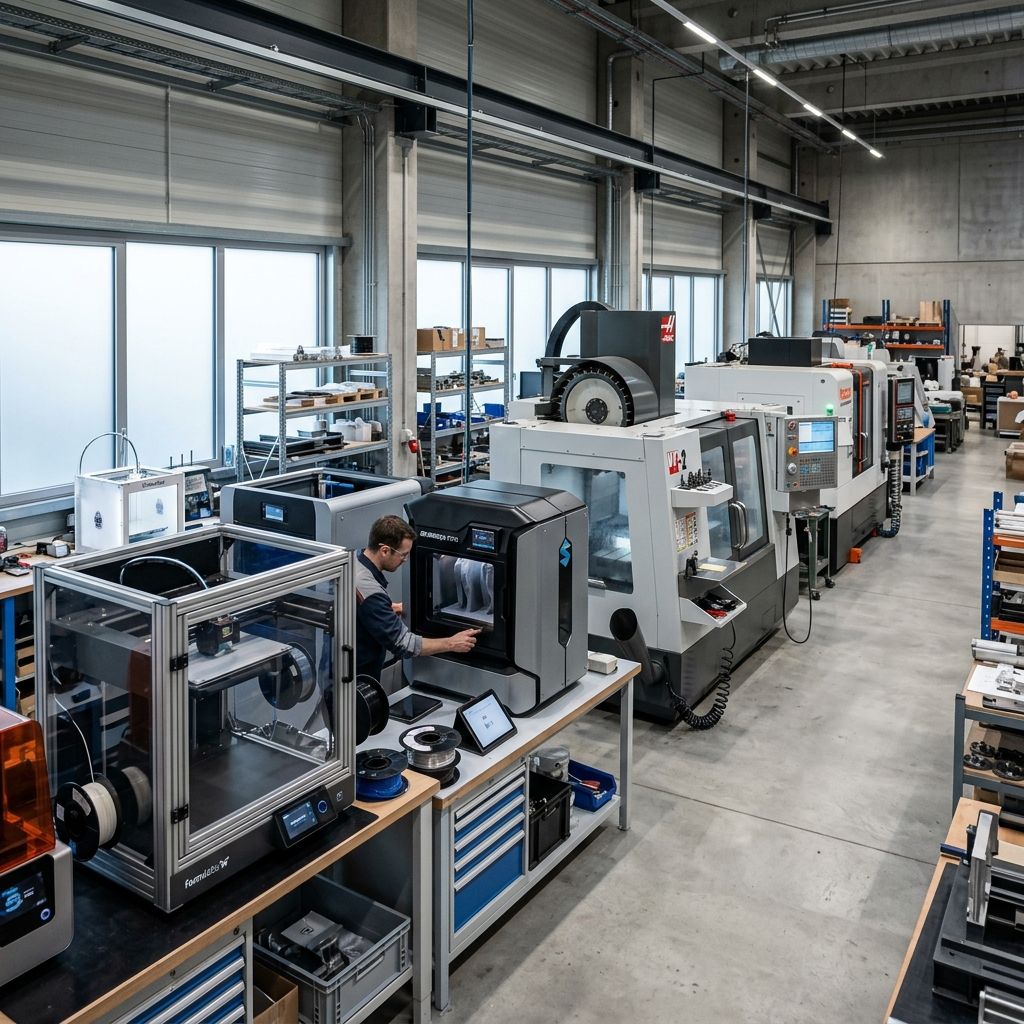
Original Prusa MK4S vs Prusa MK4: High-Flow Extrusion, Cooling Dynamics & Workcell ROI Comparison
An engineering-grade head-to-head evaluation between the Original Prusa MK4 and the enhanced Original Prusa MK4S. With the integration of a custom 360-degree high-pressure turbine cooling shroud, a high-flow nozzle architecture boosting volumetric throughput to 24 mm³/s, and native Wi-Fi/NFC integration, the MK4S redesign targets the critical thermal bottlenecks of high-speed FDM production. This exhaustive benchmark evaluates thermodynamic cooling curves, bridge overhang deflection, mechanical resonance damping via accelerometer-tuned Input Shaping, and total workshop unit economics, revealing whether retrofitting existing MK4 fleets with the S-upgrade delivers genuine operational payback for commercial rapid prototyping workcells.
Bambu Lab X1-Carbon vs X1E: Slicer Ecosystem, Network Security & Industrial Performance Comparison
In this head-to-head industrial evaluation, we dissect the Bambu Lab X1-Carbon and X1E across mechanical capabilities, thermal regulation, and slicing software ecosystems (Bambu Studio Enterprise vs. OrcaSlicer vs. LAN-only mode). While both machines share a 256x256x256 mm build envelope and CoreXY kinematics capable of 500 mm/s linear velocity, the X1E introduces active 60°C chamber heating, an upgraded 320°C hotend, WPA2-Enterprise Wi-Fi, and a physical RJ45 Ethernet port. This analysis evaluates layer adhesion shear strength (tau = F / A_contact) under active chamber soak, calculates operational amortization through our workshop cost model, and delivers a rigorous engineering verdict on whether the X1E's industrial price premium delivers measurable ROI for aerospace and automotive engineering prototyping.
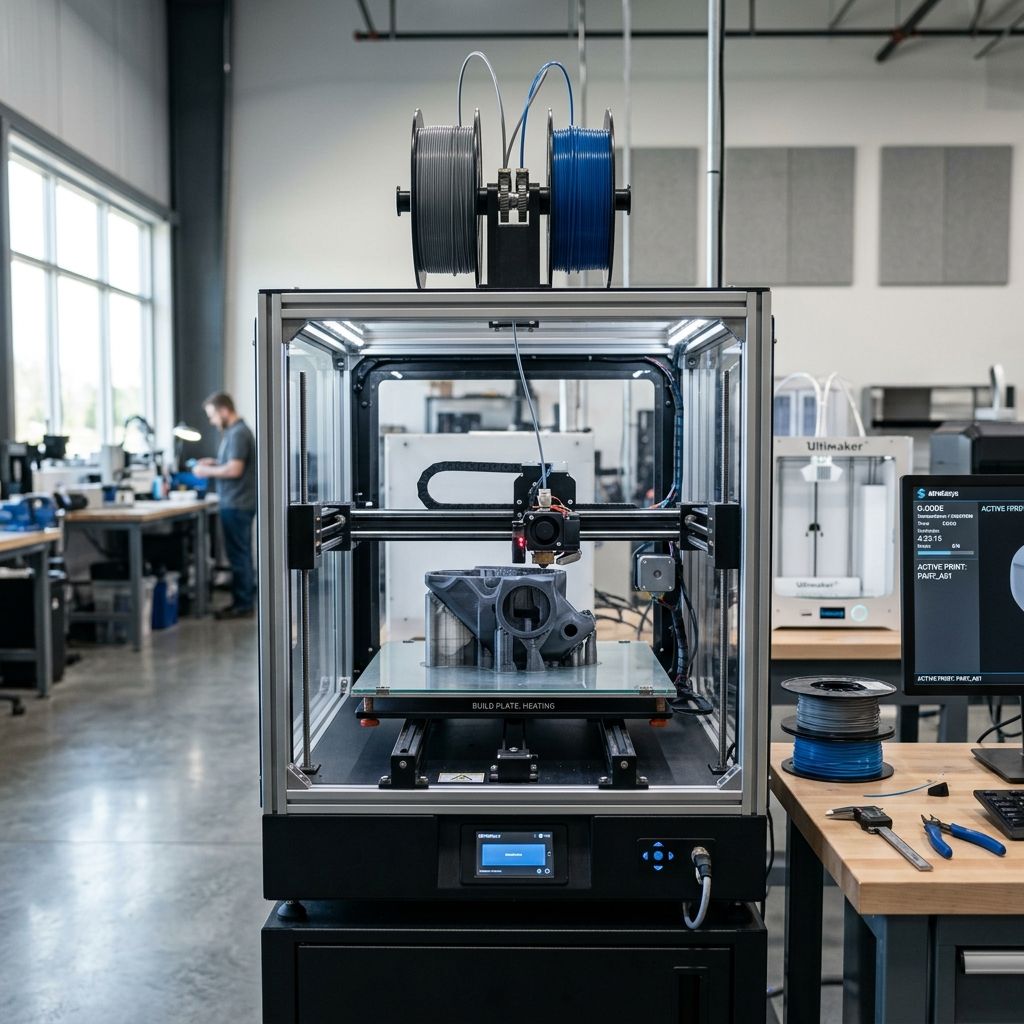
Bambu Lab P1S vs P1P: Slicer & Hardware Comparison
Head-to-head engineering and software evaluation of the Bambu Lab P1S versus P1P CoreXY 3D printers. Analyzes enclosure thermal equilibrium thermodynamics, MC board auxiliary cooling, high-temperature composite processing (ABS, ASA, PA-CF), and software ecosystem differences across Bambu Studio, OrcaSlicer, and PrusaSlicer. Features an exhaustive workshop ROI model, failure rate metrics, and a definitive procurement verdict for commercial prototyping shops.