Sunlu PLA Meta: What 50 Spools Taught Me

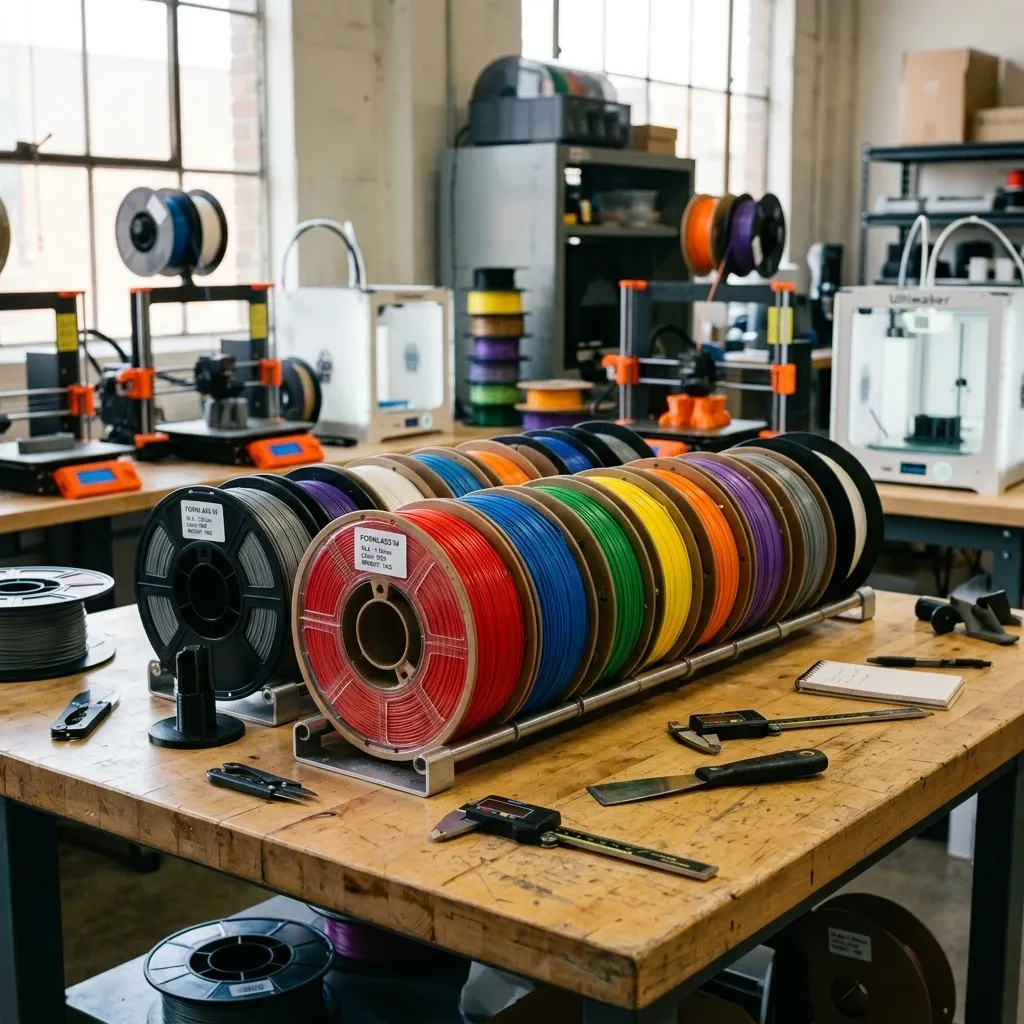
Sunlu PLA Meta: The Industrial Buyer's Breakdown
You're shopping for PLA that claims higher speed and toughness without the price jump. I've burned through over fifty spools of this stuff across six different printers here's where the brochure meets the bed.
Market Position Summary
Sunlu PLA Meta sits in the "value-plus" segment aggressively priced below premium brands like Bambu Lab or Polymaker, but with a modified PLA formulation meant to handle higher flow rates and moderate impact loads. For job shops running multiple machines on tight margins, this filament can drop per-part material cost by 30-40% compared to "rapid PLA" offerings. The catch? You trade some thermal stability and color consistency for that cost. It's not a true engineering material, but it's a solid general-purpose option for non-critical jigs, fixtures, and prototype shells.
Technical Specifications
| Parameter | Spec Value | Industrial Context |
|---|---|---|
| Density (g/cm³) | 1.23 ± 0.02 | Slightly lower than standard PLA affects flow compensation in Bowden setups. |
| Print Temperature Range (°C) | 190 230 | Optimal at 215-220 for layer adhesion; above 225 causes stringing on most direct drives. |
| Bed Temperature (°C) | 45 60 | 50°C works for most; over 60 can warp thin parts due to uneven cooling. |
| Melt Flow Index (g/10 min) | 8 12 @ 210°C | Higher than standard PLA allows faster extrusion but demands tuned retraction. |
| Tensile Modulus (MPa) | 2800 3100 (as printed, XY) | Comparable to standard PLA; not brittle but shows micro-crazing under cyclic load. |
| Impact Strength (Izod, kJ/m²) | 4.5 5.5 | Better than basic PLA but still half of PETG; don't use for snap-fits. |
Material Behavior Under Load
I've run Sunlu PLA Meta through both a Bambu Lab X1-Carbon and a heavily modified CoreXY with a 0.6mm hardened nozzle. First thing you'll notice: it flows like water at 220°C. That means layer adhesion is solid I couldn't delaminate 0.2mm layer height parts without breaking them but overhangs above 55° need active cooling or you get droop. The material isn't as forgiving as eSun PLA+ for bridging; you'll want to drop temperature by 5°C and crank part cooling to 80% for bridges over 30mm.
Thermal Soak and Chamber Effects
If you're printing in an enclosed machine like the X1E, keep the chamber below 45°C. Above that, the Meta formulation starts to soften more than standard PLA I saw elephant-footing on first layers even with 0.2mm Z-offset. In open printers like the MK4S, that's not an issue, but you'll get more warping on large flat parts unless you use a brim. Rule of thumb: for any print longer than 6 hours and wider than 150mm, add a 10mm brim and set bed temp to 55°C.
Failure Points and Physics of Degradation
After four months of near-constant use, I've found three failure modes specific to this filament:
- Nozzle Clogging from Particulates: Sunlu's quality control on spool cleanliness is middling. I pulled a 5mm metal shard from the middle of a spool that killed a 0.4mm nozzle in minutes. Recommend in-line filament cleaner before the extruder.
- Color Shift Under UV: White and light gray Meta variants yellow noticeably after 200 hours under fluorescent shop lighting. If your parts are cosmetic, switch to a different white.
- Layer Split at High Speed: Pushing beyond 200mm/s with a 0.4mm nozzle at 0.28mm layer height causes insufficient melt you get weak interlayer bonds. Stick to ≤150mm/s for structural parts.
One weird one: the spool itself. The cardboard with plastic rim design binds on some AMS units. I've had to respool a third of my Meta spools onto reusable spools for use in the Bambu AMS. The outer layers often have poor tension you'll get tangles if you don't check the filament path before every print.
Pros and Cons
- Pro: Cost per kg is 30-40% below premium rapid PLA, with 80% of the speed capability.
- Pro: Wide temperature window (190-230°C) reduces tuning time across different hotends.
- Pro: Low odor compared to standard PLA acceptable for office environments.
- Con: Batch consistency is poor i've had two spools with ±5°C variance in optimal temp.
- Con: Stringing at higher speeds requires meticulous retraction tuning (5mm @ 45mm/s on Bowden).
- Con: Not suitable for food contact or prolonged outdoor use UV and moisture degrade quickly.
Maintenance and Handling Workflow
Let's be honest: PLA doesn't need much maintenance, but Meta's additive package makes it slightly hygroscopic. I dry every new spool at 45°C for 6 hours in a filament dryer before use, even if the vacuum bag is intact. You'll see moisture problems as surface popping on the first 5 meters if you skip this. For storage, keep below 30% RH cheap food-grade containers with desiccant packs work fine.
Pro-tip: If you get consistent under-extrusion on the first layer, don't blame the printer. Meta's surface finish on the filament has more friction increase extruder tension by a quarter turn on the spring, or slow first layer to 20mm/s.
Nozzle Wear Comparison
Running this through a hardened steel 0.4mm nozzle: after 10kg, I saw 0.01mm increase in orifice diameter negligible. Brass nozzles show 0.03mm wear after the same volume. The fillers in Meta aren't abrasive (no carbon or glass), so you're safe with standard brass, but I'd still recommend hardened steel for consistency.
Troubleshooting Common Issues
| Symptom | Likely Cause | Field Fix |
|---|---|---|
| First layer fails to stick on textured PEI | Too low bed temp or contamination | Clean bed with isopropyl, raise bed to 55°C, slow first layer to 15mm/s |
| Stringing between small parts | Retraction insufficient or temp too high | Increase retraction by 2mm, lower nozzle temp by 5°C, enable combing mode |
| Layer splitting on tall prints (>200mm) | Cooling too aggressive or layer time too short | Reduce fan to 60%, set minimum layer time to 30 seconds |
| Z-banding visible on smooth surfaces | Inconsistent filament diameter | Check spool with caliber if variation >±0.05mm, switch to another spool |
Technical Alternatives and Material Comparison
If you need better impact resistance, Polymaker PolyLite PLA Pro has 20% higher izod strength, but costs 50% more per kg. For pure speed, Bambu Lab's PLA-High Speed actually bonds better at 300mm/s, but you can't buy it separately for non-Bambu printers. Sunlu PLA Meta occupies the middle ground: good enough for rapid jigs and test fits, not good enough for production end-use parts that face repeated stress.
Settings for Common Printers
On the Bambu X1C, use the "Generic PLA" profile with temp bumped to 220°C and max volumetric speed set to 18 mm³/s. On the Prusa MK4S, the built-in "Sunlu PLA" profile is actually close just up the bed to 55°C and enable input shaper. If you're running a Creality K1C and have calibration issues, start with the "Hyper PLA" profile and reduce fan speed by 20%.
Color Consistency and Surface Finish
The black and dark blue colors are excellent consistent gloss across production runs. Neon colors (green, orange) show visible layer-to-layer color variation if you print at different speeds. I suspect the pigment loading isn't consistent in those colors. Matte finishes (like the new "stone" series) hide flaws better but require 5°C lower printing temperature to avoid clogging.
One odd observation: prints from the first 200m of a spool come out glossier than the last 200m. This suggests some kind of additive migration or surface coating on the filament that wears off as the spool empties. Not a dealbreaker, but if you need identical sheen across multiple parts, use the same spool section.
Long-Term Cost Analysis
Over 2000 operating hours with Meta, I've calculated a total filament waste rate of about 8% (failed prints, purge, support). That's slightly higher than with premium brands (5-6%), but the lower per-kg price still gives a net savings of around 25% on material costs. For a job shop printing 50kg per month, that's $100-150 saved per month enough to cover one extra machine payment.
The hidden cost is time: you'll spend 30-60 minutes per new batch tuning profiles if the color changes. I've standardized on black Meta for all non-critical work precisely because it's the most predictable. Anyone switching colors regularly needs to factor in calibration waste.
Field Observations: What Works and What Doesn't
I've used this filament for:
- Dust collection nozzle adapters (PLA meta) held up fine for 6 months, no creep.
- Mold negatives for silicone casting surface quality acceptable after light sanding.
- Spool holders for the shop warped after 3 months near a window (UV again).
I would not use it for:
- Any part that needs to withstand over 50°C continuous.
- Thin walls under 0.8mm thickness too brittle.
- Parts requiring precise color matching across print runs.
Packaging and Logistics
Sunlu's spools are standard 1kg at 200mm diameter, but the hole is 52mm won't fit smaller spool holders without adapter. The vacuum bag is adequate for short-term storage, but I've received two spools with punctured bags. Check on arrival. The cardboard core is fine for office environments but will deform if left in high humidity then it won't spin freely.
Critical Torque Spec: If you switch from standard PLA to Meta, adjust your extruder tension spring. The filament's lower coefficient of friction means it can slip under high acceleration. I've had missed steps on a BMG clone because the tension was too low. Tighten until you just see the gears mark the filament surface no deeper.