Precision Engineering: What to Look for in Industrial-Grade FDM Printers
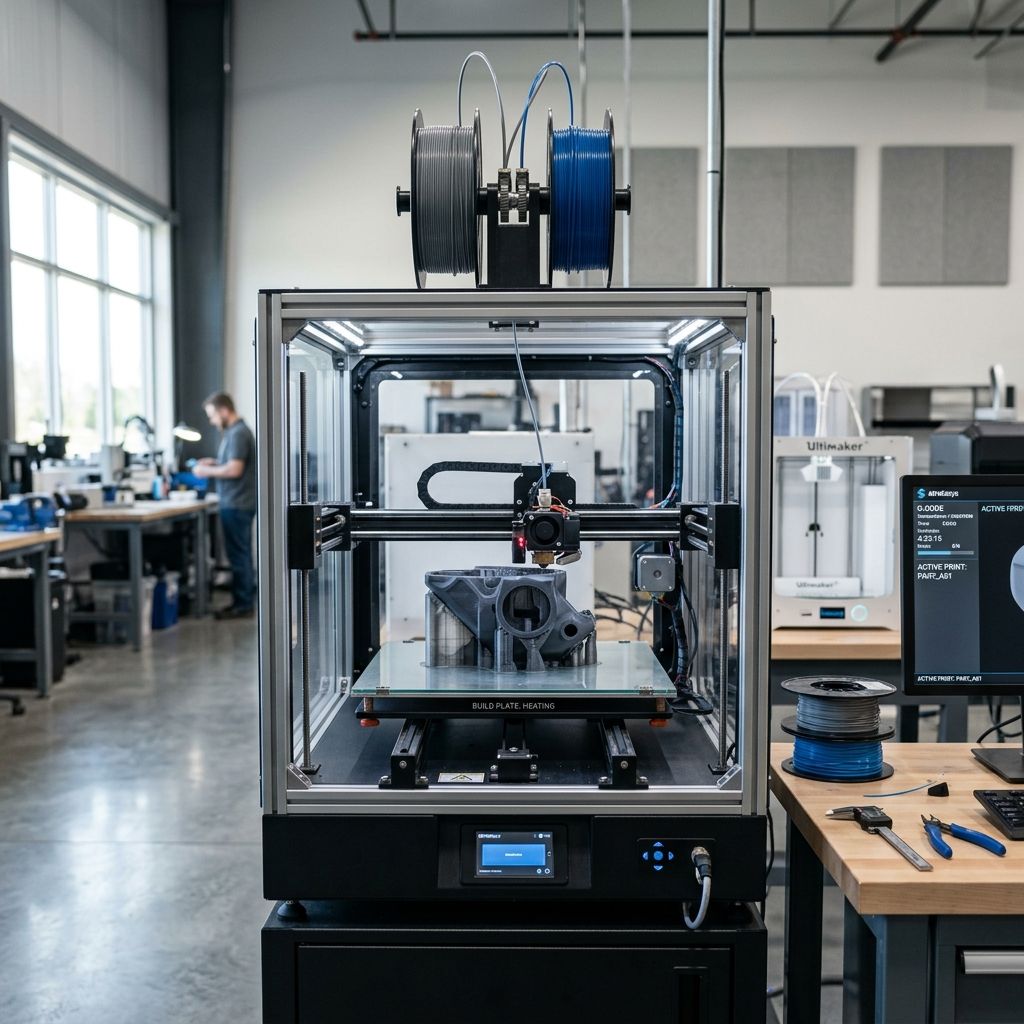
Precision Engineering: What to Look for in Industrial-Grade FDM Printers
Selecting a professional-grade FDM printer requires looking beyond standard speed and build volume specifications. In this guide, we evaluate the architectural benchmarks established by systems like the Bambu Lab X1 series.
Architectural Benchmarks
For high-authority industrial production, the distinction lies in structural resonance compensation and thermal closed-loop systems. A printer is only as good as its ability to maintain micron-level accuracy at maximum acceleration.
1. Motion Systems: CoreXY Rigidity
The transition from i3-style "bed slingers" to CoreXY kinematics is mandatory for industrial accuracy. Carbon fiber rails, as seen in the X1-Carbon, minimize moving mass, allowing for extreme accelerations (up to 20,000mm/s²) without structural flex.
2. Calibration Metrics: AI vs. Manual
Modern industrial design favors automated calibration. Look for systems that utilize LiDAR or high-frequency vibration sensors to automatically calibrate flow rate and pressure advance before every build.
- Vibration Compensation: Essential for eliminating ghosting at speeds >250mm/s.
- AI Failure Detection: Reduces material waste by identifying first-layer adhesion issues.
- Hardened Toolheads: Hardened steel or tungsten nozzles are required for carbon-filled industrial polymers.
Technical Evaluation Matrix
| Standard Feature | Industrial Benchmark | Critical Impact |
|---|---|---|
| Frame Material | Welded/Cast Aluminum Alloy | Structural Rigidity |
| Z-Axis Lead | Precision Lead Screws + Feedback | Dimensional Accuracy |
| Material Chamber | Active Regulation / Filtration | Warp Prevention (PA, PC, ABS) |