Industrializing Desktop AM: Bambu Lab X1-Carbon & X1E
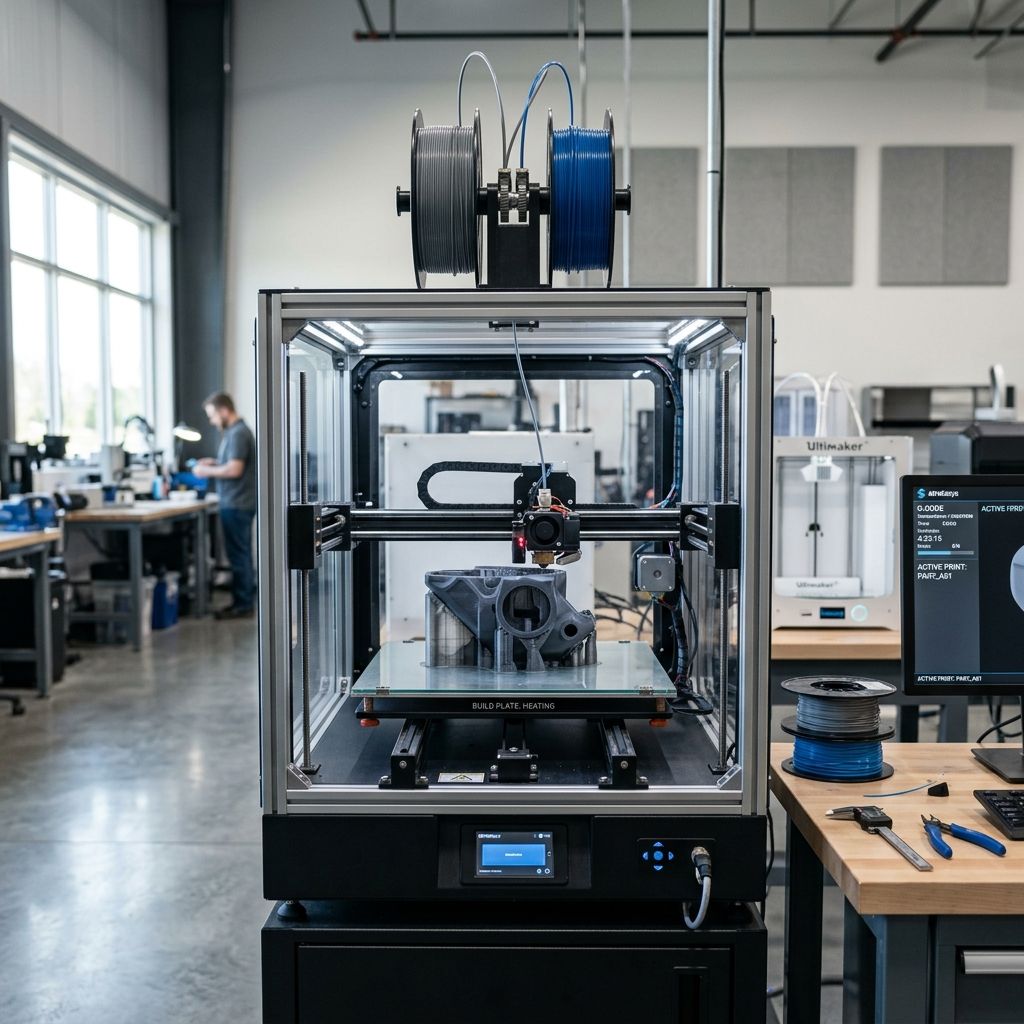
Industrializing Desktop AM: Bambu Lab X1-Carbon & X1E
A strategic consultant's guide to integrating high-speed additive manufacturing into professional engineering workflows and SME production lines.
Business Impact: The ROI of Speed
Transitioning from traditional CNC prototyping to an X1-series fleet yields a quantified reduction in R&D lead times. For a typical industrial design firm, the integration of active chamber heating and automated material management reduces the "idea-to-physical-prototype" cycle from 72 hours to under 8 hours.
- ● Prototype Cost Reduction: 65-80% vs Outsourcing
- ● Iteration Frequency: 4x increase per sprint
- ● Deployment: Zero-config network integration
Architectural Specifications
The hardware dichotomy between the X1-Carbon (X1C) and the X1-Enterprise (X1E) represents a shift from consumer excellence to professional reliability. While the X1C dominates the prosumer market, the X1E introduces critical industrial features: active chamber heating up to 60°C and a refined 320°C nozzle temperature ceiling.
-
Thermal Management
Active chamber heating in the X1E ensures structural integrity for PA-CF and PC, eliminating warp-induced delamination in structural components.
-
Data Security
The X1E features a physical kill-switch for Wi-Fi and supports WPA2-Enterprise, satisfying Tier-1 automotive and aerospace security protocols.
-
CoreXY Kinematics
20,000 mm/s² acceleration rates paired with vibration compensation allow for high-fidelity tolerances at unprecedented speeds.
-
Material Handling
The AMS (Automatic Material System) enables multi-material support structures, critical for complex geometries and internal voids.
-
AI Inspection
Lidar-driven first layer inspection and "spaghetti" detection minimize material waste and machine downtime in 24/7 print farms.
-
Filtering Systems
Enhanced VOC and HEPA filtration ensures the workstation remains compliant with OSHA indoor air quality standards during long ABS/ASA runs.
Technical Implementation: From CAD to Production
For the industrial consultant, the X1-series is not just a printer; it is a node in a decentralized manufacturing network. The software ecosystem (Bambu Studio based on PrusaSlicer) allows for granular control over perimeter density, infill orientation, and adaptive layer heights. When deploying these machines in a professional environment, the focus must shift from "aesthetic success" to "functional repeatability."
Integrating the X1E into a business workflow requires a categorized approach to filament selection. Utilizing the RFID-enabled Bambu filaments allows for automatic calibration, but the true power lies in the open-material system. Engineering-grade filaments such as PA6-CF (Carbon Fiber Reinforced Nylon) or PPS (Polyphenylene Sulfide) can be processed on the X1E with profiles that prioritize dimensional accuracy over raw speed.
| Metric | Traditional CNC | Bambu Lab X1E | Industrial SLA |
|---|---|---|---|
| Setup Time | 4-6 Hours | 15 Minutes | 1-2 Hours |
| Material Cost | High (Waste) | Low (Additive) | Extreme (Resin) |
| Skill Floor | Machinist Level | Designer Level | Technician Level |
| Maintenance | Extensive | Modular/Low | High (Chemicals) |
Professional Workshop Alert: Calibration Protocol
To achieve ISO-compliant tolerances on the X1E, never skip the manual flow rate calibration. While the Lidar-based "Auto-Cal" is revolutionary for prototyping, engineering-grade structural components require a manual pressure advance calibration to account for the unique viscoelastic properties of fiber-filled polymers. Always dry your filaments in a dedicated oven—the internal AMS desiccant is for maintenance, not initial dehydration.
Strategic Conclusion
The Bambu Lab X1-Carbon and X1E represent the "democratization of the factory floor." For an industrial consultant, these tools are force multipliers. They allow designers to fail faster, iterate more cheaply, and produce end-use parts that were previously relegated to high-cost injection molding or CNC machining.
By establishing a localized print farm of X1E units, a business can effectively move from a centralized manufacturing model to an "on-demand" architectural workflow. This is the future of industrial design: high-speed, high-fidelity, and highly automated.