Industrial Technical Specifications and Blueprint Standards
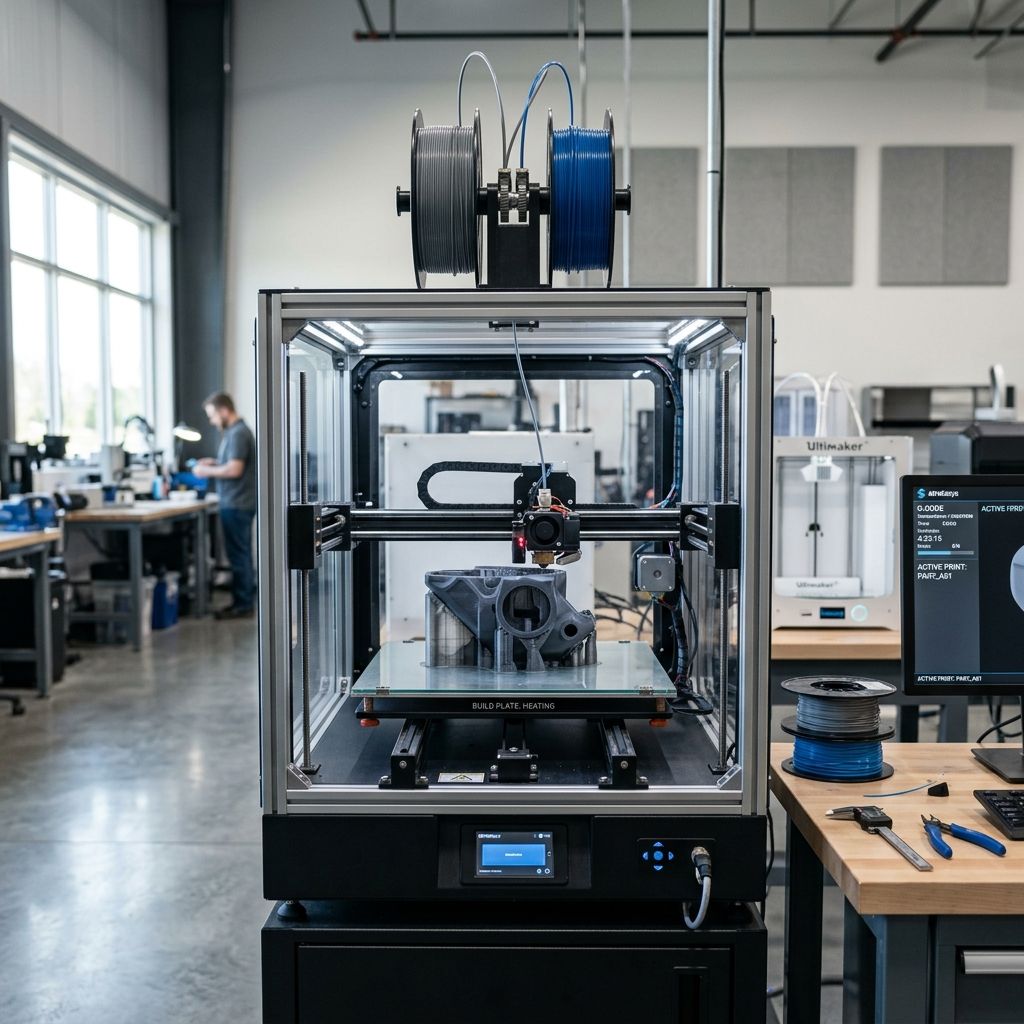
Industrial Deployment: Scaling with Bambu Lab X1C & X1E
Architecting a high-velocity additive manufacturing ecosystem for enterprise engineering and rapid functional prototyping.
In the contemporary industrial landscape, the chasm between conceptual design and functional validation has traditionally been bridged by high-cost, slow-turnaround machining or outsourced SLS/SLA services. The introduction of the Bambu Lab X1-Carbon (X1C) and its enterprise-tier sibling, the X1E, represents a paradigm shift. These systems are not merely printers; they are precision instruments capable of 20,000mm/s² acceleration, effectively collapsing the NPI (New Product Introduction) cycle from weeks to hours.
Business Impact & ROI Metrics
Implementation of X1-series clusters within an R&D department yields immediate quantifiable advantages:
Lead Time Reduction
Reduction of functional prototype turnaround from 10 days (outsourced) to 14 hours (in-house), accelerating design iterations by 85%.
Operational Expenditure
Shift from $400/part outsourcing costs to approximately $18/part internal material and energy cost, achieving machine ROI within 45 operating days.
System Comparison: X1-Carbon vs. X1E
For the industrial consultant, choosing between the X1C and X1E is a matter of network architecture and material sensitivity. While both share the core CoreXY kinematics, the X1E is purpose-built for the high-security engineering environment.
| Technical Feature | X1-Carbon (Standard) | X1E (Enterprise) |
|---|---|---|
| Connectivity | Wi-Fi, Bambu Bus | Ethernet, WPA2 Enterprise, Physical Toggle |
| Chamber Heating | Passive (Radiation) | Active (Up to 60°C) |
| Filtration | Activated Carbon | Grade H13 HEPA + Activated Carbon |
| Hotend Temp | 300°C | 320°C (Industrial Grade) |
Technical Deployment Requirements
To achieve professional-grade reliability and 99% uptime, the following hardware and software stack is mandatory for industrial workflows.
- Material Management The AMS (Automatic Material System) must be utilized for humidity-controlled storage of PA-CF and PPS.
- Security Protocols The X1E requires dedicated LAN-mode configuration to bypass cloud dependencies for IP protection.
- Thermal Stability For the X1E, active chamber heating must be pre-conditioned for 30 minutes prior to printing engineering thermoplastics.
- Data Integration Bambu Studio (Orchestration) and MQTT integration for real-time factory floor monitoring.
Industrial Tutorial: Deploying a Multi-Material Workflow
Phase 1: Engineering-Grade Preparation
Begin by utilizing the X1E’s active chamber heating set to 60°C. This is critical for preventing delamination in large-scale Polycarbonate (PC) or Nylon-Carbon Fiber (PA-CF) components. The thermal gradient must be managed to ensure dimensional accuracy within ±0.1mm—the industrial benchmark for functional assembly.
Phase 2: Automated Validation
Leverage the Micro-Lidar for dual-redundant first-layer inspection. In a business context, "failure" is the most expensive variable. By utilizing the X1-series AI failure detection (spaghetti detection), the operator can manage a fleet of five machines with only 10 minutes of daily manual oversight.
PROFESSIONAL MAINTENANCE TIP: Carbon Fiber reinforced filaments (PA-CF/PET-CF) are highly abrasive. In an industrial setting, the 0.4mm hardened steel nozzle should be treated as a consumable and replaced every 500 printing hours to maintain volumetric flow consistency.
Strategic Conclusion
The transition from legacy FDM systems to the Bambu Lab X1-series ecosystem is not a mere hardware upgrade; it is a strategic architectural shift. For the industrial architect, the X1E offers the necessary security and thermal control required for aerospace and medical applications, while the X1C remains the gold standard for rapid geometric iteration. By deploying these systems, enterprises effectively decentralize their production capabilities, placing the power of a micro-factory directly onto the engineer’s desk.