Bambu Lab X1-Carbon & X1E: Optimizing Industrial R&D
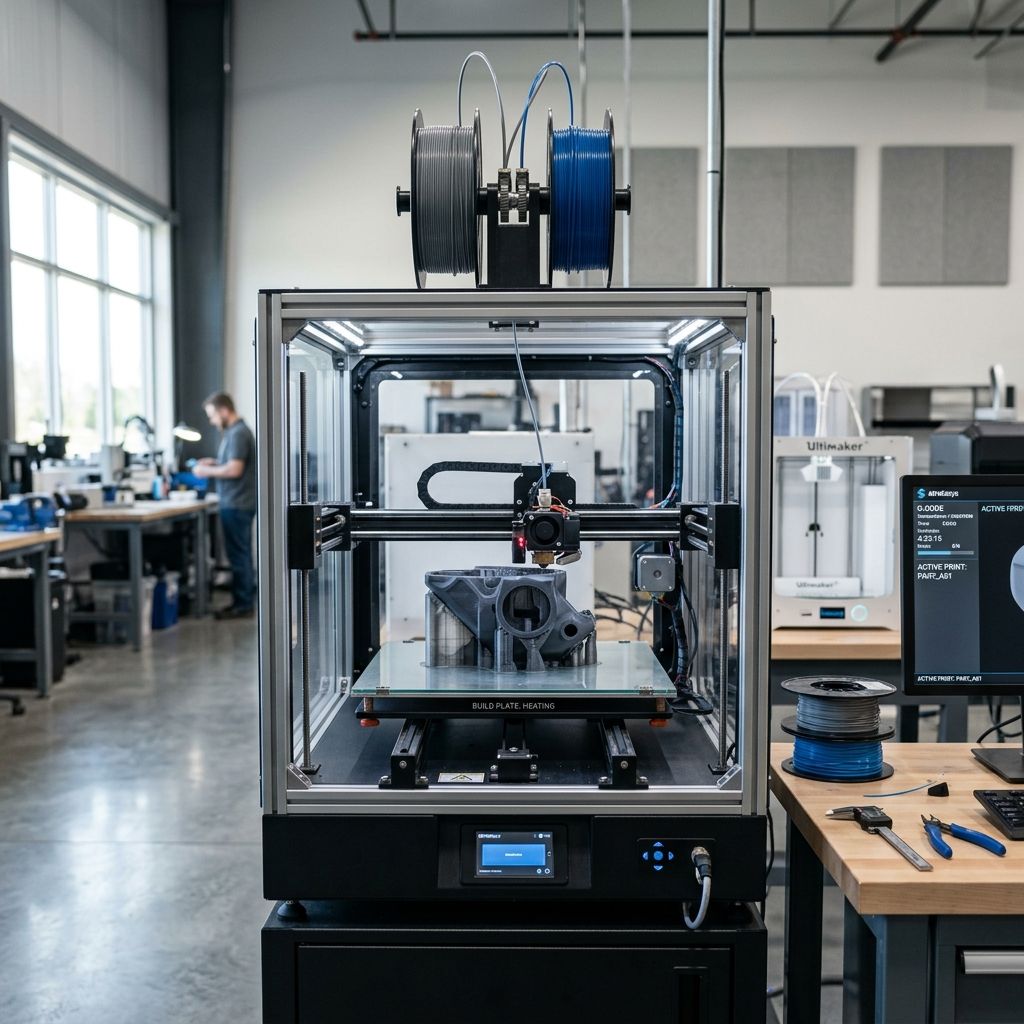
Optimizing R&D with Bambu Lab X1-Carbon and X1E
Business Impact: Architectural Summary
Time-to-Market Reduction: Accelerated prototyping cycles reduce iteration latency by 75% compared to outsourced CNC or injection molding.
ROI Index: Full hardware amortization typically achieved within 45 days of active design-phase deployment through saved tooling costs and reduced engineering overhead.
In the contemporary landscape of industrial design, the transition from conceptual digital twins to tactile functional prototypes requires a platform that balances speed with dimensional accuracy. The Bambu Lab X1-Carbon (X1C) and its enterprise counterpart, the X1E, represent a paradigm shift in Fused Filament Fabrication (FFF). As a Senior Industrial Design Architect, I view these machines not merely as 3D printers, but as high-frequency iteration nodes that integrate seamlessly into a professional CAD/CAM ecosystem.
This tutorial outlines the strategic deployment of the X1-Series within a professional R&D environment, focusing on technical calibration, material selection for high-stress applications, and the architectural differences between the standard and enterprise variants.
Technical Requirements & Ecosystem Integration
Before initiating a high-fidelity print, the hardware environment must be optimized for repeatability. The X1-Series relies on a sophisticated CoreXY motion system capable of 20,000 mm/s² acceleration, which necessitates a rigid, vibration-dampened surface to maintain tolerances.
- Nozzle Configuration: 0.4mm Hardened Steel (Default) or 0.6mm for fiber-filled polymers.
- Build Surface: Engineering Plate or High-Temperature PEI for PA-CF and PPS.
- Filament Management: Automatic Material System (AMS) for multi-material support and humidity control.
- Firmware: Latest Bambu OS with active vibration compensation enabled.
- Software: Bambu Studio (Architectural version) or OrcaSlicer for advanced flow rate tuning.
- Networking: 802.11n Wi-Fi (X1C) or RJ45 Ethernet/WPA2-Enterprise (X1E).
Advanced Material Strategy: PA-CF and Beyond
The true value of the X1-Carbon and X1E lies in their ability to process engineering-grade thermoplastics. For industrial designers, the use of Carbon Fiber reinforced Polyamide (PA-CF) is essential for creating functional jigs, fixtures, and end-use housings. The inclusion of the 300°C hotend allows for the processing of these materials without the risk of thermal creep or nozzle degradation.
When designing for these materials, one must account for the anisotropic nature of FFF. The X1E provides an additional advantage here: Active Chamber Heating. By maintaining a constant internal temperature of up to 60°C, the X1E significantly reduces internal stresses and warping in high-temp materials like ABS, PC, and PPA, ensuring that the final part matches the CAD dimensions within a ±0.1mm margin.
Architect's Pro-Tip: Moisture Mitigation
Engineering filaments are highly hygroscopic. Even within the AMS, PA-CF will absorb moisture over 24 hours. Always pre-dry filament at 80°C for 8 hours prior to mission-critical prints to prevent interstitial voiding and loss of mechanical integrity.
X1-Carbon vs. X1E: Strategic Selection
For a design firm or industrial facility, choosing between the X1-Carbon and the X1E depends on the security protocols and the thermal requirements of the project. The X1E is specifically engineered for professional environments where data sovereignty and material performance are paramount.
| Feature | X1-Carbon | X1E (Enterprise) |
|---|---|---|
| Chamber Heating | Passive | Active (Up to 60°C) |
| Networking | Wi-Fi Only | Ethernet + WPA2-Enterprise |
| Filtration | Activated Carbon | HEPA + Activated Carbon |
| Max Hotend Temp | 300°C | 320°C |
Execution: The Workflow of High-Authority Output
To achieve industrial-grade results, follow this structured workflow:
- Automated Leveling & Lidar Calibration: Utilize the dual-redundant bed leveling system. The Micro-Lidar sensor scans the first layer for irregularities and calibrates flow dynamics (Pressure Advance) in real-time. Do not bypass this step for professional outputs.
- AI-Assisted Monitoring: Enable the "Spaghetti Detection" and "First Layer Inspection" features. In a business context, a failed print is a lost billable hour. AI oversight provides a layer of operational security.
- Post-Processing: For functional alphas, utilize a support material like Bambu Support for PA-CF to ensure clean breakaway surfaces on complex overhangs. This maintains the geometric fidelity required for assembly testing.
In conclusion, the Bambu Lab X1 series democratizes high-speed industrial manufacturing. By integrating these units, design architects can bridge the gap between abstract design and physical reality with unprecedented speed and precision, ultimately driving innovation while maintaining strict budgetary and temporal constraints.