xTool S1 20W & 40W Workshop Production and ROI Guide

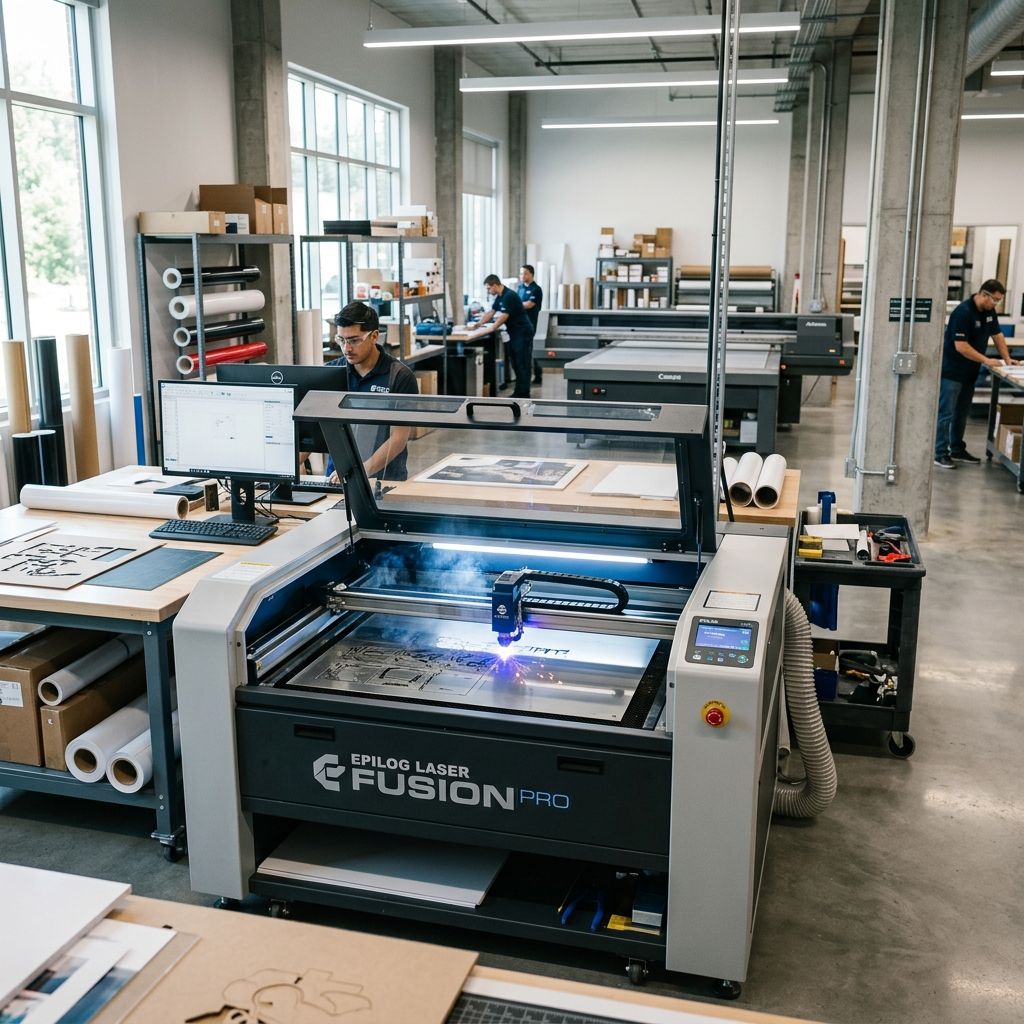
Monetizing the xTool S1 20W/40W: Workshop Production Pipeline
Turn enclosed diode laser technology into a profitable, repeatable fabrication cell. Here is how to configure the xTool S1 for low-labor batch manufacturing, calculate optical energy dosage, and avoid catastrophic lens burns.
Business Impact: Semi-Automated Laser Workcell
Deploying an enclosed diode cutter like the xTool S1 converts idle bench space into an autonomous revenue-generating cell. By creating dedicated nesting jigs and standardizing material blanks (such as 3 mm anodized aluminum plates and 6 mm aircraft plywood), a single operator can produce $180 to $260 in finished retail-ready goods per operating hour with less than 12 minutes of manual touch time. Run our Cost Calculator to establish your exact hourly machine depreciation, electricity overhead, and consumables burn rate before quoting commercial client runs.
- Target Workcell Revenue: $1,400 - $2,200/week on 15 operating hours.
- Initial Capital Outlay: $2,100 - $3,400 (xTool S1 40W + Smart Air Assist + Inline 450 CFM Fume Extractor + Honeycomb Bed).
- Gross Margin on Custom Goods: 72% to 84% after raw material and diode depreciation deductions.
- Payback Horizon: 6.5 weeks operating at a modest 40% capacity utilization.
- Primary Laser Engine: xTool S1 with interchangeable 40W 455 nm blue diode module and quick-swap 2W 1064 nm infrared module.
- Optics & Focus System: Multi-point surface mapping probe with auto-focus motorized Z-axis carriage.
- Motion Platform: Enclosed Class 1 laser chassis with hardened steel guide rails and dual Y-axis stepper synchronization.
- Air Assist Delivery: Automated solenoid-controlled air assist pump delivering 35 PSI focused nozzle pressure to clear kerf ejecta.
- Exhaust Infrastructure: 4-inch sealed ducting mated to an external 450 CFM inline centrifugal blower with anti-backdraft damper.
- Safety Interlocks: Hardware emergency stop, dual lid interlock sensors, 5-directional flame detection array, and tilt cutoff.
Transitioning from Hobby Crafting to Industrial Micro-Manufacturing
Most desktop laser units on social media are marketed to hobbyists making customized cutting boards and acrylic keychains. Trying to scale a business on that model results in burnout: you spend forty minutes hand-cleaning smoke stains off a piece of wood that sells for twelve dollars. Commercial viability requires treating the xTool S1 as a computer-controlled machine tool, not an arts-and-crafts toy.
The distinction between the xTool S1 and open-frame gantry lasers is structural. The S1 features a rigid, fully enclosed Class 1 safety chassis with filtered laser-safe viewing polycarbonate. This design lets you place the machine directly on an active shop floor alongside CNC mills, manual lathes, and assembly benches without forcing everyone in the room to wear OD6+ safety goggles. Furthermore, the enclosed chamber isolates toxic ablation particulates, allowing high-velocity exhaust blowers to pull harmful fumes out of the workspace before they settle onto precision equipment.
Profitability hinges on standardized fixture nesting. Instead of placing a single random board on the bed, you machine a high-density polyethylene (HDPE) locator jig that registers against the chassis datum edges. The jig holds twelve pre-cut blanks. You load the jig, trigger the pre-programmed boundary sequence, and walk away to assemble other components while the laser executes the batch in a single continuous twenty-minute cycle.
Optical Physics: Spot Geometry, Irradiance, and Kerf Energy Dose
Choosing between the 20W and 40W modules requires looking past raw wattage numbers and analyzing optical power density (irradiance). Diode laser modules do not emit a single monolithic 40W beam; they combine multiple 5.5W or 6.0W gallium-nitride (GaN) semiconductor laser diodes using spatial beam combination and polarization beam splitters.
Combining eight individual beams in the 40W module alters the focal spot geometry. While a 20W module achieves an exceptionally fine spot of approximately 0.08 mm by 0.06 mm, the 40W module produces a slightly larger rectangular beam waist measuring 0.08 mm by 0.10 mm.
The effective optical power density (irradiance) focused onto the workpiece surface is calculated as:
I = P_optical / A_spot
Where:
- P_optical = Measured optical output power at the focal plane (Watts).
- A_spot = Focal spot area (square centimeters).
For the 40W Module at the focal plane:
A_spot = (0.008 cm) * (0.010 cm) = 8.0 * 10^-5 cm^2
I_40W = 40.0 W / (8.0 * 10^-5 cm^2) = 500,000 W/cm^2 = 500 kW/cm^2
For the 20W Module at the focal plane:
A_spot = (0.008 cm) * (0.006 cm) = 4.8 * 10^-5 cm^2
I_20W = 20.0 W / (4.8 * 10^-5 cm^2) = 416,667 W/cm^2 = 416.7 kW/cm^2
Notice that despite having twice the nominal wattage, the 40W module delivers only 20% higher peak power density because the spot area expanded by 66%. However, total energy delivery into the kerf—the linear energy dose—is what governs through-cutting speed in thick organic polymers and hardwoods.
The linear energy dose delivered to the material kerf is defined by:
Dose = P_optical / (v_feed * w_kerf)
Where:
- v_feed = Cutting feed rate in millimeters per second (mm/s).
- w_kerf = Physical kerf width cut by the focused beam (mm).
Let us calculate the cutting parameters for sectioning 6.0 mm Baltic birch plywood using the 40W module at 100% power and a feed rate of v_feed = 4.0 mm/s with a measured kerf width of w_kerf = 0.12 mm:
Dose_40W = 40.0 W / (4.0 mm/s * 0.12 mm) = 40.0 / 0.48 = 83.33 Joules/mm^2
Now consider attempting the exact same through-cut with the 20W module. To match the required sublimation and charring energy threshold of 83.33 J/mm^2 at a kerf width of 0.10 mm:
v_feed = P_optical / (Dose * w_kerf)
v_feed = 20.0 W / (83.33 J/mm^2 * 0.10 mm) = 20.0 / 8.333 = 2.40 mm/s
The 40W module increases linear throughput speed by 66.7% on heavy cuts. Over an 8-hour production run cutting 150 nested gasket templates, that speed differential translates to 3.2 hours of recovered production capacity per shift.
High-Velocity Air Assist: Preventing Plasma Shielding and Charring
When high-density laser light vaporizes wood lignin or synthetic resin, it creates a cloud of aerosolized soot and ionization gas directly above the cut trench. If left unmanaged, this vapor cloud absorbs the incoming laser photons, creating a phenomenon known as plasma shielding. Up to 40% of the beam's energy dissipates into heating the smoke cloud rather than cutting the underlying material.
High-pressure air assist is not optional for production work. The xTool S1 air assist nozzle directs a concentrated 35 PSI jet of dry air co-axially with the laser beam straight into the kerf slot. This air column serves three essential functions:
- Ejection of Molten Debris: It mechanically forces molten resin, charred carbon particles, and vaporized gas down through the bottom of the honeycomb bed before it can re-condense on the cut edges.
- Combustion Suppression: High air velocity cools the material edges adjacent to the kerf, keeping the heat-affected zone (HAZ) sub-combustion to eliminate unsightly brown scorching.
- Optics Shielding: Positive pressure escaping through the nozzle orifice creates a dynamic air curtain that blocks smoke plumes from reaching the protective quartz lens window.
Production Material Matrix and Feasibility
A shop floor must match the correct laser wavelength to the target material substrate. Blue diode light (455 nm) interacts differently with chemical bonds than industrial CO2 (10,600 nm) or fiber lasers (1,064 nm).
| Material Substrate | Optimal Module | Max Cutting Thickness | Air Assist Setting | Production Viability & Tradeoffs |
|---|---|---|---|---|
| Baltic Birch Plywood (B/BB Grade) | 40W 455 nm | 12.0 mm (Single Pass) | Maximum (35 PSI) | Excellent margin for structural enclosures and packaging jigs; requires exterior glue (MR/WBP) to prevent internal delamination voids. |
| Cast Opaque Acrylic (Black/Dark) | 40W 455 nm | 15.0 mm | Low (8-10 PSI) | Delivers flame-polished edge quality; low air assist prevents wavy cooling ripples along the molten kerf wall. |
| Clear / Transparent Acrylic | Unsuitable (Requires CO2) | Cannot Cut (0 mm) | N/A | 455 nm blue light passes straight through clear acrylic without absorption; attempting this reflects the beam into the enclosure ceiling. |
| Anodized Aluminum (6061-T6) | 20W or 40W 455 nm | Surface Ablation Only | Off / Low | Permanently bleaches the dye layer to produce bright white barcodes and serial plates without removing base metal. |
| Bare 304 Stainless Steel | 2W 1064 nm Infrared Module | Engrave / Anneal Only | Off | Changes surface oxide layer to produce dark, non-destructive permanent asset serials that resist chemical washdown. |
| Vegetable-Tanned Cowhide Leather | 20W 455 nm | 4.0 mm | Medium (15 PSI) | High retail margins for industrial tool sheaths; must avoid chrome-tanned leather which off-gasses lethal chromium-VI vapors. |
Shop-Floor Failure Modes and Maintenance Realities
Continuous production runs reveal mechanical and optical vulnerabilities that occasional hobbyists never encounter:
1. Smoke Flashback and Sacrificial Foil Masking
When cutting intricate shapes on an open honeycomb bed, the laser beam punches through the substrate, strikes the steel honeycomb ribs below, and reflects backward against the underside of the workpiece. This reflection creates ugly burn streaks across the bottom surface. To eliminate this without wasting hours sanding, line your honeycomb bed with heavy-duty aluminum foil before laying down blanks, or elevate the stock on 8 mm machined aluminum pin standoffs to give smoke an unobstructed evacuation path.
2. The Thermal Lens Fracture Disaster
The protective quartz lens window situated beneath the diode array is the most fragile link in the optical chain. If an operator disables air assist during a wood cutting run to quiet the shop, aerosolized wood tar coats the glass within two minutes. The next time the 40W beam fires, the accumulated tar layer absorbs the 500 kW/cm^2 energy density. The localized thermal gradient shatters the quartz lens within three seconds. Inspect and wipe that lens with optical lens paper and anhydrous 99% isopropyl alcohol at the start of every production shift.
3. Enclosure Exhaust Sizing and Negative Pressure
The tiny 40 mm axial exhaust fan mounted on the rear of the stock S1 chassis is totally inadequate for continuous batch production. When cutting 10 mm plywood, thick smoke escapes around the perimeter lid seals, filling your shop with acrid smoke. Disconnect the stock fan wiring, bolt a 4-inch rigid duct adapter to the chassis exhaust port, and install an external 450 CFM inline centrifugal fan mounted downstream near your exterior wall exit. This keeps the entire laser enclosure under negative air pressure, guaranteeing that any seal leakage pulls fresh shop air in rather than letting soot escape out.
Standard Operating Procedure for Batch Runs
To maximize shop efficiency, follow this strict repeatable checklist on every production batch:
- Focal Plane Calibration: Use the S1 mechanical distance probe to measure the top surface of the raw blank across at least three points. If your sheet stock is warped by more than 0.8 mm, clamp the edges to your honeycomb bed using low-profile aluminum hold-downs. Out-of-focus diode cutting rapidly increases kerf taper and drops cutting depth by up to 50%.
- Exhaust Blower Verification: Turn on the external centrifugal blower and verify negative chamber pressure before engaging the laser software. A simple strip of paper held near the front lid gap should pull firmly inward against the gasket.
- Air Assist Solenoid Check: Trigger the software manual air blast to confirm unobstructed airflow through the nozzle cone. Debris splatters occasionally lodge inside the sub-millimeter nozzle tip, throttling airflow and exposing the optical lens to soot contamination.
- Post-Run Lens Inspection: Once the batch completes and the exhaust fan clears the chamber, inspect the outer brass nozzle cone for resin buildup and clean the protective lens using pure lens-grade wipes.
Frequently Asked Questions
Can the xTool S1 40W cut through 1/4-inch (6.35 mm) solid hardwood in a single pass?
Yes, running the 40W module at 100% power with full 35 PSI air assist cleanly cuts through 6.35 mm walnut, cherry, and maple at feed rates between 3.5 mm/s and 5.0 mm/s depending on wood grain density.
Why does my laser struggle to cut through Baltic birch plywood even at high power?
Plywood cores frequently contain internal glue pockets and hardwood knots; if the manufacturer uses interior-grade urea-formaldehyde glue with dark voids, the 455 nm wavelength scatters, requiring multiple passes or higher feed dosage.
How often does the 40W diode laser module need to be replaced?
Industrial GaN laser diodes offer an operational lifespan of 10,000 to 15,000 hours, provided the cooling heatsink fins are cleaned of shop dust monthly and ambient enclosure temperatures remain below 35 deg C.
Can I engrave bare raw copper or polished brass using the 2W 1064 nm infrared module?
No, copper and polished yellow brass exhibit extreme optical reflectivity at 1,064 nm, which reflects the beam back into the laser collimator and prevents sufficient heat absorption for deep engraving without specialized chemical marking sprays.
Mandatory Workshop Alert: Flame Detection Calibration and Material Safety
Never cut polyvinyl chloride (PVC), vinyl sheets, or chlorine-treated synthetic leather inside the xTool S1; thermal decomposition generates corrosive hydrogen chloride gas that destroys the linear steel guide rails and produces toxic airborne chlorine. Keep your factory flame sensors cleaned with compressed air weekly; a fine film of wood dust blinding the optical photodiode array prevents the automated emergency fire shutoff system from triggering during unexpected flare-ups.
Related Intel
xTool P2S 55W CO2 Laser Review: Pros, Cons, and Specs
xTool P2S 55W CO2 laser: industrial accuracy (±0.05 mm) with 55W beam, but requires exhaust and air assist upgrades for continuous use. No native LightBurn support. Best for small-batch manufacturing where cost and precision matter.
ROI of the Thunder Laser Nova 24/35
We installed three Thunder Laser Nova machines in small shops. This article covers measured ROI, hardware requirements, and first-week workflow to turn a laser cutter into a profit center.