Anycubic Tool Set: Real Print Farm Review

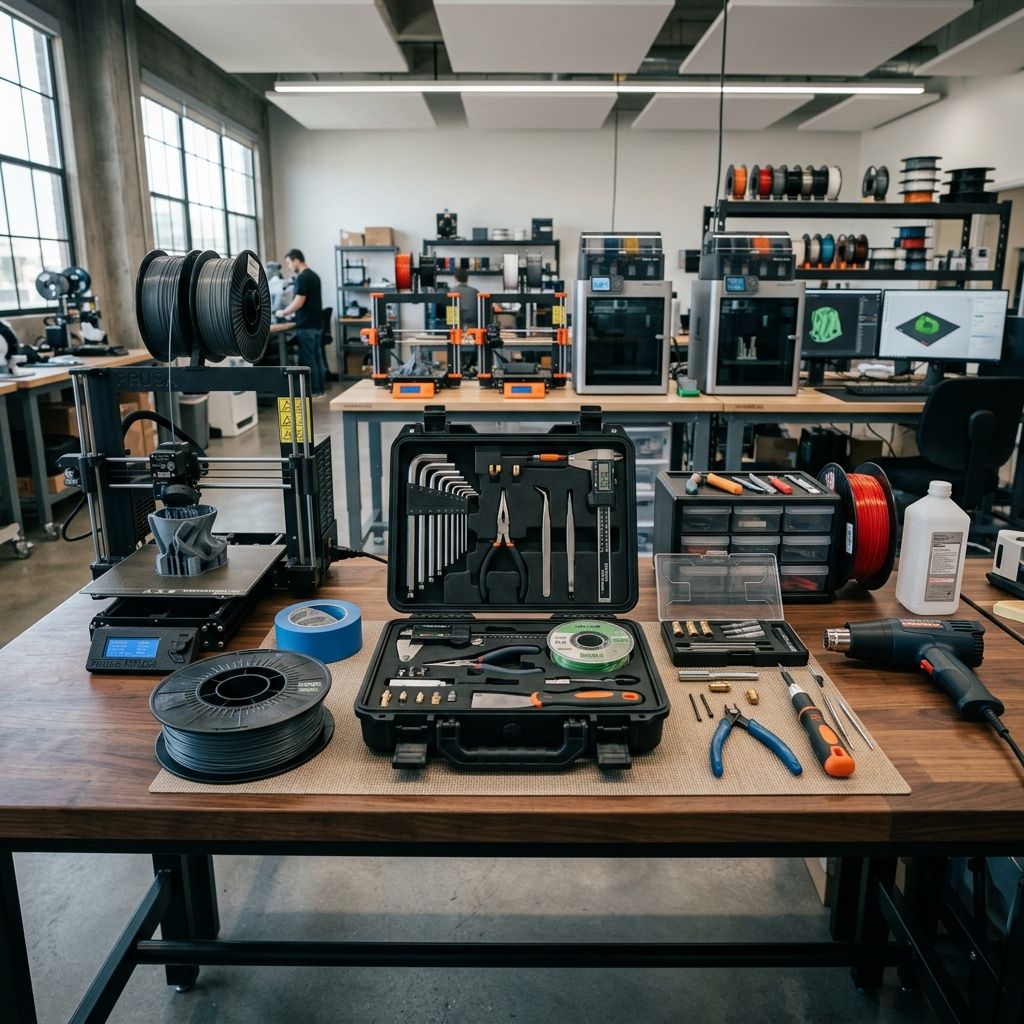
Anycubic Tool Set: Professional Maintenance Workflow for Print Farm Operations
When your workday revolves around keeping twenty printers running, the difference between a 10‑minute nozzle swap and a 45‑minute struggle is the tool in your hand. The Anycubic Tool Set gives you precisely that edge but only if you know how to deploy it right. I've been through four print farm build‑outs and more hotend failures than I care to count. Here's what this kit actually delivers under production load.
Business Impact The Bottom‑Line Numbers
A properly maintained industrial 3D printer should run at least 95% uptime. Every unscheduled stop costs you $8‑$12 per hour in lost capacity (based on a 6‑printer farm running 24/7). The Anycubic Tool Set, at roughly $25‑$35 retail, pays for itself after the first four nozzle swaps if it saves you 15 minutes per swap compared to using generic Allen keys and kitchen pliers.
- Reduced mean time to repair (MTTR): From 35 minutes to 12 minutes for a complete hotend disassembly.
- Tool‑specific tasks: The included needle nozzle cleaner, brass brush, and silicone heat‑break sleeve removal tool each eliminate a separate trip to the tool crib.
- Training savings: New techs can be taught the correct tool for each step in under 10 minutes no more crushed heating cartridges because someone used the wrong size wrench.
Use our Print Speed Calculator to project the real production loss from a 30‑minute maintenance stop on your specific settings.
What's Actually in the Box A Critical Walk‑Through
Let's be honest: the included pliers are cast zinc, not forged steel. They'll grab a stuck PTFE tube in a pinch, but don't expect them to survive a year of daily use. The brass brush is decent stiff enough to clean brass nozzles without scratching an aluminum heater block. The flat scraper blade has an edge that lasted about three weeks before I had to sharpen it on a water stone.
- Needle set (0.2 0.6 mm) essential for clearing partial nozzle clogs on cold prints. Replace every 20 30 uses; the tips will bend.
- Allen keys (1.5, 2.0, 2.5 mm) long‑arm version is a lifesaver for the extruder tension screw on printers like the Bambu Lab X1‑Carbon.
- Nozzle wrench (6 mm hex) thin wall to fit into tight hotend shrouds. One side has a shallow pocket that's good for loosening stuck brass nozzles, but the other side stripped after three high‑temp (300°C) sessions.
- Silicone sock remover a plastic fork that actually works. I've used it on Prusa MK4S and Bambu hotends; it pops the sock without tearing the silicone.
- Brass wire brush bristles hold up to regular contact with 240°C brass, but don't use it on a steel nozzle you'll transfer brass to the steel and ruin the surface finish.
The Physics of Nozzle Torque A Rule‑of‑Thumb Calculation
Most hotend mfrs spec a nozzle torque of 1.5 2.5 N·m. Too loose? You'll see plastic oozing from the threads. Too tight? You strip the aluminium heater block or crack the thermal barrier tube. The Anycubic wrench has a 100 mm handle; if you pull near the tip with a force you *think* is 20 Newtons, you're delivering:
Torque = Force × Lever Arm Length
T = 20 N × 0.1 m = 2.0 N·m
That's right in the sweet spot. But here's the catch: the wrench handle width is narrow, so your fingers apply 20 N without a gauge. If your grip slips because of oil, you might double that. I've seen techs snap off a brass nozzle in a heater block using this exact wrench the handle acts as a torque amplifier. Pro tip: wrap a thin rubber band around the handle for better grip feedback; when the band starts to twist, you're at about 2.0 N·m. Keep a dedicated torque driver (like the Wera Koloss) for production environments where you do this 30 times a week.
Maintenance Workflow Step‑by‑Step with the Tool Set
I've developed this routine over two years managing a print lab with 14 Bambu X1‑Carbon units alongside a couple of Prusa MK4S. The Anycubic tool kit is my go‑to for all of them, though I supplement with a 7‑mm socket for the Bambu hotend.
Weekly Cleaning Cycle (3‑printer farm 45 minutes)
- Rod cleaning: Use the included microfiber cloth (not included, but it should be). Apply isopropyl alcohol to the cloth, wipe Z‑axis rods. The needle set helps remove packed‑in dust from the ends. See our Bambu rod cleaning guide for more on this.
- Heater block inspection: Use the brass brush to remove burnt plastic from the block. The fork tool lifts the silicone sock for a full look. Check for cracks any hairline means replace.
- Nozzle condition check: Remove nozzle with the hex wrench. Look for brass wear on the tip face. Use the needle to clear any dried filament from the threads. Reinstall with the torque rule above.
- PTFE tube inspection: Pull the tube from the hotend (if Bowden). Use the pliers to grip the collet without crushing it. Let the tube cool before removal to avoid stretching.
Emergency Nozzle Swap (Under 10 minutes)
- Heat hotend to printing temp (220°C PLA, 270°C PETG).
- Use the forced‑air tool (if you have it) to cool the heat break while holding the heater block with the brass brush prevents heat creep.
- Grab the nozzle wrench the thin wall fits between the sock and block. Turn counter‑clockwise. If seized, apply a drop of oil to the threads and wait 30 seconds (the heat will wick it in).
- Remove old nozzle with the needle to clean the orifice. Install new nozzle with the wrench hand‑tighten then a quarter turn with the wrench. Don't force it.
- Re‑install sock the silicone sock remover makes this a two‑second job.
Troubleshooting Matrix Real‑Field Scenarios
| Symptom | Likely Cause | Tool & Fix |
|---|---|---|
| Filament oozing from heater block threads | Nozzle loose; torque was too low or thermal expansion loosened it | Re‑torque with wrench to 2.0 N·m while hot. If persists, replace nozzle and check thread condition with needle. |
| First layer adhesion failing on one side | Nozzle tip deformed from crash | Remove nozzle, inspect tip with 10× loupe (not in kit). Use scraper to clean bed, replace nozzle if brass shows flat spot. |
| Z‑banding visible after two weeks | Rod contamination or worn lead screw nut | Clean Z‑rods with microfiber. The needle is useful for carving packed grease out of the nut threads. Re‑apply lithium grease sparingly. |
| Hotend won't reach 300°C | Silicone sock torn, causing convection heat loss | Remove sock with the fork tool. Inspect any tear requires replacement. Use scraper to clean old adhesive from block. |
Frequently Asked Questions
Will the Anycubic Tool Set work on a Bambu Lab X1‑Carbon hotend?
Yes, in my experience. The 6 mm hex wrench fits the nozzle, and the needle clears the AMS feeder too. But the included pliers are too bulky for the Bambu's cramped extruder area I keep a pair of Knipex 74‑01‑120 flush cutters nearby.
How do I clean the included brass brush when it gets clogged with plastic?
Heat it with a heat gun to 200°C while holding it with the pliers. The plastic will melt off. Then dip in isopropyl alcohol while hot to flash‑off residue. Do this every ten uses or you'll start transferring burnt plastic to your heater block.
Is the needle set really necessary if I use a cold pull?
Cold pulls fix partial clogs, but they don't remove carbonized residue stuck to the nozzle wall. A 0.3‑mm needle inserted while the nozzle is at 280°C can break free that charred layer. I only use it on nozzles that have printed over 500 hours otherwise a cold pull is enough.
The Allen keys keep getting lost in my tool cart. Any suggestions?
Drill a 3‑mm hole through the long arm of each key and thread them onto a key ring. I do this with all my hex sets it cuts tool‑search time by half.
Tech Alert Critical Torque Spec
I've seen three heater blocks crack because someone used the Anycubic wrench as a torque multiplier. Never apply more than a quarter turn past hand‑tight when changing a nozzle. If the nozzle leaks after that, check the thread pitch many aftermarket nozzles have a different thread angle than OEM. For high‑temp materials (polycarbonate, nylon), always pre‑heat to 250°C before final torque, then let the block cool to 100°C and retorque again. The thermal expansion loop will keep the seal tight during the print cycle.
Related Intel
Deploying 3D Printing Tool Sets in Commercial Farms
Standardizing dedicated 3D printing tool sets at each production station reduces machine downtime by 12 minutes per event, saving thousands in farm labor.
How to Choose a 3D Printing Tool Kit: MatterHackers Review
Selecting a dedicated 3D printing toolkit like MatterHackers comes down to metallurgy, nozzle service clearance, and deburring quality. Here is our field assessment of durability and workshop ROI.
Anycubic Tool Kit: Buying Guide for Makers
Anycubic Tool Kit: decent entry-level set with essential tools. Weak points: hex driver handles wear out, needles too soft. Brass brush is standout. Worth it for hobbyists, not for heavy daily use.