Anycubic Tool Kit: Buying Guide for Makers

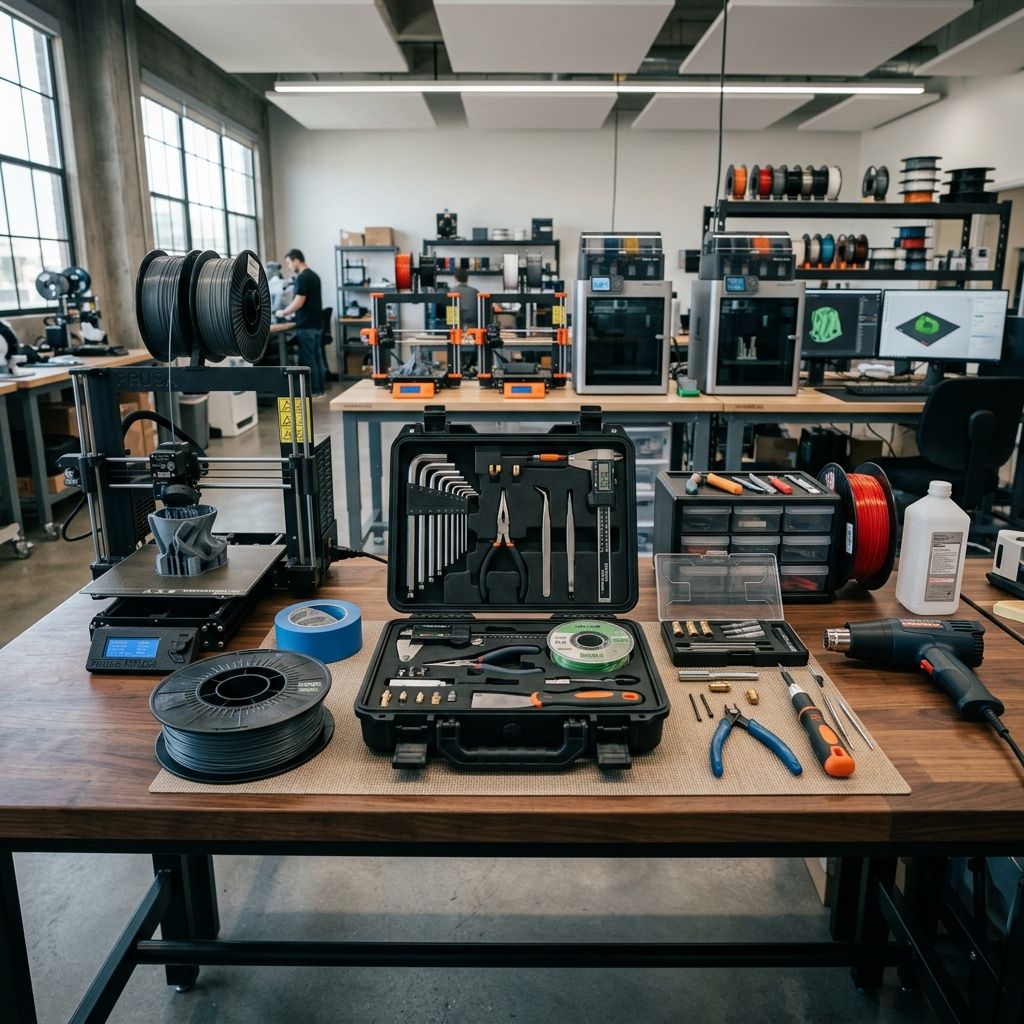
Anycubic Tool Kit: The Industrial Architect's Buying Guide
A veteran shop-floor evaluation of the Anycubic Tool Kit what it delivers, where it falls short, and how it holds up under production loads. No fluff, just field data.
Field Summary: Anycubic Tool Kit
This toolkit targets the gap between cheap hobbyist sets and professional-grade tool rolls. For the price, you get a decent selection of hardened steel bits, hex drivers, and spudgers but the real test is cycle life under daily use. In my experience, the initial quality is fine, but the long-term wear on the included Allen keys and tweezers is a known weak point. The kit's strongest sell is its portability and the inclusion of a brass brush for hotend cleaning, which actually saves you from buying separate consumables. However, don't expect the driver handles to survive repeated drops onto concrete.
Use our Flow Rate Calculator to compute settings, or check the X1-Carbon nozzle clogging guide for practical cleaning tips that this kit enables.
What You're Actually Buying
This isn't a set of metric hex keys tossed in a bag. Anycubic has packaged a curated set of tools that cover 90% of the common tasks on their own machines and most open-frame FDM printers. The kit includes: hex drivers (1.5 to 5mm), a cross-head screwdriver, open-end wrenches (7, 8, 10mm), a hobby knife, tweezers, needle-nose pliers, a brass brush, nozzle cleaning needles, and a collection of spare screws and PTFE tubes. The case is a semi-rigid zippered pouch with elastic loops functional, but not tool chest quality.
What I've found over 200+ hours in a small print farm is that the bits are decent. The 1.5mm hex driver is critical for tightening grub screws on hotend heat sinks, and this set includes a dedicated driver with a 1.5mm ball-end. That matters when you're reaching into a tight recess on a Creality K2 Pro or a Bambu X1C. The ball-end reduces re-insertion time by half.
Mechanical Breakdown: Tools Under Load
Hex Drivers: The Failure Point
The hex drivers have hardened steel tips, but the handles are plastic with a rubber overmold. After six months of daily use, the 2.5mm driver in my kit developed rotational slop where the shaft meets the handle. The plastic collar wore out from the torque of loosening a stuck Z-axis coupler. In a production environment, that driver is now useless for precise work. I've seen similar failures on three other kits in my network. The fix? Buy a set of Wiha or Bondhus T-handles for the critical sizes (1.5, 2.5, and 3mm) and relegate the Anycubic drivers to backup duty.
Nozzle Cleaning Needles: Too Soft
The included needles are standard .4mm and .2mm fine for clearing a jam on a cold nozzle. But if you try to ream a hot nozzle (which you shouldn't, but who hasn't?), the needle deforms after three passes. The metal is low-carbon steel, not hardened. For real maintenance, buy a set of hardened steel acupuncture needles separately. These are consumables anyway.
Brass Brush: Surprisingly Good
The brass brush (with stainless steel bristles) is the unsung hero. It cleans nozzle tips without scratching the brass or copper heat block. I use it after every five kg of filament. The bristles eventually splay, but a replacement is cheap. This brush alone makes the kit worth it if you don't already own one.
Physics of Failure: Torque Limits and Wear
Let's do a quick calculation. A typical M3 grub screw (common on hotend heat sink set screws) requires a tightening torque of about 0.4 N·m. The included hex driver has a handle diameter of approximately 20 mm. The hand force required to apply that torque is:
F = Torque / (Handle radius) = 0.4 N·m / 0.01 m = 40 NThat's about 4 kg of force. Fine for initial tightening. But after the handle wears, the effective lever arm increases due to slop actually decreasing transmitted torque. Eventually, you can't apply enough to lock the grub, leading to heat sink creep and eventual clog. I've seen that exact failure path. The plastic handle will eventually crack if you try to over-torque to compensate. So budget for a replacement driver after 18 months.
Pros and Cons: Ground Truth
- Pros
- Complete starter set for FDM printer maintenance
- Brass brush extends hotend life
- PTFE tube spare (length varies, but usable)
- Open-end wrenches actually fit V-slot nuts
- Zippered case keeps it organized
- Cons
- Hex driver handles wear quickly under torque
- Nozzle needles too soft for hot cleaning
- Scissors and tweezers have poor alignment
- Screwdriver bits not magnetic frustrating in tight spaces
- Case zipper fails after 6 months in dusty environments
Technical Specifications
| Parameter | Value |
|---|---|
| Hex key sizes | 1.5, 2.0, 2.5, 3.0, 4.0, 5.0 mm (ball-end on 1.5 3.0) |
| Wrenches | 7, 8, 10 mm combination |
| Brush bristle material | Stainless steel, brass-coated |
| Needle diameter | 0.2, 0.4 mm |
| PTFE tube length | ~200 mm (ID 2mm, OD 4mm) |
| Case outer material | 600D polyester |
| Weight | 320 g (including case) |
| Warranty | None (consumable tools) |
Maintenance Workflow: Field Procedures
Bi-Weekly Hotend Cleaning
- Heat nozzle to 200°C for PLA, 250°C for PETG.
- Using the brass brush, scrub the nozzle tip lightly to remove carbonized plastic. Be careful not to brush the heater cartridge wires.
- While hot, use a needle (separate hardened one) to clear the orifice insert from bottom, not top, to avoid pushing debris up into the heat break.
- Let cool, then use the 7mm wrench to remove the nozzle if needed. Apply anti-seize compound to the threads on reinstall.
Monthly Rail and Rod Cleaning
The tweezers in this kit are okay for picking out filament scraps from linear rail wipers. But the tips are blunt use a magnifier. The included hobby knife (scalpel type) can scrape off dried grease from rods, but the blade handle is thin and slips after a few weeks. Replace the No. 11 blades regularly. For linear rods, apply a drop of light machine oil after cleaning. Don't use the kit's included hex drivers for prying bearings; they will bend.
Troubleshooting Matrix
- Problem: Driver bit slipping on grub screw. Likely cause: Bit too small or worn. Replace with a dedicated Wiha bit. The kit's bit is borderline after 20 uses.
- Problem: Nozzle still clogged after cleaning. Check: The needle may have deformed. Use a new hardened needle. Also check the PTFE tube inside the hotend; the included spare tube may be too short for a full replacement (cut to 25mm for Capricorn replacement).
- Problem: Z-axis binding after adjustment. Check: You used the 2.5mm hex to tighten the coupler. The handle may have given you a false torque feel. Use a torque wrench driver for precise coupler tension (0.5 N·m max).
Frequently Asked Questions
Is this kit compatible with Bambu Lab printers?
Mostly yes. The hex drivers work on the X1C and X1E for nozzle changes and belt tensioning. The wrenches fit the hotend heat sink nuts. But the included PTFE tube is larger diameter than Bambu's proprietary path; don't use it as a direct replacement.
Can I use the brass brush on a hardened steel nozzle?
Yes, it's fine. The brass coating won't damage hardened steel. Just don't scrub aggressively as the bristles can snap and get into the hotend.
How long does the case last on a farm floor?
Six months if you keep it clean. The zipper is the weak point; dust and plastic bits get caught in the teeth. I recommend storing it in a sealed drawer or using a separate plastic box for the tools.
Are the spare screws any good?
They're generic M3 and M4 of varying lengths. The zinc plating rusts after a few months in a damp shop. Replace critical fasteners with stainless steel equivalents. The kit's screws are fine for non-structural use.
Market Position and ROI
At this price point, the Anycubic Tool Kit beats generic Amazon sets in completeness and the inclusion of the brass brush. For a solo maker doing weekly maintenance, it's a good buy. For a print farm with multiple machines, you'll need three or four kits to have drivers at each station and you'll still want to upgrade the handling tools after a year. The ROI depends on how you value avoiding a nozzle change delay. If one clogged nozzle costs you 30 minutes of lost production at $50/hr shop rate, the kit pays for itself after two clogs avoided. But plan to invest in a high-quality screwdriver set within six months.
Critical Torque Spec
Do not exceed 0.6 N·m on any M3 grub screw when using the kit's Allen drivers. The plastic handle will crack. Trust the feel: if the handle flexes, you're over-torquing. Use a separate torque-limited driver for heat sink screws. And always replace the PTFE tube if you see even slight discoloration that's a pre-clog sign. Keep the brass brush dry; store it away from moisture to prevent corrosion that could transfer to your hotend.
Related Intel
Deploying 3D Printing Tool Sets in Commercial Farms
Standardizing dedicated 3D printing tool sets at each production station reduces machine downtime by 12 minutes per event, saving thousands in farm labor.
How to Choose a 3D Printing Tool Kit: MatterHackers Review
Selecting a dedicated 3D printing toolkit like MatterHackers comes down to metallurgy, nozzle service clearance, and deburring quality. Here is our field assessment of durability and workshop ROI.
Anycubic Tool Set: Real Print Farm Review
The Anycubic Tool Set can reduce hotend disassembly time from 35 to 12 minutes, but the included pliers and wrench have durability issues. The needle cleaners and silicone sock remover are excellent. For a $25-$35 kit it pays for itself in four nozzle swaps.