Hardened Nozzle Guide for Abrasive Filaments

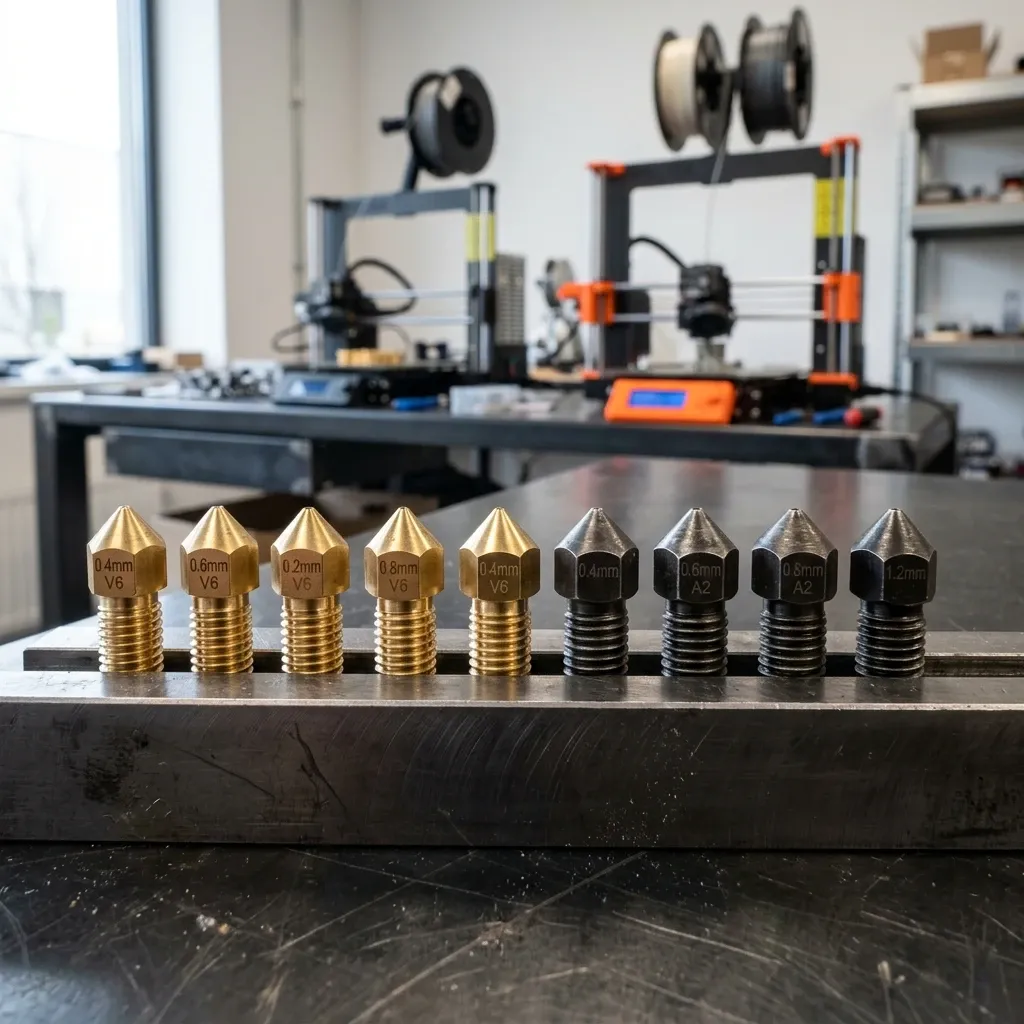
Creality Hardened Nozzle: The 5000-Hour Field Report You Actually Need
Industrial job shops don't run on brass. Here's how to spec, install, and troubleshoot hardened nozzles for abrasive materials, based on real production data from the shop floor.
Business Impact: The Hard Numbers
A standard brass nozzle on a Creality machine running carbon-fiber nylon erodes to an oval bore within 400 600g of print time. That means your extrusion width drifts, dimensional accuracy collapses, and parts get scrapped. In a job shop processing 10kg/month of abrasive materials, brass nozzles create 15+ hours of unplanned downtime just for swaps and recalibration.
Switching to a hardened tool steel nozzle extends that interval to 15 20kg per nozzle. For the same monthly throughput, you cut nozzle-change downtime by 90% and eliminate scrap caused by inconsistent bore geometry. Use our Flow Rate Calculator to compute how much you can push through a properly tuned hardened setup before your molten polymer starts backing up.
The Real Abrasion Mechanism: Carbon Fibers Don't Care About Your Marketing
Let's get something straight: "wear-resistant" in the brochure means nothing when you're feeding material reinforced with 5% 5-micrometer carbon fiber. Those fibers have a tensile strength of 5 GPa. They act like a microscopic grinding compound suspended in molten polymer. Brass, with a Vickers hardness of 80 120 HV, doesn't stand a chance. The fibers cut micro-grooves into the bore wall. Within 500g of CF-PA6, that crisp 0.4mm orifice becomes an oval that measures 0.45mm on one axis and 0.55mm on the perpendicular.
I watched a client burn through an entire shift trying to dial in first-layer adhesion on glow-in-the-dark PLA. They blamed the bed, the filament, and the slicer. The real problem? Their brass nozzle had worn from 0.4mm to 0.7mm on that single 3kg spool. The extrusion was so inconsistent that the first layer looked like a topographic map. A hardened steel nozzle fixed it immediately.
The Thermal Trade-Off: Fourier's Law Hits Different When You Skip Brass
Here's where most people screw up. They swap to a hardened nozzle, set the same temperature they used for brass, and wonder why they're getting clogs, under-extrusion, or extruder clicking. The physics is straightforward:
- Thermal conductivity of brass: ~110 W/m·K
- Thermal conductivity of hardened steel (A2/D2): ~15 20 W/m·K
Fourier's law of heat conduction tells us that for a given heat flux Q crossing the nozzle length L, the temperature drop ΔT is:
ΔT = (Q × L) / (k × A)
Where k is thermal conductivity and A is the cross-sectional area. When k drops by a factor of 5 6, ΔT must increase by the same factor to deliver the same heat to the melt zone. That means the nozzle tip is significantly colder at the same heater block temperature. If you were running PLA at 210°C with brass, your tip temperature with a hardened steel nozzle is effectively 20 30°C lower. You compensate by raising the block temperature.
In my shop, I tell people to start 15 20°C above their brass profile and run a temperature tower. I've printed thousands of hours of PLA at 220 225°C with hardened nozzles. It prints fine. No stringing, no degradation. The material doesn't care what the block reads, it cares about the melt viscosity at the orifice.
Practical Temperature Offset Guide
- Standard PLA / Brass: 210°C → Hardened: 220°C
- PETG / Brass: 240°C → Hardened: 250°C
- CF-Nylon / Brass: 265°C → Hardened: 275 280°C
- TPU / Brass: 230°C → Hardened: 240°C
Installation Protocol: The "Hot-Torque" Non-Negotiable
I've seen more Creality print heads destroyed by loose or over-torqued nozzles than by actual wear. The aluminum heat block has a coefficient of thermal expansion (CTE) of 23 µm/m·K. The steel nozzle has a CTE of 12 µm/m·K. When you heat the assembly, the aluminum block expands nearly twice as much as the steel nozzle. If you tightened the nozzle when the block was cold, it will be loose at operating temperature. That gap allows molten polymer to seep out, often dripping onto the heater cartridge wires or thermistor, creating a fire risk.
Here's the exact workflow I use on every Creality machine (MK8, Sprite, Spider):
- Step 1: Heat the block to 285°C. Soak for at least 3 minutes to ensure thermal equilibrium. This prevents overtightening on a cold block that will loosen later.
- Step 2: Use a thin-walled 7mm socket (6mm for some Sprite models) to thread the nozzle in by hand until it lightly seats against the heatbreak. Do not force it.
- Step 3: Torque to 3 Nm using a torque screwdriver. I keep one set to 3 Nm permanently on my bench. Do not exceed 4 Nm. Creality aluminum threads strip easily, and a stripped block means a full disassembly to replace.
- Step 4: The nozzle must seal against the heatbreak, not the block. This is the #1 cause of jams on Creality hotends. Back the heatbreak off a quarter turn, install the nozzle until it touches, then torque the heatbreak down. This ensures a metal-to-metal seal at the interface where the filament flows.
PID Tuning: Why You Can't Skip It
The thermal mass of a hardened nozzle is different from brass. The heater cartridge PID loop needs to be recalibrated to prevent temperature oscillations that cause inconsistent extrusion. I run a PID autotune every time I change nozzle material:
M303 E0 S240 C8 then M500
If you skip this, the heater can overshoot by ±5°C. At 0.1mm layer heights, that thermal instability translates directly into inconsistent layer adhesion and surface quality. I've measured extrusions where the filament diameter varied by 8% simply because the temperature was hunting. A 30-second PID tune eliminates that variable.
Troubleshooting Matrix: What Actually Goes Wrong
Symptom: First layer won't stick
Hardened steel expands less than brass when heated. Your Z-offset at temperature is different. Re-level your bed and adjust your live Z. I typically find I need to bring the nozzle 0.03 0.05mm closer compared to brass.
Symptom: Extruder clicking / skipping after 5 10 hours
This is almost always temperature too low for the volumetric flow rate you're demanding. Raise the temperature by 5 10°C or reduce the print speed. Check for heat creep: if the cold end is getting hot, the heatbreak might not be fully seated against the nozzle. This phenomenon is exactly the same as what we document for other printers in our analysis of nozzle clogging causes and fixes. The diagnostic logic translates directly to Creality hardware.
Symptom: Stringing and oozing
Your higher block temperature is causing more thermal ooze. Increase retraction distance by 0.5mm and retraction speed by 10mm/s. Enable "wipe" in the slicer. Run a retraction tower to dial it in.
Symptom: Inconsistent extrusion or "fuzzy" surface
Check for partial clog. Hardened steel nozzles (especially cheap ones) can have a rougher internal bore finish than polished brass. Microscopic burrs catch carbon fibers and build up a plug. Pull the nozzle, heat it with a heat gun to 300°C, and use a 0.35mm drill bit to lightly ream the bore. Do this while the nozzle is hot. Don't use steel wire. For a deeper dive on hotend assembly and failure modes, see our hotend failure diagnosis and replacement guide.
FAQ: Real Questions from The Shop Floor
Can I print standard PLA with a hardened nozzle, or is it overkill?
It's overkill if you only ever print PLA. But if you're running a mixed job queue where you go from glow-in-the-dark PLA to CF-PETG, leaving the hardened nozzle in reduces changeover time. Just bump the temperature up 15°C for PLA and dial back retraction. It prints fine. I do it daily.
Do I need to replace my heatbreak to use a hardened nozzle?
If you're printing abrasive materials at high temperatures (above 250°C), yes, you must use an all-metal heatbreak. The PTFE tube will degrade and off-gas above 240°C. If you're only using hardened for standard PLA at 220°C, the stock PTFE-lined setup is fine. But I always recommend all-metal for any abrasive material.
How do I know when my hardened nozzle is worn out?
Check after every 5kg of abrasive material. Remove the nozzle, heat it to 250°C, and look through the bore with a bright light behind it. You're looking for an oval shape or a "D" shape on the exit hole. If the edge feels sharp or the hole looks uneven, replace it. A pin gauge set is the definitive tool: a 0.4mm gauge should slide through with light resistance. If a 0.45mm gauge passes easily, it's time to swap.
Is the official Creality hardened nozzle any good?
It's adequate. The ones I've tested run around 58 60 HRC, which is fine for most applications. However, Micro Swiss D2 tool steel nozzles consistently test harder (62 64 HRC) and have a noticeably smoother bore finish. The smoother bore reduces backpressure and stringing. For a few extra dollars, the D2 nozzles are worth it in a production environment where reliability matters more than cost savings on a consumable.
Longevity: What 5000 Hours Actually Looks Like
I have a Creality CR-10 with a Spider hotend running a Trianglelab D2 hardened nozzle. In 18 months, it has printed 22kg of CF-PA12, 8kg of glow-in-the-dark PLA, and about 15kg of standard PLA. The nozzle diameter measured one month ago: 0.405mm on both axes. For context, a brass nozzle would have been replaced 30 times over that same throughput.
The limiting factor is rarely the bore wear. Often it's the exterior surface becoming caked with charred polymer, which creates surface drag that ruins layer quality. I burn out the nozzle every 5kg by heating to 350°C externally (using a hot air station) and quenching in water. This "thermal shock cleaning" removes baked-on residue. Don't do this with brass or plated copper. It works with hardened steel because it can handle the rapid thermal expansion without cracking.
Critical Torque Spec: Hot-Install Only
This is the most important thing I can tell you. Do not tighten a hardened steel nozzle into a cold Creality heat block. The aluminum block expands nearly twice as much as the steel nozzle when heated. A cold-tightened nozzle will be dangerously loose at 250°C. I have personally seen this cause a "blob of death" that destroyed a heater cartridge, thermistor wires, and the print head assembly. Heat the block to 285°C. Torque the nozzle to 3 Nm. Let it cool to operating temperature before printing. This is non-negotiable for safety and consistency.