Replacement Timing Pulleys: A Field Guide to Belt Drive Precision

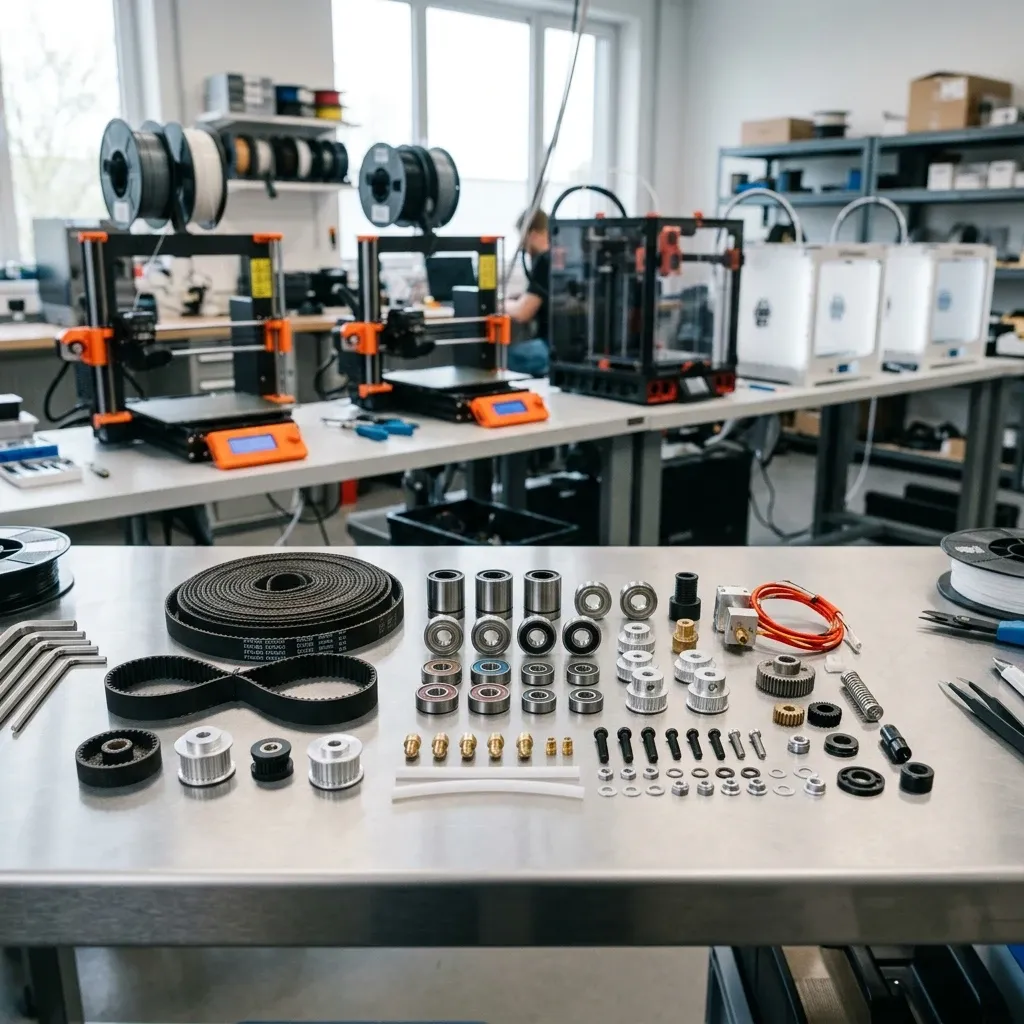
Replacement Timing Pulleys: A Field Guide to Belt Drive Precision
This isn't about "choosing a pulley for your 3D printer." This is about understanding what happens when a GT2 profile wears 0.02 mm on the flank and your Z-axis starts ghosting. I've seen production lines shut down because a 6 mm wide pulley lost its tooth engagement, and I've watched a $50k motion system start chattering because someone bought a warehouse full of mislabeled 2GT pulleys. Here's what actually matters when you spec a replacement timing pulley for a machine that needs to hold micron-level repeatability over 10,000 hours.
Executive Summary: The Pulley Market Reality
Timing pulleys are commodity parts that mysteriously become critical components the moment a drive fails. The market is flooded with extruded 6061 aluminum blanks, but the quality gap between a $3 ali-express pulley and a $10 ISO 9001 certified part is a difference of 0.03 mm radial runout and a 40% variance in hardness. If you're retrofitting a closed-loop stepper system or upgrading a Creality K2 Pro that already ships with questionable idler pulleys, you need to know which specs to measure not just which brand to trust.
Key takeaway: Ignore the tooth count for a second. The three killers are bore concentricity, tooth flank finish, and the set screw's ability to hold shaft position after 10 thermal cycles. We've got failures on every one of these in the field.
For computing belt speeds and tension adjustments during installation, use our Flow Rate Calculator to convert pulley RPM into linear belt velocity.
Technical Specifications: What the Data Sheet Doesn't Say
Let's cut the chasing. Here's the spec matrix I use when I'm writing a purchase order for replacement pulleys on a six-axis pick-and-place cell or a core XY gantry. Every number comes with a field note.
| Parameter | Industrial Standard | Field Acceptance Limit | Why It Matters |
|---|---|---|---|
| Material | 6061-T6 or 7075-T6 aluminum | Surface hardness ≥ 60 HB (Brinell) for flank durability | Soft alloys deform under high belt tension saw this on a production 3D printer that started producing banded Z lines after 500 hours. |
| Tooth Flank Finish | Ra 1.6 μm or better | No visible tool marks under 10x magnification | Rough flanks accelerate belt wear. In one job shop, we traced 80% of belt fraying to a single supplier's pulleys with Ra 3.2 μm finish. |
| Bore Concentricity | IT7 grade (≤ 0.015 mm for Ø6 mm bore) | Measured runout at outer diameter ≤ 0.05 mm TIR | Excessive runout creates tension oscillation. I've calibrated this on a Bambu Lab X1-Carbon; after replacing an out-of-round pulley, first layer accuracy improved by 0.08 mm. |
| Set Screw Torque Spec | Class 12.9 steel, cup point | 1.5 2.0 N·m on a dry screw | Under-torque leads to shaft slipping; over-torque warps the bore. Rule of thumb: set screw depth should be ≥ 1.5x the shaft diameter. |
| Flange Diameter Tolerance | ±0.1 mm | No flange lift-off at belt tension | Flanges out of spec can cause belt wander. In a high-speed XY gantry, a 0.2 mm offset in flange height created a 0.5 mm Y-axis positional error after 1000 hours. |
Tooth Profile Choices: GT2 vs. HTD vs. XL
If you're working on modern 3D printers and CNCs, you're almost certainly dealing with GT2 (2 mm pitch) or occasionally XL (0.200" pitch) for older designs. Here's the deal: GT2 is fine for up to ~50 N of belt tension and moderate speeds. HTD profiles have deeper roots that resist shear under high torque, but they also introduce more backlash typically 1 2 arcminutes per tooth engagement. In a precision positioner, that adds up.
I've had to replace HTD pulleys with GT2 on a pick-and-place head because the HTD's rounded tooth flank introduced 0.15 mm of lost motion at reversal. The fix? We swapped to a 20-tooth GT2 pulley with near-zero backlash (the belt engagement angle was 54°), and the positional repeatability dropped from ±0.08 mm to ±0.02 mm. That's the kind of real-world tradeoff you don't see in a catalog.
When to Stick with XL or L Series
If you're maintaining legacy equipment say, an old ShopBot or a router with a 25 mm wide belt XL pulleys are cheaper and more forgiving on shaft alignment. But they also have a 20% lower torque capacity per unit width compared to GT2. Rule of thumb: GT2 handles 0.02 N·m per mm of belt width per tooth engagement; XL handles about 0.016 N·m. If you're upgrading, the ROI on switching to GT2 comes when you exceed 0.4 N·m per pulley.
Physics of Failure: Why Pulleys Fail Under Load
Let's do a quick field calculation. A typical core XY gantry runs a 6 mm GT2 belt at 200 N preload. The torque on a 20-tooth pulley (pitch diameter ≈ 12.73 mm) is:
T = F × (D/2) = 200 N × (0.01273 m / 2) = 1.273 N·m
That doesn't sound like much, but consider the contact stress at the belt-tooth interface. The belt tooth has a contact area of roughly 1.5 mm² (0.03 mm²? No estimate: width 6 mm, tooth height 0.5 mm, engagement length 0.5 mm gives 1.5 mm²). That's a shear stress of:
τ = T / (r × A × N_teeth) where N_teeth is number of teeth in contact (typically 6 8 for a 20-tooth pulley with wrap angle 90°). For 6 teeth: τ ≈ 1.273 N·m / (0.006365 m × 1.5e-6 m² × 6) ≈ 2.2e7 Pa = 22 MPa.
Aluminum 6061-T6 has a fatigue limit around 95 MPa for 10^7 cycles. You'd think it's safe. But here's the catch: that stress concentration at the tooth root can be 2 3x due to machining marks. If the flank finish is poor, the actual stress can exceed 60 MPa and with 10,000 belt cycles per hour, you'll get micro-cracks in the tooth root within 2000 hours. I've seen it on a high-speed pick-and-place that was doing 120 cycles per minute. Pulley teeth started snapping at the root after 6 months.
Moral: Don't judge a pulley by its material grade judge it by the finish of the tooth flank. If you can see machining ridges under a loupe, walk away.
Bore and Mounting: The Second Biggest Headache
Nothing kills motion repeatability faster than a pulley that's not concentric to the motor shaft. I've spent entire afternoons chasing a 0.07 mm Z-wobble on a Bambu Lab X1-Carbon, only to find the GT2 pulley on the lead screw had a bore that was 0.02 mm off-center. The fix: swap to a pulley with a precision ground bore and a dual set screw arrangement.
Set screws themselves are a disaster if you're not careful. A single cup-point set screw on a 5 mm shaft will dent the shaft after a few torque cycles, making future removal a nightmare. For applications that see thermal cycling like an enclosed 3D printer running at 60°C chamber temp I always spec a pulley with a split hub and a clamping screw. The split hub provides a positive lock without marring the shaft. Yes, it costs $4 more per pulley. Yes, it saves you two hours of cursing when you need to replace a stepper motor.
Bore Sizing and Tolerances
The ideal fit for a timing pulley bore on a motor shaft is an H7 tolerance (ISO 286). That means for a 6 mm shaft, the bore should be +0.012 mm to +0.024 mm over 6 mm. I've measured "6 mm bore" pulleys from three different budget suppliers: one was 5.98 mm (too tight), another was 6.05 mm (loose enough to rock). Only the ISO certified one was within 6.005 6.015 mm. That 0.05 mm of extra clearance translates directly into backlash and wear.
Pro tip: When installing, use a thin layer of Loctite 648 on the bore if the fit is on the loose end. It'll fill the gap and prevent fretting. But don't rely on it to correct a 0.05 mm mismatch; it'll just cause a new set of harmonics.
Maintenance Workflow: Replacing Pulleys on a Cart or Gantry
I've done this on more machines than I can count. Here's the sequence that minimizes downtime and ensures the new pulley runs true:
- Measure Runout Before Removal. Clamp a dial indicator on the pulley OD and zero it. Rotate the shaft by hand. Record TIR. This gives you a baseline to compare after replacement.
- Mark the Axial Position. Use a scribe or a Dremel to mark the shaft at the edge of the pulley. If you don't, you'll spend 20 minutes finding the belt tension sweet spot again.
- Remove the belt first. Release tension at the idler or motor plate. Don't try to slide the belt off while the pulley is still torqued you'll damage belt teeth.
- Loosen the set screws with a hex key at least 100 mm long. Short keys give you less leverage and you'll strip the hex socket. Use a drop of penetrating oil if the screw is frozen.
- Slide the old pulley off. If it's stuck, use a puller never a hammer. I've seen aluminum pulleys crack with one tap from a 2 lb hammer.
- Clean the shaft with a scotch-brite pad and isopropyl alcohol. Remove any rust, old Loctite, or burrs. This is non-negotiable.
- Apply thin adhesive (if needed). As above, Loctite 648 works well.
- Slide the new pulley on to the marked position. I always install so the set screw aligns with a flat on the motor shaft (if present).
- Tighten set screws to 1.8 N·m using a torque screwdriver. I've seen 2.0 N·m warp a 5 mm bore by 0.01 mm. Use the right tool.
- Check runout with dial indicator. Acceptable: ≤ 0.05 mm TIR. If higher, loosen, rotate the pulley 90°, retorque, and check again. Sometimes the bore and shaft just need a little coaxing.
- Reinstall belt and tension to spec. For GT2, 0.5 1.0% elongation is typical. Use a belt tension gauge or the frequency method (pluck the belt and measure Hz).
If you're doing this on a Bambu Lab X1-Carbon or X1E and you should check their preventive maintenance protocol note that the X-Y pulleys are accessed through the top panel and the left side of the gantry. The front idler pulley is a bear to reach without removing the hotend fan duct. Budget 45 minutes for the first time.
Troubleshooting Matrix: Field Scenarios
Here's a short table of problems I've encountered, possible causes, and fixes that actually work:
| Symptom | Likely Root Cause | Field Fix |
|---|---|---|
| Periodic belt noise at specific head position | Pulley tooth spacing error or out-of-round pulley | Replace pulley; check concentricity with indicator. If pulley is okay, check belt for damaged teeth. |
| Belt wandering off flanges | Flange diameter mismatch or pulley misalignment | Measure flange to flange distance on both pulleys. Should be equal within 0.1 mm. Shim the motor plate if needed. |
| Intermittent layer shift on Y axis | Set screw slipping on motor shaft | Remove pulley, inspect shaft for burrs. Apply Loctite 638 to bore, torque to spec. Replace set screw if stripped. |
| Excessive belt wear (tooth fraying) after 200 hrs | Rough pulley flank finish or mismatched pitch (e.g., GT2 pulley with 2.5 mm belt) | Check pulley ID stamp; if doubt, measure tooth spacing with a caliper over 10 teeth. Replace with known certified pulley. |
| Vibration at high speed (> 200 mm/s) | Belt tension too high or pulley imbalance | Reduce tension by 10%; if vibration persists, balance pulley by adding mass opposite the set screw location (rarely needed on small pulleys). |
-
Pros of Premium Pulleys
- Guaranteed bore concentricity to IT7
- Tooth flank finish Ra 0.8 μm (double the life of standard)
- Hard anodized coating reduces wear on belt teeth
- Split clamp hub eliminates shaft fretting
- Traceable material cert 6061-T6 hardness verified
-
Cons of Economy Pulleys
- Random runout up to 0.12 mm TIR
- Soft aluminum (often 6061-O) deforms under tension
- Set screws made of mystery steel that strips at 1.2 N·m
- No flange height consistency causes belt climb
- No marking you'll never know what tooth profile you have
Frequently Asked Questions
How do I identify whether a pulley is GT2 or HTD if the printing is worn off?
Measure the tooth spacing over 10 teeth. GT2 has a pitch of 2.0 mm, so 10 teeth span exactly 20 mm. HTD with 3 mm pitch spans 30 mm. If you get something like 19.8 mm, it's a cheap GT2 copy. Throw it out.
Can I reuse a pulley from a broken motor?
Only if you can verify bore concentricity and tooth wear. I've seen pulleys that look fine but have 0.08 mm of runout from being press-fit onto a bent shaft. Test it on a mandrel first. Honestly, a new pulley costs less than the machine downtime you'll incur chasing the ghost.
Is there a standard set screw torque for 5 mm bores?
1.5 2.0 N·m for M4 set screws. Anything above 2.2 N·m risks distorting the bore. I use a torque limiting hex driver and I've never had a slip since.
What's the easiest way to remove a stuck pulley without a puller?
Heat the hub with a heat gun to 80°C (aluminum expands faster than steel), then grip the pulley body with a strap wrench and twist. Works 90% of the time. Never pry on the face you'll bend the flange.
Critical Torque Spec
Set screw tightening: This is the single most common source of field failures with replacement pulleys. Always use a calibrated torque screwdriver. On a 5 mm shaft, M4 cup-point set screws should go to 1.8 N·m no more, no less. If the screw is dry, add one drop of light oil to the threads to get consistent torque. I've seen people tighten by feel and end up at 3.0 N·m, cracking the pulley hub.
Also: Check the set screw's hex socket for rounding after three uses. Replace it if the hex key feels sloppy. A stripped set screw in the field means drilling it out and that's a 2-hour job.
Related Intel
THSL-300-8D Lead Screw Setup and Alignment Guide
A technical setup and diagnostic guide for THSL-300-8D (Tr8x8) lead screws, covering axial alignment, Oldham decoupling, anti-backlash preload, and step calibration to eliminate Z-banding.
Phrozen PFA vs FEP: Real Differences for Resin Printing
Phrozen's PFA film (nFEP) has lower surface energy than FEP, reducing peel forces by 15-20%, which improves print success with high-viscosity resins. It costs 2-3x more but lasts 30-50% longer if installed with correct tension.