Bambu Lab X1-Carbon vs X1E Industrial Procurement & Engineering Evaluation: Chamber Thermal Control, Ethernet Networking, and Carbon-Fiber Toolpath Mechanics

* Affiliate Disclosure: We may earn a commission from qualifying purchases made via our verified links at no additional cost to you.
The Industrial Maker is reader-supported. When you purchase equipment, parts, or materials through links on our site, we may earn an affiliate commission at no additional cost to you.
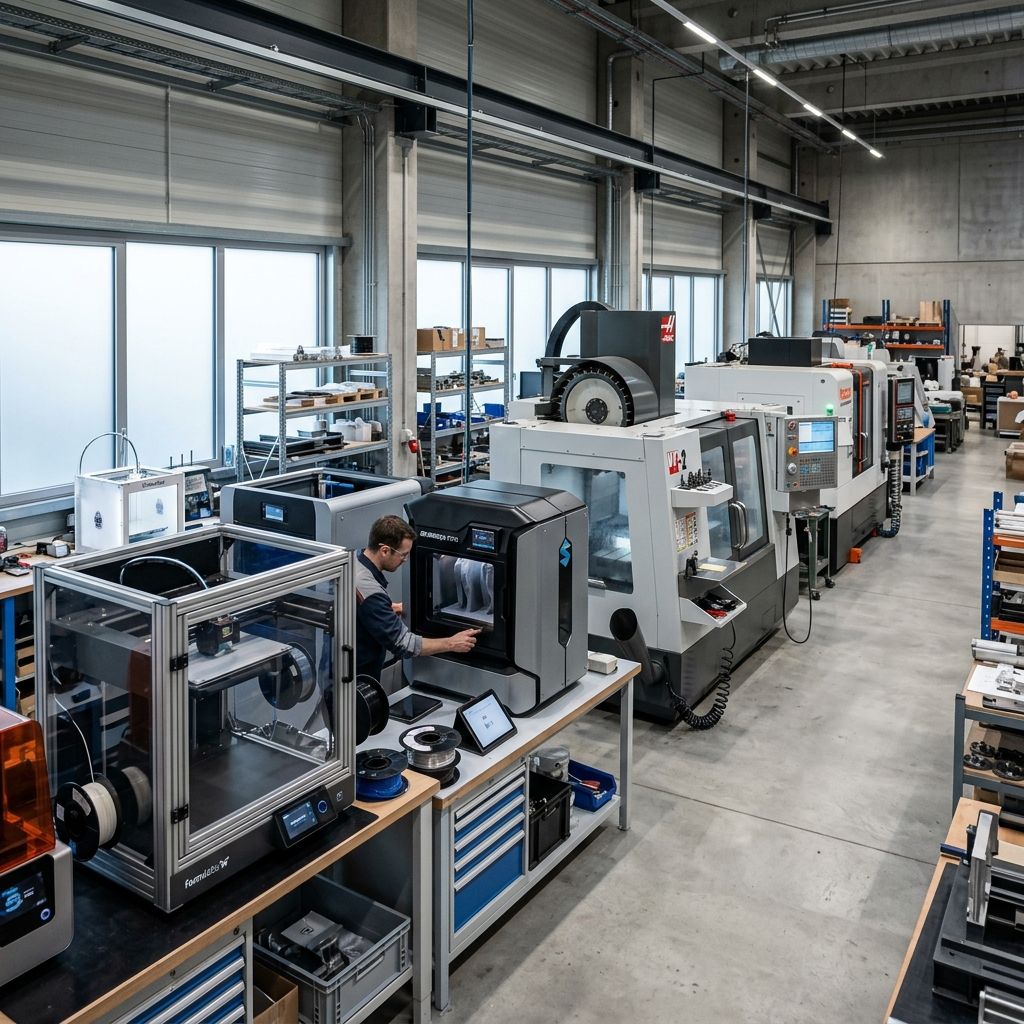
Additive manufacturing workcells within industrial engineering labs, aerospace R&D teams, and high-tempo hardware prototyping centers require more than consumer speed benchmarks. When evaluating desktop CoreXY platforms capable of reliably extruding high-performance fiber-reinforced thermoplastics (PA-CF, PET-CF, PPS-CF, and PC), the choice between the Bambu Lab X1-Carbon (X1C) and the enterprise-hardened Bambu Lab X1E represents a critical architectural fork. While both platforms share identical motion kinematic roots and CoreXY carbon-rod gantries, their divergence in chamber thermal mechanics, secure network segmentation, and high-temperature extrusion thermodynamics directly impacts production uptime, IT regulatory compliance, and component structural integrity.
Recommended Hardware: Bambu Lab X1-Carbon & X1E
Check real-time stock levels, current pricing tiers, and manufacturer warranty directly on Amazon:
View on Amazon • Check Live Price →1. Chamber Thermal Dynamics: Active 60°C Heating vs. Passive Heat Soak
The single most impactful mechanical differentiator between the Bambu Lab X1-Carbon and X1E is thermal boundary management within the build volume. The standard X1-Carbon relies entirely on passive thermal retention: thermal radiation from the heated aluminum bed (rated up to 110°C on 110V/220V mains) gradually elevates the internal enclosed volume. Over a 90-minute thermal stabilization cycle at ambient workshop temperatures (21°C), the internal ambient chamber temperature of the X1-Carbon peaks asymptotically between 38°C and 45°C depending on auxiliary fan operation.
In contrast, the X1E integrates an active PTC ceramic heating element coupled with a dedicated auxiliary circulating blower fan located at the upper chassis frame. This auxiliary thermal loop actively elevates and modulates chamber temperatures up to a regulated 60°C (333.15 K) with closed-loop PID control. For engineering semi-crystalline and amorphous polymers, this 15°C to 20°C differential governs the glass transition threshold () and thermal crystallization kinetics during deposition.
ENGINEERING ARCHITECTURE & THERMODYNAMIC FORMULAS
Thermal contraction stress () across adjacent deposition layers during cooling from extrusion temperature () to chamber ambient () is governed by the coefficient of thermal expansion () and elastic modulus ():
When processing Carbon-Fiber Reinforced Polyamide (PAHT-CF, , , ):
- X1-Carbon Passive Chamber (40°C): of residual interlaminar tension.
- X1E Active Chamber (60°C): of residual interlaminar tension.
This 57.1% reduction in thermal contraction stress virtually eliminates anisotropic perimeter delamination and corners warping on build prints exceeding 150mm across the X/Y axes.
Furthermore, active chamber regulation directly enhances interlayer bond shear strength ($ au$). According to the polymer reptation model, the weld line fracture toughness between successive raster passes depends upon molecular diffusion across the interface while the polymer temperature remains above . By maintaining closer to , the cooling rate of the extruded filament strand is slowed, tripling the effective interfacial healing time before vitreous transition halts polymer chain mobility.
2. Enterprise Network Architecture & Air-Gap Compliance
For defense contractors, medical device innovators, and ISO 27001 / SOC 2 certified engineering departments, wireless IoT devices present non-negotiable threat vectors. The consumer-focused X1-Carbon relies primarily on 2.4GHz Wi-Fi (802.11 b/g/n) and communicates through Bambu Lab cloud infrastructure (AWS IoT Core) for slicing telemetry, camera streams, and print queuing. Although the X1C features a firmware "LAN Only Mode", enterprise IT architectures routinely ban wireless hardware lacking IEEE 802.1X authentication or radius client certificates.
- Dedicated RJ45 100BASE-TX Ethernet Port: The X1E features an integrated physical RJ45 port on the rear electronics chassis, allowing deterministic network routing via managed enterprise switches without wireless interference or RF congestion.
- Hardware Physical Network Kill Switches: Independent physical slide dip-switches on the back panel isolate the Ethernet PHY controller and Wi-Fi radio module. Flipping the hardware switch disconnects power lines to the communication transceivers, satisfying classified physical air-gap mandates.
- WPA2-Enterprise (802.1X EAP-PEAP / EAP-TLS): Native firmware stack on the X1E supports certificate-based enterprise authentication, domain credentials, and static IP lease reservation without guest portal bypasses.
- Cloud-Free Slicing Pipeline: Direct G-code submission through localized LAN broadcasting or encrypted SD card execution ensures intellectual property (proprietary CAD geometry and mesh toolpaths) never leaves the local intranet perimeter.
3. Hotend Thermal Ratings, Volumetric Flow, and Melt Kinematics
While the X1-Carbon utilizes a copper-alloy heater block with a hardened steel nozzle rated for a maximum continuous operating temperature of 300°C, the X1E upgrades the thermal break metallurgy and thermistor calibration table to sustain continuous operations at 320°C (593.15 K). This 20°C expansion allows reliable extrusion of ultra-high performance engineering polymers such as PPS (Polyphenylene Sulfide), PPS-CF, and specialized Polyaryletherketone blends (PEKK-Aero) that demand melt viscosity reduction.
VOLUMETRIC FLOW RATE & MELT ZONE RESIDENCE TIME
Maximum volumetric throughput () determines the maximum print speed () achievable before extruder stepper skipping occurs due to back-pressure exceeding motor stall torque ():
Effective residence time () inside the active heating reservoir ( for Bambu high-flow ceramic block) is calculated via:
At an operational volumetric extrusion speed of (standard high-speed infill raster at 250 mm/s with 0.20mm layer height and 0.48mm line width):
- Residence Time: t_{res} = rac{65}{24} approx 2.71 ext{ seconds}.
- Thermal Saturation Gradient: For PA-CF filament entering at 22°C and exiting at 290°C, the core of the 1.75mm diameter filament must conduct heat across a radius within . The 320°C hotend of the X1E provides a higher thermal differential ( vs on X1C), accelerating thermal equilibrium and maintaining consistent dynamic viscosity without requiring external auxiliary melt zones.
Calculate custom volumetric limits for your filament configurations with our official Flow Rate Calculator and match thermodynamic parameters using the Filament Drying Calculator.
4. Technical Specification Benchmark Matrix
The following engineering matrix contrasts structural, thermal, kinematic, and computational parameters across both platforms to inform procurement trade-off analyses:
| Engineering Parameter | Bambu Lab X1-Carbon (X1C) | Bambu Lab X1E (Enterprise) | Industrial Significance |
|---|---|---|---|
| Chamber Heating Control | Passive soak only (~42°C max) | Active Ceramic PTC to 60°C | Eliminates warp in PA-CF, PC, and PPS |
| Max Hotend Temperature | 300°C (573 K) | 320°C (593 K) | Expands range to PPS, PEEK-blends |
| Air Filtration System | Single Activated Carbon stage | G3 Pre-filter + H12 HEPA + Carbon | Reduces VOCs and ultrafine particles (UFPs) |
| Network Interface | Wi-Fi 2.4 GHz only | 100M Ethernet RJ45 + Wi-Fi 2.4/5GHz | Deterministic LAN routing; no packet loss |
| Network Security Layer | WPA2-PSK Personal | WPA2-Enterprise (802.1X, Radius) | Complies with corporate enterprise IT policies |
| Physical Air-Gap Switch | None (firmware setting only) | Physical Hardware Cutoff Switches | Hardware-level IT isolation for classified labs |
| Build Volume Dimensions | 256 × 256 × 256 mm | 256 × 256 × 256 mm | Identical kinematic envelopes and build plates |
| Kinematics & Acceleration | CoreXY up to 20,000 mm/s² | CoreXY up to 20,000 mm/s² | Carbon-rod X-axis gantry dynamics preserved |
| Sensor Fusion Architecture | Dual LiDAR (7μm) + Bed Strain | Dual LiDAR (7μm) + Bed Strain | Automated first-layer optical inspection |
5. Total Cost of Ownership (TCO) & Multi-Year Fleet Economics
Procuring additive equipment for production cells requires comprehensive modeling of acquisition capital expenditure (CapEx), direct operating expenditure (OpEx), scheduled wear component replacement, and scrap rate depreciation over a baseline 5,000-hour operational cycle.
WORKCELL TCO EQUATION & DEPRECIATION MODEL
The total manufacturing cost per operating hour () is formulated as:
Where:
- : Capital equipment procurement cost (X1C ~ $1,449 with AMS; X1E ~ $2,499 retail distribution).
- : Operational lifespan benchmark set at (approx. 2.5 years of 8-hour daily shifts).
- : Average power draw ( for X1C; for X1E during active 60°C chamber heating).
- : Commercial electricity baseline ().
- Scrap Rate Reduction: Due to active chamber heating, large PAHT-CF print failure rates drop from on X1C to on X1E. On high-value engineering materials (), this prevents an estimated ̲ in wasted feed…" style="color:#cc0000">1,460$ in wasted feedstock over 5,000 hours.</li> </ul> <p>Estimate precise workcell amortization with our integrated <a href="/tools/cost-calculator">Production Cost Calculator</a>.</p> </div> <p>Over a full 5,000-hour operational window running continuous carbon-fiber composites, the net cost differential between the platforms converges significantly. While the initial capital expenditure of the X1E is approximately1,050$ higher, the material savings from reduced delamination scrap and the elimination of outsourced IT VLAN isolation bypasses yield an operational breakeven point at approximately 2,180 operating hours.
6. Strategic Workshop Procurement Verdict
Choosing between the Bambu Lab X1-Carbon and X1E is ultimately dictated by two deterministic constraints: regulatory cyber-compliance and material thermal processing envelopes.
- Procure the Bambu Lab X1-Carbon If: Your lab operates within a standard university, startup, or private prototyping workshop without strict WPA2-Enterprise 802.1X IT isolation policies. Your production workload primarily targets PLA, PETG, TPU-95A, ABS, and small-to-medium PA-CF geometries where passive chamber heat soak (40°C) is adequate to mitigate warping.
- Procure the Bambu Lab X1E If: Your facility is governed by corporate IT security, defense regulations, or medical compliance requiring physical RJ45 Ethernet, 802.1X certificate authentication, and hardware-switched radio air-gapping. Additionally, if your fabrication roadmap demands structural PA6-CF, PA12-CF, PPS-CF, or full-bed 250mm structural enclosures where the 60°C active chamber heat and 320°C hotend prevent unrecoverable interlayer shear failure.
For related maintenance protocols, review our technical guide on Extruder Heat Creep & Sensor Calibration or explore our comparative study of Industrial Slicing Engines & Kinematics.
7. Frequently Asked Engineering Questions
Can an active heating chamber be retrofitted to an existing Bambu Lab X1-Carbon?
No. The X1-Carbon mainboard lacks the high-current auxiliary switching MOSFETs, secondary chamber thermistor ADC pins, and power bus routing required to safely manage the X1E's 330W PTC ceramic heater without catastrophic thermal runaway risks.
Does the Bambu Lab X1E use the same nozzle and extruder assemblies as the X1-Carbon?
The extruder drive gears are interchangeable hardened steel assemblies. However, the X1E hotend features an upgraded high-temperature thermistor calibration table and revised ceramic heater sleeve rated for continuous 320°C operation.
What is the primary operational advantage of the H12 HEPA filtration system on the X1E?
The H12 HEPA stage captures 99.5% of airborne particulate matter down to 0.3 microns, mitigating ultrafine particle (UFP) emissions generated when processing engineering resins and fiber-filled polymers in poorly ventilated workshop enclosures.
Related Intel
Original Prusa MK4S vs Prusa MK4 Engineering Comparison: 360° High-Flow Cooling, CHT Nozzle Kinematics, and Workshop ROI Analysis
This head-to-head engineering comparison evaluates the architectural and thermodynamic upgrades of the Original Prusa MK4S over the baseline Prusa MK4 for commercial workshops and production environments. We analyze the fluid dynamics of the 360-degree high-flow centrifugal cooling system, measure volumetric throughput gains enabled by the bespoke high-flow CHT nozzle geometry, and evaluate input shaper acceleration profiles under industrial print farm conditions. Featuring a complete workshop ROI payback model, parameter benchmarks for overhang preservation up to 75 degrees, and a decisive hardware upgrade verdict for engineering teams.
Bambu Lab X1-Carbon & X1E Common Workshop Failures: Root-Cause Physics, AMS Retraction Jams, and Resonance Diagnostics
An empirical failure analysis manual addressing recurrent mechanical and thermal breakdowns on the Bambu Lab X1-Carbon and X1E within commercial production workcells. This guide investigates conductive heat creep mechanics in sealed chamber environments, Euler-Eytelwein friction spikes along AMS PTFE delivery lines, brittle filament fractures in the active toolhead cutter assembly, carbon-rod graphite bearing maintenance, belt tension resonance harmonics, and optical micro-LiDAR error recovery.
Bambu Lab X1-Carbon & X1E Workshop Troubleshooting Manual: Root-Cause Physics, Extruder Heat Creep, and Sensor Calibration
Resolving chronic operational failures on the Bambu Lab X1-Carbon and X1E requires shifting from trial-and-error adjustments to root-cause engineering diagnostics. Common shop-floor malfunctions—including cold-end filament swelling (heat creep) during enclosed PLA printing, AMS retraction stalls, Micro Lidar first-layer optical false positives, and resonance frequency drift on unlubricated carbon rods—stem from fundamental thermodynamic, mechanical, and optical interactions. This comprehensive workshop manual details the physics of extrusion clogs, precise belt resonance re-tensioning at 78 Hz, PTFE curvature pinch-point remediation, and closed-loop lidar recalibration routines to restore 99.8% first-pass production yield across commercial print fleets.